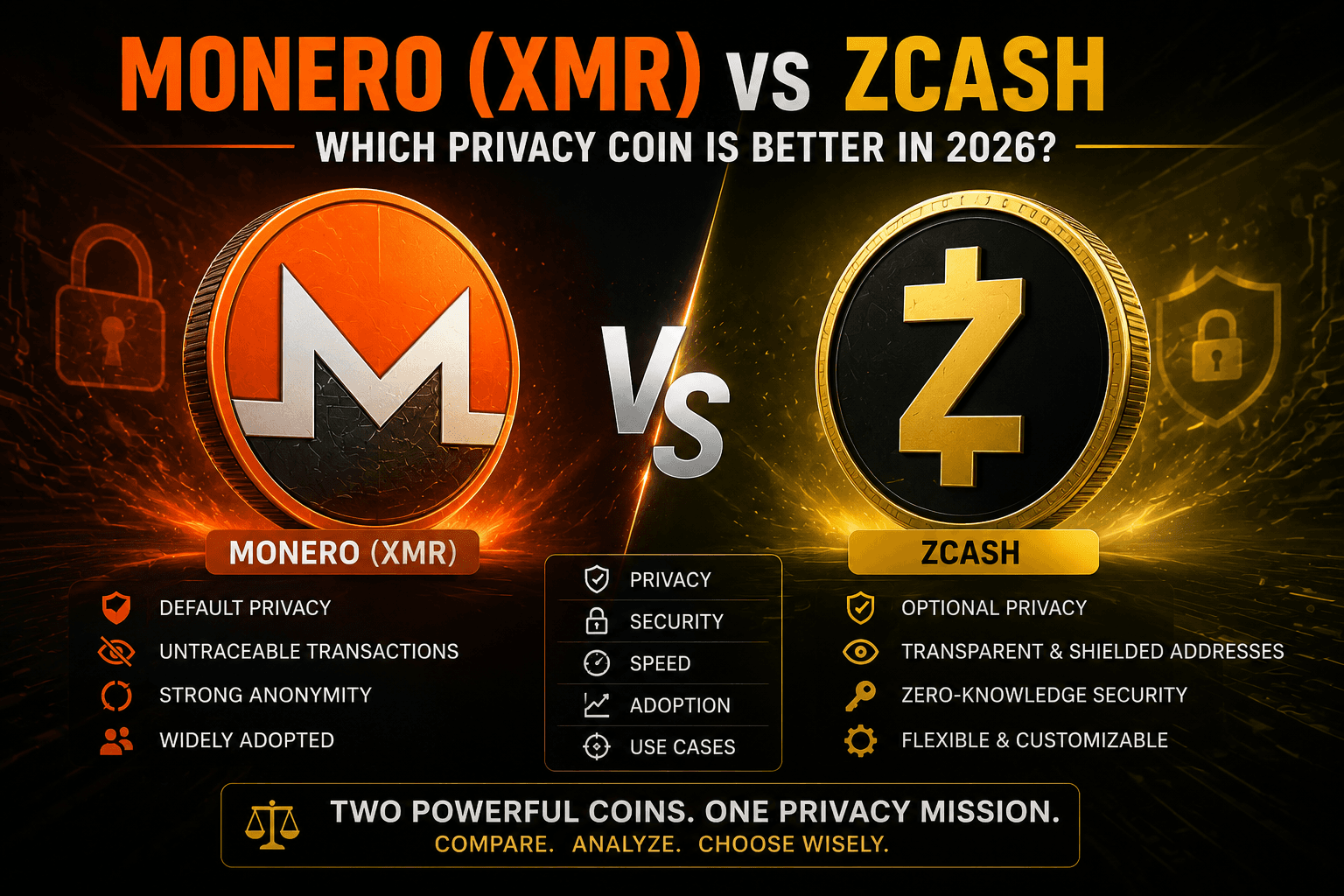



As demand for financial privacy grows in crypto, Monero (XMR) and Zcash (ZEC) remain two leading privacy coins. Both aim to protect user identity and transaction data but use very different approaches to anonymity, transparency, and security. Monero offers "always-on" privacy for maximum anonymity, while Zcash provides "optional shielded" privacy with greater regulatory flexibility.
Table of Contents
1. What Is Monero (XMR)?2. What Is Zcash (ZEC)?
3. Monero vs Zcash: Key Differences
4. Privacy & Security Comparison
5. Privacy Trade-Offs & Technical Differences
6. Adoption & Market Performance
7. Final Verdict
Frequently Asked Questions (FAQ)
If you're interested in privacy-focused crypto projects, you may also explore Crypto visualizing tool to understand how modern crypto platforms are evolving.
1. What Is Monero (XMR)?
Monero (XMR) is one of the most recognized privacy-focused cryptocurrencies in the market. Launched in 2014, Monero was designed specifically to provide anonymous and untraceable transactions through advanced cryptographic techniques.
Unlike Bitcoin and many public blockchains, Monero hides wallet addresses, transaction amounts, and transaction history by default. Its privacy system makes blockchain analysis significantly more difficult.
- Mandatory privacy for every transaction
- Highly anonymous blockchain structure
- Strong community-driven ecosystem
- Widely used for privacy-focused transactions
2. What Is Zcash (ZEC)?
Zcash (ZEC) is another major privacy cryptocurrency that focuses on balancing anonymity with optional transparency. Introduced in 2016, Zcash uses advanced zero-knowledge cryptography called zk-SNARKs to allow users to shield transaction details when desired.
Unlike Monero, Zcash gives users the option to choose between transparent transactions and private shielded transactions. This flexibility makes Zcash more compatible with certain exchanges, institutions, and regulatory environments.
- Optional shielded privacy
- Powered by zk-SNARK cryptography
- Greater regulatory flexibility
- Supports both transparent and private transfers
3. Monero vs Zcash: Key Differences
Although both cryptocurrencies focus on privacy, their approach to anonymity is fundamentally different. Monero enforces privacy automatically for all users, while Zcash allows users to choose whether transactions remain public or private.
| Feature | Monero (XMR) | Zcash (ZEC) |
|---|---|---|
| Privacy Type | Mandatory | Optional |
| Transaction Visibility | Hidden by default | User selectable |
| Technology | RingCT & Stealth Addresses | zk-SNARKs |
| Fee Structure | Dynamic fees based on transaction size and network usage | Generally low fees with optional shielded transaction costs |
| Exchange Availability | Limited on some regulated exchanges due to privacy concerns | More widely supported on major exchanges |
| Regulatory Compatibility | Lower | Higher |
| Main Strength | Maximum anonymity | Flexible privacy |
Reality Check: True privacy in crypto often comes with trade-offs. The stronger the anonymity, the greater the regulatory pressure and exchange restrictions.
4. Privacy & Security Comparison
Monero is generally considered the stronger privacy coin because all transactions are private by default. This creates a much larger anonymity set, making blockchain tracing extremely difficult.
Zcash, while technologically advanced, depends heavily on users actually enabling shielded transactions. Since many users still use transparent addresses, overall network anonymity becomes weaker compared to Monero.
- Monero prioritizes privacy above everything else
- Zcash balances privacy with transparency and compliance
- Monero transactions are harder to trace on-chain
- Zcash may appeal more to institutions due to optional transparency
5. Privacy Trade-Offs & Technical Differences
Although both Monero and Zcash are designed to improve financial privacy, their technologies introduce different trade-offs in terms of scalability, transparency, efficiency, and usability.
| Factor | Monero (XMR) | Zcash (ZEC) |
|---|---|---|
| Privacy Model | Always-on mandatory privacy | Optional shielded privacy |
| Transaction Size | Generally larger due to RingCT signatures | Smaller transparent transactions possible |
| Cryptographic Complexity | Moderate | Higher due to zk-SNARK computations |
| Fungibility | Very strong due to default privacy | Depends on shielded transaction usage |
| Regulatory Compatibility | More challenging | More exchange and institution friendly |
Monero focuses heavily on maximum anonymity and fungibility, which strengthens privacy but can create regulatory and exchange-related challenges. Zcash takes a more flexible approach by allowing users to choose between transparent and shielded transactions, potentially improving compatibility with institutions and regulated platforms.
Key Insight: Stronger privacy often introduces trade-offs in scalability, compliance, and usability. The ideal choice depends on whether a user prioritizes maximum anonymity or greater flexibility within the evolving regulatory environment.
6. Adoption & Market Performance
Monero has developed one of the strongest privacy-focused communities in crypto and is often favored by users who prioritize anonymity above convenience. Its reputation as a true privacy coin has helped maintain long-term demand despite regulatory challenges.
Zcash, on the other hand, has focused more on research-driven innovation and institutional compatibility. While its adoption has been more moderate compared to Monero, it remains one of the most technically advanced privacy projects in the blockchain industry.
| Category | Monero | Zcash |
|---|---|---|
| Community Strength | Very Strong | Strong |
| Exchange Support | Limited on some exchanges | More exchange-friendly |
| Privacy Reputation | Excellent | Very Good |
| Institutional Compatibility | Lower | Higher |
6. Final Verdict
Both Monero and Zcash play important roles in the future of financial privacy, but they are built for different philosophies and user priorities.
- Monero (XMR) may suit you if maximum privacy and anonymity are your top priorities.
- Zcash (ZEC) may suit you if you prefer flexible privacy with better regulatory compatibility.
As governments and regulators continue to increase oversight on crypto transactions, privacy coins will likely remain one of the most debated sectors in the blockchain industry. The future success of both projects will depend on how they balance privacy, usability, adoption, and regulation.
Frequently Asked Questions (FAQ)
Is Monero more private than Zcash?
Yes. Monero is generally considered more private because all transactions are anonymous by default, whereas Zcash privacy is optional.
Why is Monero controversial?
Monero's strong privacy features make transaction tracing extremely difficult, which has led to increased regulatory scrutiny and exchange delistings in some regions.
What makes Zcash different?
Zcash offers optional shielded transactions using zk-SNARK cryptography, allowing users to choose between transparency and privacy.
Can privacy coins be traced?
Tracing privacy coins is significantly more difficult compared to public blockchains like Bitcoin, although no system is considered perfectly anonymous.
Which privacy coin is better for long-term adoption?
Monero currently dominates in pure privacy adoption, while Zcash may have advantages in regulatory acceptance and institutional compatibility.