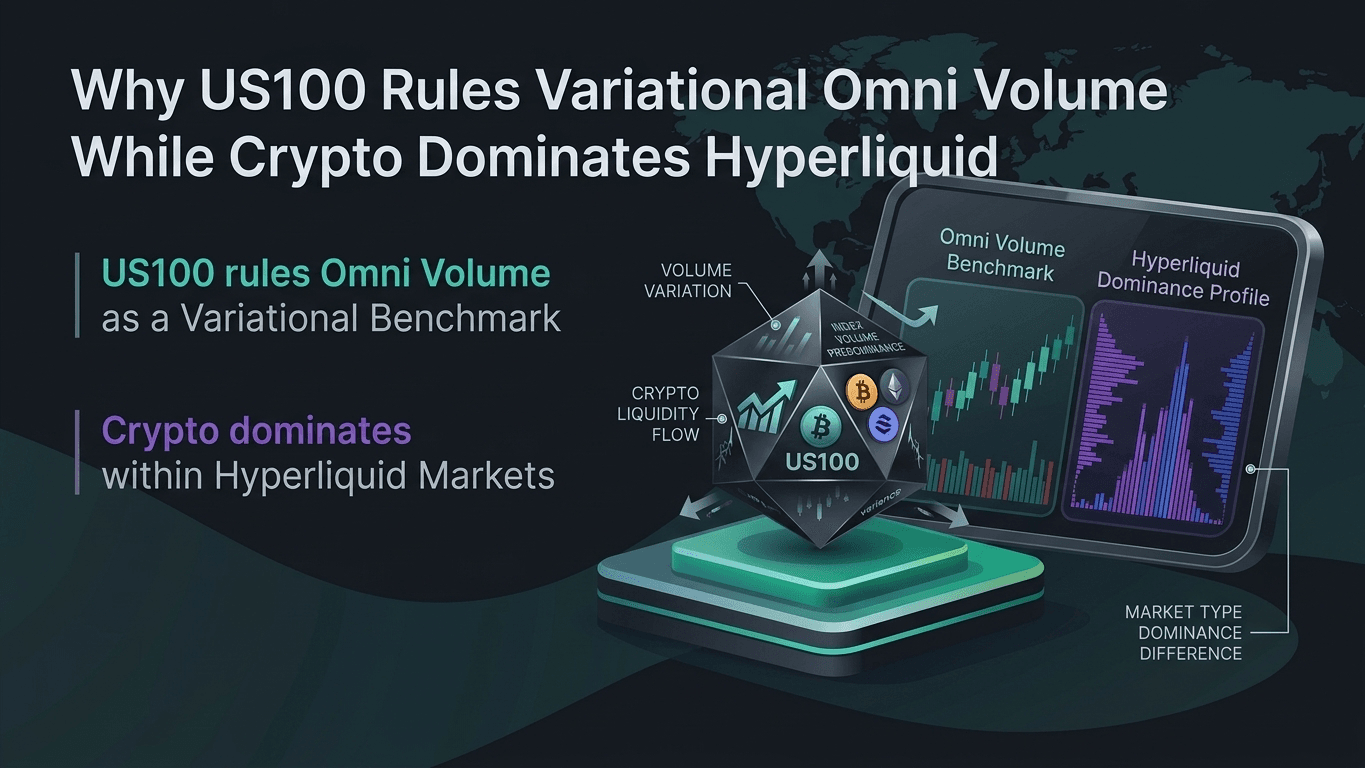




US100 was the largest market by 24-hour volume on Variational Omni during the captured market snapshot, while Hyperliquid’s activity was concentrated in crypto perpetual markets. The difference reflects how the two platforms currently attract liquidity: Variational Omni shows strong activity in traditional-market instruments, while Hyperliquid remains heavily associated with crypto trading.
What does the official volume snapshot show?
The Variational Omni markets page displayed $3.81 billion in total 24-hour trading volume. US100 swaps accounted for $1.95 billion, making the Nasdaq-100-linked market the largest listed market by volume at that time.
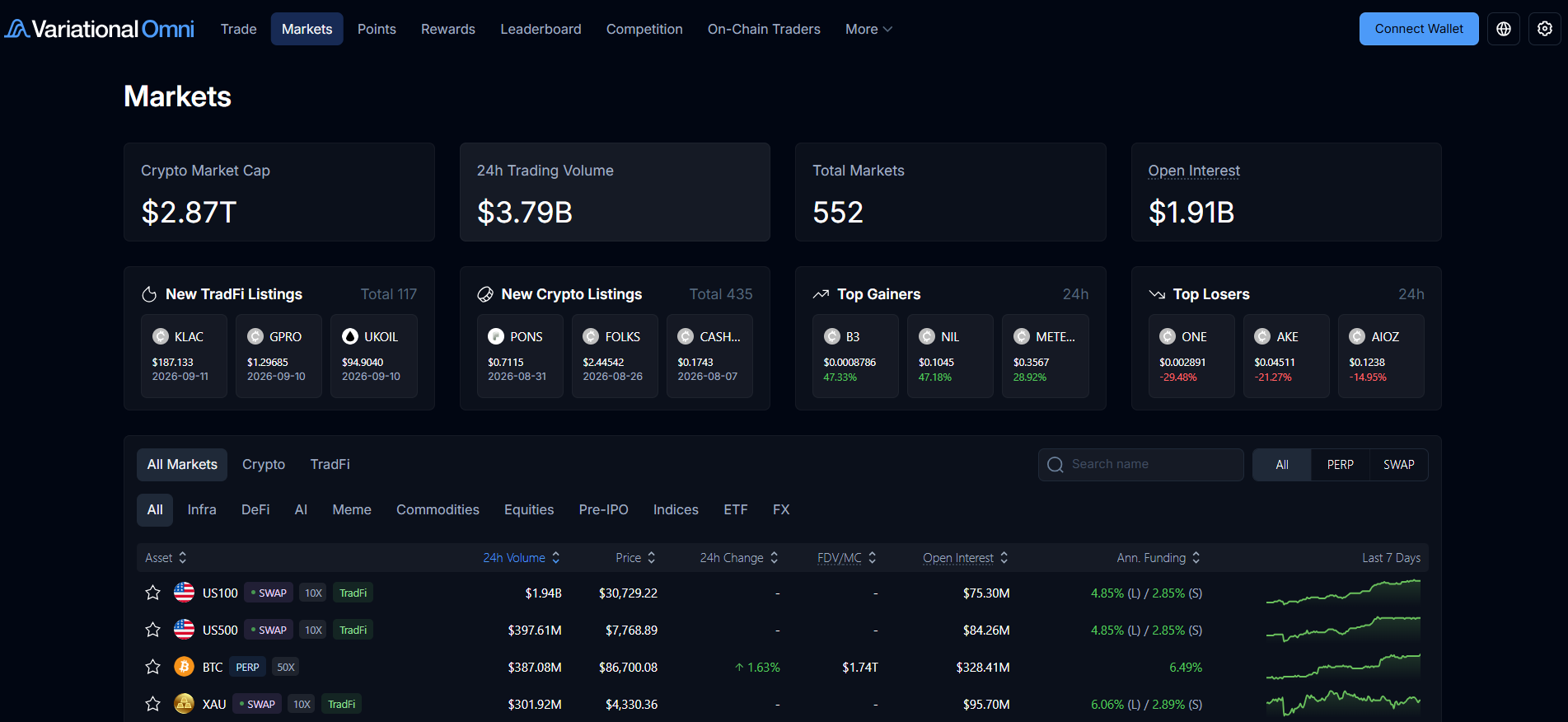 Source: Omni.variational
- Variational Omni total 24-hour volume: $3.81 billion.
- US100 swap volume: $1.95 billion.
- US100 share of Omni’s displayed volume: approximately 51%.
- US500 swap volume: $406.43 million.
- BTC perpetual volume on Omni: $388.20 million.
- ETH perpetual volume on Omni: $190.44 million.
Why is US100 so important on Variational Omni?
Variational classifies US100 as a swap linked to CME E-mini Nasdaq-100 futures. The market is designed to track the total return of the underlying index. Its funding benchmark is SOFR, adjusted by a spread, and its standard trading hours follow the traditional-market schedule rather than operating continuously throughout the weekend.
The platform’s swap design connects liquidity to traditional financial institutions. That gives traders access to an index associated with large U.S. technology companies through a leveraged, USDC-settled derivative. The official Omni documentation also states that qualifying index swaps can pass dividend adjustments through to long and short positions.
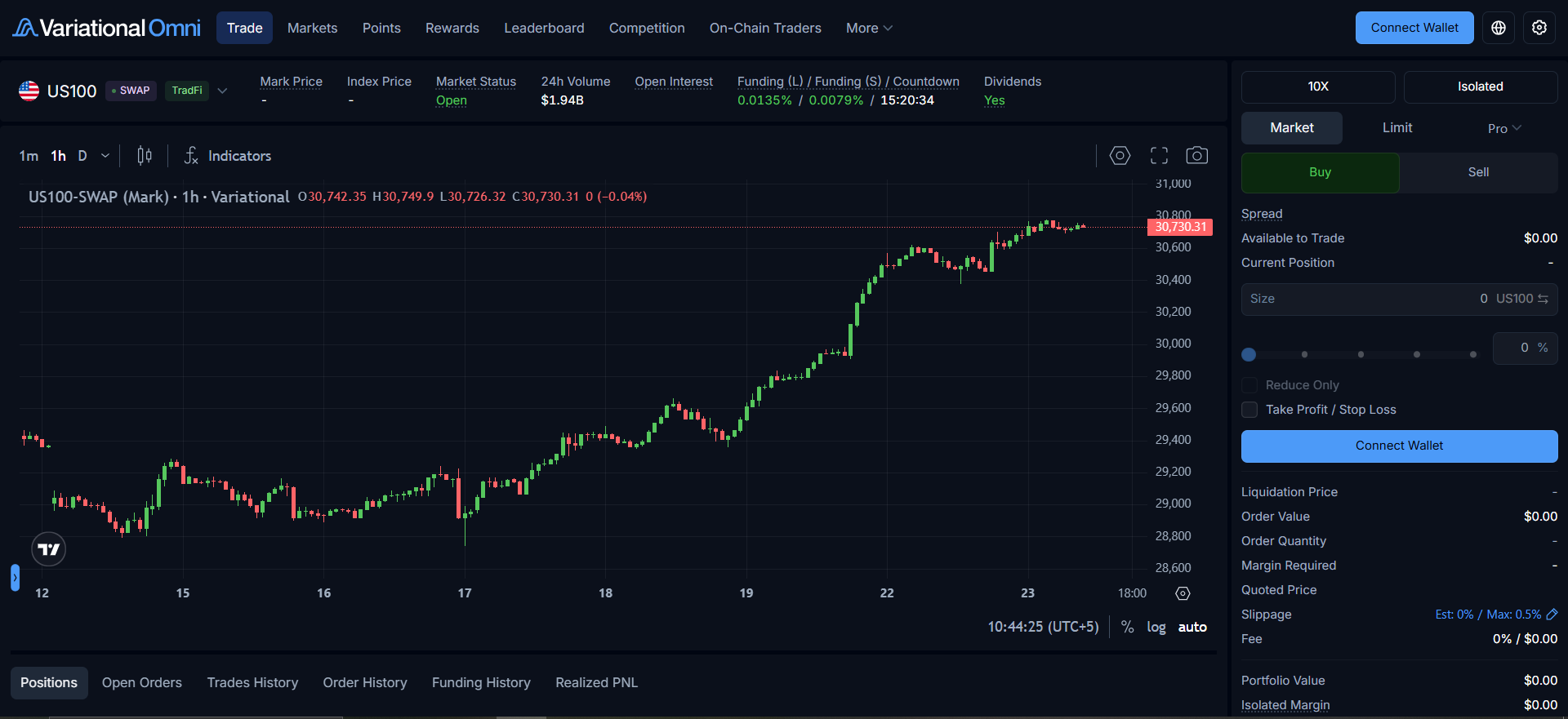 Source: US100 SWAP
The volume data does not prove that US100 will always lead the platform. It shows that, during this specific snapshot, the instrument attracted more activity than the crypto and other traditional-market products listed alongside it.
How does Hyperliquid’s volume differ?
Hyperliquid’s official website displayed approximately $7.2 billion in total 24-hour volume during the same general observation period. Its official API showed the largest individual markets were crypto assets, led by BTC and ETH, followed by ZEC, HYPE, XRP, SOL and NEAR.
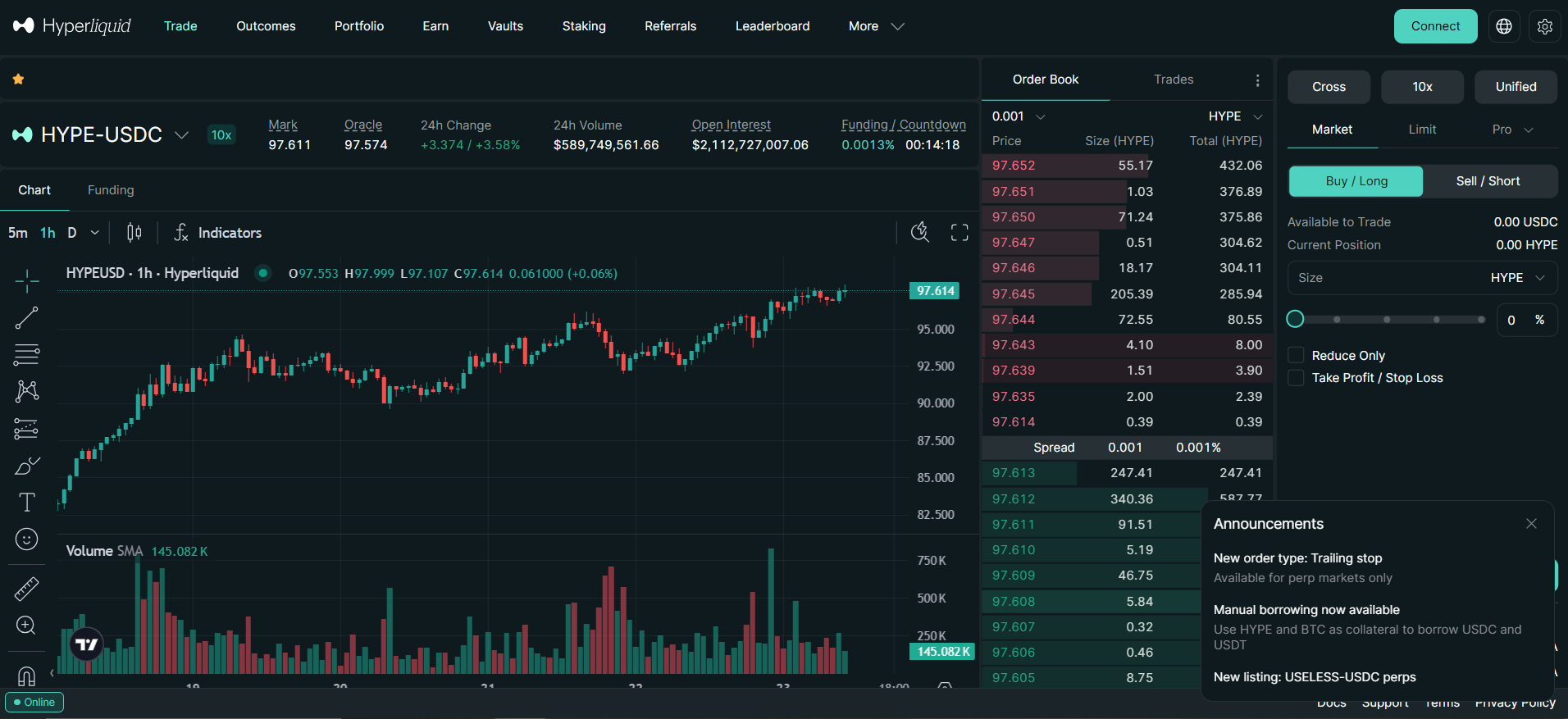 Source: Hyperliquid.com
Based on the official API snapshot, those seven leading crypto markets generated about $5.77 billion in combined 24-hour volume. Compared with Hyperliquid’s displayed total of $7.2 billion, that represents approximately 80% of the platform’s reported volume.
- BTC: approximately $2.77 billion in 24-hour volume.
- ETH: approximately $958.56 million.
- ZEC: approximately $676.41 million.
- HYPE: approximately $597.15 million.
- XRP: approximately $256.50 million.
- SOL: approximately $254.81 million.
- NEAR: approximately $252.77 million.
Variational Omni vs. Hyperliquid: What is the core difference?
The platforms are not showing the same type of market concentration. Variational Omni’s leading market in this snapshot was a traditional-market index swap. Hyperliquid’s leading markets were crypto perpetuals.
| Category | Variational Omni | Hyperliquid |
|---|---|---|
| Largest observed volume driver | US100 swap | BTC perpetual |
| Largest observed market volume | $1.95 billion | $2.77 billion |
| Platform volume shown | $3.81 billion | $7.2 billion |
| Dominant market group | Traditional-market instruments in this snapshot | Crypto markets in this snapshot |
| Trading structure highlighted by the platforms | Swaps and perpetuals | Perpetual futures and spot trading |
What should traders take from the comparison?
The main lesson is that volume follows the market type and liquidity environment each platform currently serves. US100’s lead on Variational Omni shows strong demand for a traditional equity-index product. Hyperliquid’s crypto concentration shows that BTC, ETH and other digital assets remain the primary sources of activity on that platform.
- Do not compare the figures without checking whether they refer to a single market or an entire platform.
- Review the contract type before trading: US100 on Variational Omni is a swap, while the leading Hyperliquid markets are perpetual futures.
- Check funding terms because Variational swaps use traditional-market financing benchmarks, while perpetual funding changes with market conditions.
- Check trading hours because Variational swaps follow defined market schedules, while Hyperliquid promotes 24/7 trading.
- Treat all volume figures as time-specific snapshots because market rankings can change quickly.
Conclusion
US100 led Variational Omni’s displayed market volume because the platform is attracting substantial activity in traditional-market index products. Hyperliquid’s volume was led by crypto markets, with BTC, ETH, ZEC, HYPE, XRP, SOL and NEAR accounting for most of the activity identified in the official snapshot. The contrast is best understood as a difference in liquidity concentration, not as a direct ranking of the two platforms.
Frequently Asked Questions< (FAQs)
Q: Which market had the highest 24-hour volume on Variational Omni in the snapshot?
A: US100 swaps had the highest displayed 24-hour volume at $1.95 billion in the official Variational Omni markets snapshot.
Q: What does the US100 market represent on Variational Omni?
A: US100 is a swap linked to CME E-mini Nasdaq-100 futures. Variational’s documentation states that the market uses the Nasdaq-100 futures reference and SOFR as its financing benchmark.
Q: Why is Hyperliquid’s volume described as crypto-dominated?
A: Hyperliquid’s official API snapshot showed its largest markets were crypto assets, led by BTC, ETH, ZEC, HYPE, XRP, SOL and NEAR. These seven markets produced approximately $5.77 billion in combined 24-hour volume in that snapshot.
Q: What was the difference between the volume figures shown by the two platforms?
A: Variational Omni displayed $3.81 billion in total 24-hour volume, with US100 contributing $1.95 billion. Hyperliquid’s official website displayed approximately $7.2 billion in total 24-hour volume during the comparison period.
Q: Do Variational Omni swaps and Hyperliquid perpetuals use the same trading structure?
A: No. Variational Omni’s US100 product is a swap designed to track the total return of the underlying index, while Hyperliquid is primarily known for perpetual futures and spot trading. Their funding systems, trading schedules and liquidity sources can differ.
Disclaimer: The information provided on this blog is for informational and educational purposes only and does not constitute financial, investment, legal, or tax advice.