



The sudden decline of the EDGE token has raised major concerns among traders and investors. The token experienced a sharp price drop amid heightened volatility, liquidity stress, and cascading liquidations across leveraged positions.
While short-term price movements in crypto are common, the EDGE token crash stands out due to its speed and intensity, prompting questions about whether it was driven by market structure issues, trading behavior, or broader ecosystem conditions.
This article breaks down why the EDGE token price dropped, what triggered the selloff, and what it could mean for the future of the EdgeX ecosystem.
Table of Contents
1. Why Is the EDGE Token Price Dropping?2. Market Volatility & Price Instability Explained
3. Liquidity Pressure on EdgeX Markets
4. Liquidation Cascades & Leverage Impact
5. Trader Sentiment & Panic Selling
6. Market Structure Breakdown
7. EDGE Token vs Other DeFi Tokens
8. Risks Behind EDGE Token Price Movements
9. Final Verdict
FAQs
1. Why Is the EDGE Token Price Dropping?
The EDGE token price drop is primarily linked to a combination of market volatility, liquidity imbalances, and rapid liquidation events affecting leveraged traders.
Unlike gradual corrections, this decline appears to have been accelerated by structural market pressures that intensified selling activity within a short time frame.
| Factor | Description | Impact |
|---|---|---|
| Market Volatility | Rapid price swings in crypto markets | Unstable price action |
| Liquidity Imbalance | Thin order books during high activity | Sharp price drops |
| Liquidations | Forced closing of leveraged positions | Accelerated sell pressure |
| Trading Sentiment | Fear-driven market behavior | Increased volatility |
Together, these factors created a feedback loop that intensified the downward movement of the EDGE token price.
The EDGE token crash highlights how quickly leveraged crypto markets can unwind when liquidity conditions weaken.
2. Market Volatility & Price Instability Explained
Cryptocurrency markets are inherently volatile, but tokens with concentrated liquidity or newer market structures often experience amplified price swings.
EDGE token price instability appears to have been influenced by rapid trading activity and uneven order book depth.
Sharp moves triggered by low liquidity conditions.
Limited buy support increases downside risk.
Short-term speculation intensifies price swings.
3. Liquidity Pressure on EdgeX Markets
Liquidity plays a crucial role in maintaining price stability. When liquidity weakens, even moderate selling pressure can cause disproportionate price declines.
In the case of EDGE, reduced liquidity depth may have contributed to sharper downward moves during high-volume trading periods.
Fewer buyers available at key price levels.
Large price gaps accelerate downward movement.
Reduced liquidity provision during volatility.
4. Liquidation Cascades & Leverage Impact
One of the most significant contributors to the EDGE token drop is likely the impact of leveraged trading positions being forcibly liquidated.
When prices fall below liquidation thresholds, automated trading systems begin closing leveraged positions automatically. This not only increases selling pressure but also creates a feedback loop where each wave of liquidations triggers additional downside momentum. In low-liquidity or sentiment-sensitive tokens like EDGE, this effect can quickly amplify small declines into sharp market-wide drops.
How Liquidation Cascades Impact Price Declines
Initial Price Drop
Liquidations Triggered
Cascade Selling Effect
Volatility Spike
5. Trader Sentiment & Panic Selling
Market sentiment plays a decisive role in shaping crypto price movements, especially in tokens with relatively high retail participation like EDGE. When confidence weakens—due to news, speculation, or broader market uncertainty—traders react quickly rather than holding positions.
1. Market Sentiment Weakens
Confidence drops due to negative news, speculation, or broader market uncertainty.
2. Traders Lose Confidence
Traders react quickly instead of holding positions, seeking to exit early.
3. Early Holders Start Selling
Initial selling pressure emerges as early holders and short-term traders exit positions.
4. Stop-Loss Orders Get Triggered
Price declines activate stop-loss orders, creating automatic sell pressure.
5. Leveraged Positions Begin Liquidation
Forced liquidations increase selling pressure as leveraged positions are closed automatically.
6. Selling Pressure Accelerates
Continuous sell orders push prices lower, intensifying downward momentum.
7. Panic Selling Cascades Downward
Fear-driven selling intensifies, creating a chain reaction that accelerates the crash.
This creates a chain reaction where initial selling pressure leads to further downside, as stop-losses get hit and leveraged positions unwind. Even moderate negative sentiment can amplify volatility far beyond fundamental changes.
In the case of the EDGE token, early exits from holders created additional downward pressure, encouraging others to follow suit and accelerating the decline.
Sentiment shifts in crypto often amplify price movements far beyond fundamental value changes.
6. Market Structure Breakdown
The combination of liquidity stress, volatility, and liquidations suggests a broader market structure breakdown within EDGE trading dynamics.
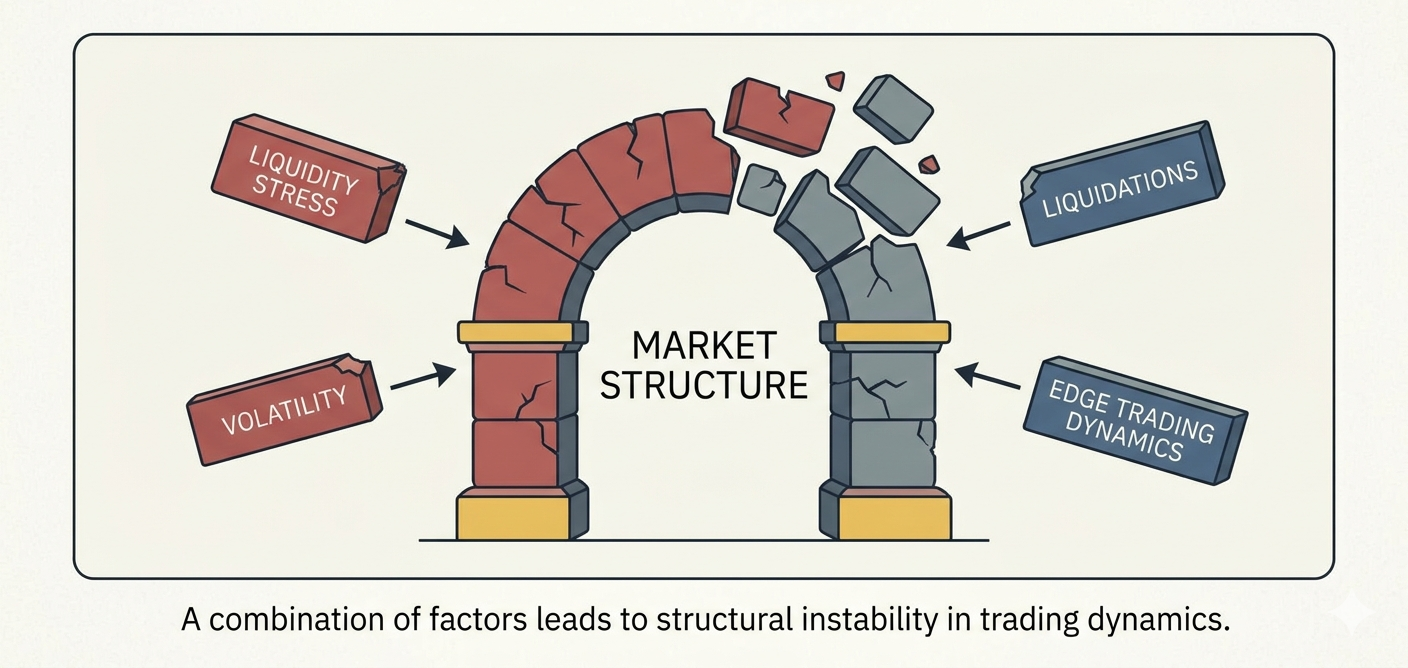
| Component | Condition |
|---|---|
| Liquidity Depth | Weakened |
| Leverage Exposure | High |
| Price Stability | Compromised |
| Volatility Control | Failed during crash |
7. How EDGE Token Compares with Other DeFi Tokens
EDGE operates differently from more established DeFi assets, particularly in terms of volatility behavior, liquidity depth, and overall market maturity. The comparison below highlights the key structural differences.
EDGE experiences stronger short-term price movements compared to mature DeFi tokens like ETH or AAVE, mainly due to lower market depth and evolving demand cycles.
Even moderate buy/sell pressure can significantly influence price levels, making liquidity conditions a key driver of short-term market behavior.
Unlike established DeFi ecosystems, EDGE is still in a growth phase with developing infrastructure, integrations, and broader adoption pathways.
8. Risks Behind EDGE Token Price Movements
High leverage increases liquidation probability.
Thin markets exaggerate price swings.
Fear-driven trading accelerates crashes.
Any technical instability can amplify uncertainty.
The EDGE token crash reflects how interconnected leverage, liquidity, and sentiment are in DeFi markets.
9. Final Verdict
The EDGE token price drop appears to be the result of multiple overlapping factors including liquidity stress, leverage-driven liquidations, and shifting trader sentiment on the EdgeX platform. While sharp declines are not uncommon in crypto, this event highlights the importance of understanding market structure risks in emerging DeFi ecosystems.
Frequently Asked Questions (FAQ)
1. Why did EDGE token price drop?
EDGE dropped due to liquidity issues, market volatility, and liquidation cascades across leveraged positions.
2. Was the EDGE token crash caused by EdgeX?
There is no confirmed single cause; it appears to be a combination of market and structural factors.
3. Will EDGE token recover?
Recovery depends on liquidity improvements, sentiment recovery, and trading activity stabilization.
4. Is EDGE token risky?
Like most DeFi tokens, EDGE carries risks related to volatility, liquidity, and leverage exposure.
5. What should traders learn from this crash?
The importance of managing leverage and understanding liquidity conditions in crypto markets.