



- Pump.fun and Fomo are now directly competing for the same scarce resource: trader attention.
- Pump.fun started as a major memecoin launch and trading ecosystem.
- Fomo grew as a social trading aggregator focused on token discovery, following traders, and routing activity across chains.
- The reported conflict and any past partnership details are based on industry reporting and market commentary.
- Public information does not fully confirm the alleged partnership history or its breakdown — these should be treated as reported claims, not established facts.
The reported conflict between Pump.fun and Fomo
Pump.fun is reportedly fighting an elimination war against the rapidly growing Fomo social-trading app after their earlier commercial relationship broke down, as both now compete aggressively for the same traders, creators, liquidity, and attention in the memecoin ecosystem.
- Pump.fun (dominant memecoin launchpad) is trying to reclaim revenue, liquidity, and users from Fomo.
- Fomo grew by routing retail volume toward Pump.fun tokens, but the partnership has turned into direct competition.
- Both platforms are battling over top traders, creators, social groups, and transaction activity.
- The conflict highlights a broader shift in crypto toward aggressive, web2-style tactics (incentives, leaderboards, social features, and loyalty campaigns).
What are the main differences between the Pump.fun and FOMO?
| Category | Pump.fun | Fomo |
|---|---|---|
| Core identity | Memecoin creation, launch, and early trading ecosystem. | Social-first trading and discovery application. |
| Primary competitive asset | Token supply, launch activity, liquidity, and a large memecoin audience. | Trader relationships, social signals, user discovery, and cross-chain convenience. |
| Social strategy | Expanding feeds, calls, trader profiles, followers, and social trading features. | Built around following traders, observing activity, receiving notifications, and discovering tokens. |
| Market role | Where many new memecoins are launched and initially traded. | Where users can monitor traders and tokens across supported chains before executing trades. |
| Strategic risk | Adding social features may create a direct confrontation with established social-trading competitors. | Its social network may be vulnerable to user poaching, feature replication, and incentive-heavy competition. |
Why this is a zero-sum fight for attention
Memecoin trading is unusually dependent on speed and social momentum. A platform that owns the feed, the influential traders, and the execution path can influence where attention turns into volume.
-
Fomo’s advantage:
It built its identity around social discovery, trader tracking, notifications, and a unified cross-chain trading experience. -
Pump.fun’s advantage:
It controls a major launch environment where new memecoins appear and begin trading through a bonding-curve system. -
The point of conflict:
Pump.fun can use its existing token supply and liquidity ecosystem to build more social features, while Fomo can use its trader network to direct attention and volume toward tokens already associated with Pump.fun. -
The strategic prize:
The platform that keeps the strongest traders, creators, and communities may capture more of the resulting trading activity and economic value.
How Pump.fun is positioning itself
Original strength:
Pump.fun’s original strength is token creation and early-stage trading. New coins can be created and traded in the platform’s launch environment, with price discovery taking place through a bonding curve before a qualifying token can move into a deeper liquidity venue.
Newer Social Direction:
Its newer social direction adds another layer to that model. Feeds, trader profiles, displayed positions, calls, followers, trending sections, and mobile trading features allow Pump.fun to compete not only as a launch venue but also as a destination where users discover and act on market narratives.
Strategic goal:
That expansion matters because it reduces the need for traders to leave the Pump.fun ecosystem after a token is launched. The platform can keep issuance, discovery, social interaction, and execution closer together.
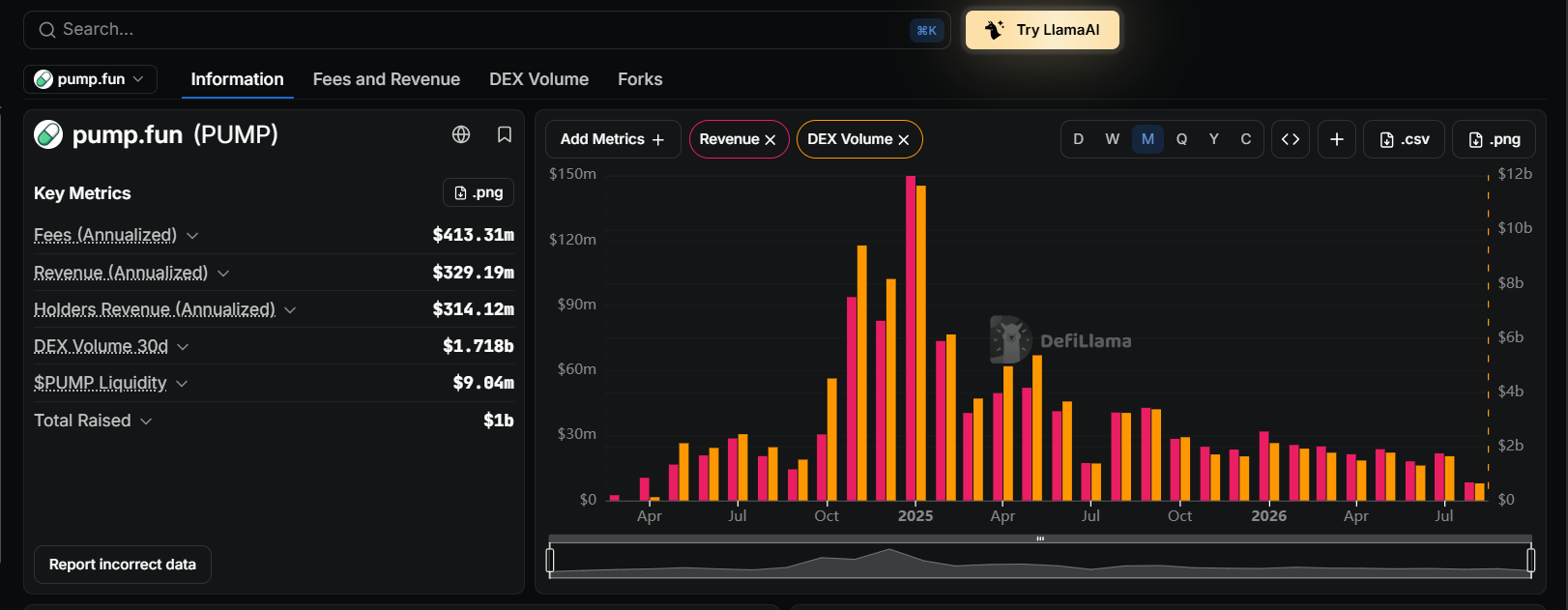 Source: Pump.fun Analytics
How Fomo built its position
Fomo’s central proposition is different. It organizes the market around people, activity, and discovery. Users can:
- Follow traders
- Observe buying and selling activity
- Receive notifications
- Inspect token information
- Trade supported assets through a unified interface
This makes Fomo less dependent on being the place where every token is created. Its value comes from becoming the place where users notice a token, identify who is trading it, decide whether the activity is meaningful, and execute a transaction.
That model can grow quickly when a platform develops a trusted network of traders and creators. It can also become vulnerable when a larger platform copies its most visible features or offers incentives designed to move influential users elsewhere.
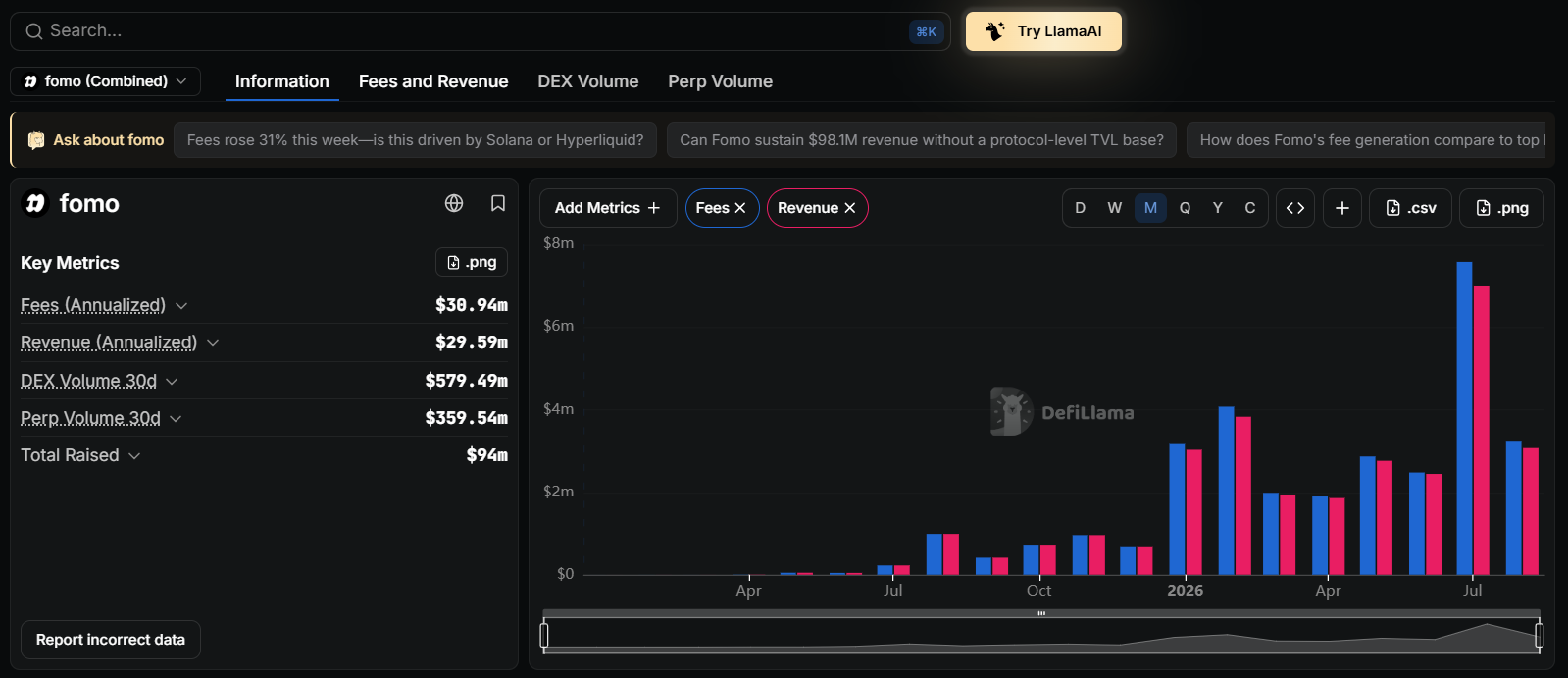 Source: FOMO on DefiLlama
What the Reported Incentive Campaign Would Mean
Recent reports describe substantial incentives being offered to selected Fomo users or traders to migrate to Pump.fun. The reported conditions include moving funds and positions, using a dedicated wallet, publicly identifying that wallet as the user’s primary wallet, deleting Fomo accounts, and avoiding competing platforms.
Those reported terms would make the campaign more than a standard referral program. They would represent an attempt to move both individual users and the social graph around them: the traders, followers, calls, credibility, and liquidity that make social trading networks difficult to rebuild.
Why the conflict matters for decentralized markets
The Pump.fun–Fomo dispute illustrates how decentralized ecosystems are becoming more competitive at the application layer. The underlying blockchains may remain open, but the user experience around them is increasingly shaped by centralized product decisions, brand identity, incentives, and network effects.
- Liquidity is becoming portable: Traders can move between interfaces while interacting with many of the same on-chain assets.
- Social identity is becoming valuable: A trader’s followers, history, calls, and reputation can be as strategically important as raw transaction volume.
- Features are converging: Launch platforms are adding social tools, while social apps are improving execution and asset discovery.
- User acquisition is becoming more aggressive: Bonuses, exclusivity requirements, creator recruitment, and switching incentives resemble competitive web2 growth tactics.
- Decentralization does not eliminate platform competition: Open settlement rails can still support intense battles between front ends, communities, and distribution channels.
Frequently Asked Questions (FAQs)
Q1: Is Pump.fun really offering large incentives to Fomo traders?
A:Yes. Recent reports say Pump.fun is offering selected Fomo users a $20,000 signing bonus plus $30,000 monthly, with conditions that include migrating funds, using a dedicated wallet, and deleting their Fomo accounts.
Q2: What is the main difference between Pump.fun and Fomo?
A:Pump.fun focuses on launching and early trading of memecoins. Fomo is a social trading app built around following traders, discovering tokens, and executing trades across chains.
Q3. Is the reported incentive campaign legal?
A:Crypto legal commentary cited in reports suggests it is a commercial incentive program and does not clearly break existing laws, though the strict terms have made it controversial.
Disclaimer:
This article is based on publicly available reports, industry commentary, and observed platform features as of August 2026. Claims regarding any past commercial relationship between Pump.fun and Fomo are drawn from third-party reporting and remain unverified allegations. Market dynamics and platform strategies can change quickly. This content is for informational purposes only and does not constitute financial advice.