


As of June 17, 2026.
Hyperliquid's Fee Structure
Hyperliquid generates revenue through trading fees on perpetual futures and spot markets. Its tiered fee model rewards higher-volume traders while directing most fee revenue toward the HYPE ecosystem through token buybacks and burns.
| Category | Details |
|---|---|
| Perpetual Futures Fees | 0.045% taker fee, 0.015% maker fee |
| Spot Trading Fees | 0.070% taker fee, 0.040% maker fee |
| Fee Tier System | Based on rolling 14-day trading volume |
| Revenue Allocation | ~99% directed to the Assistance Fund for HYPE buybacks and burns |
| HLP Vault Share | Receives ~1% of perpetual and spot trading revenue |
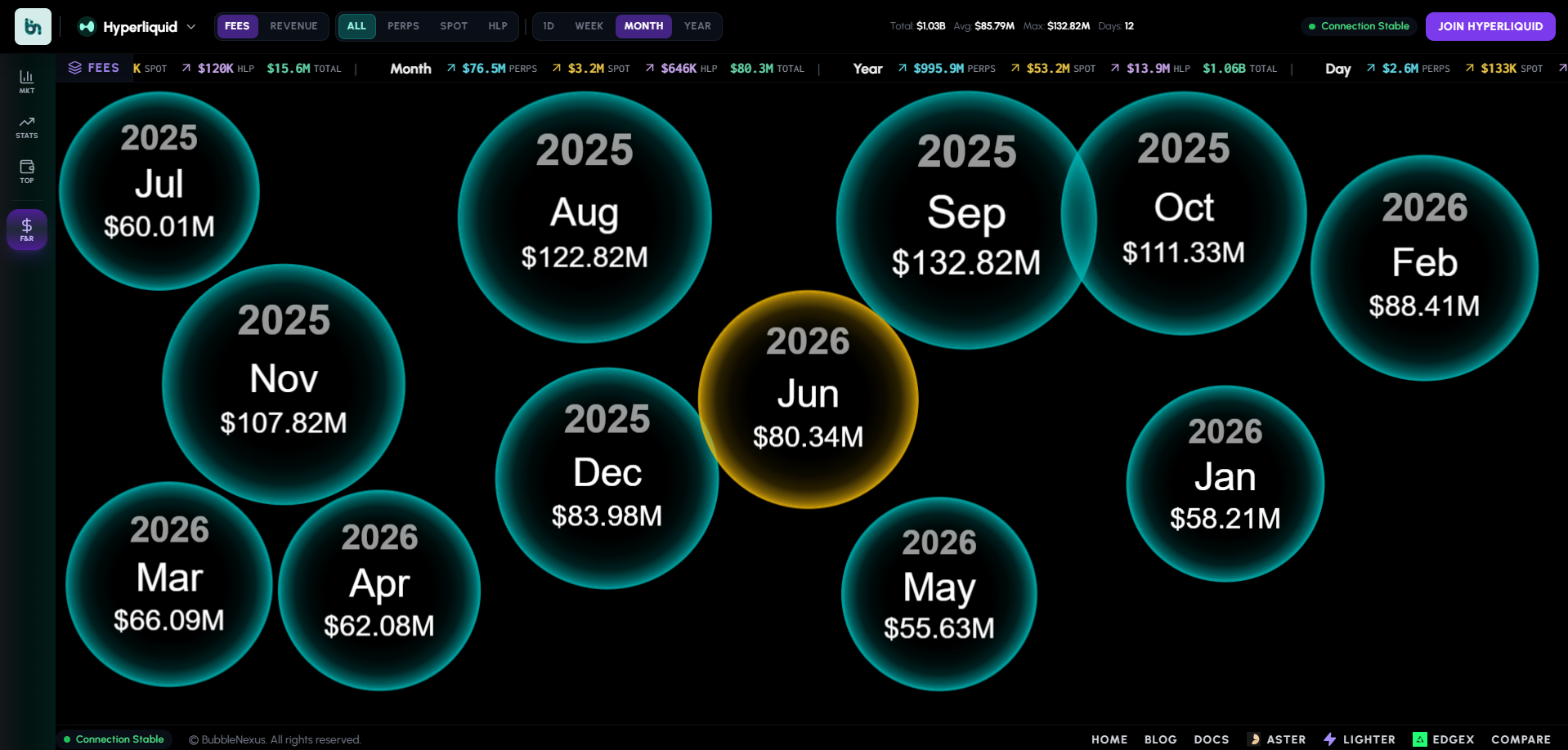
This graphical interface tracks Hyperliquid's monthly transaction fees from 2025 and 2026. The orange highlighted circle emphasizes the specific volume collected throughout June. Click the image to review the fee metrics for the active month.
Recent Revenue Performance and Market Position
Hyperliquid has emerged as one of the highest-revenue protocols in decentralized finance, driven by strong perpetual futures trading activity and growing market adoption. The platform consistently ranks among the leading decentralized exchanges by trading volume and revenue generation.
| Metric | Value |
|---|---|
| Cumulative Revenue | $1.164 Billion |
| Annualized Revenue | $881.43 Million |
| 30-Day Revenue | $63.79 Million |
| 7-Day Revenue | $11.78 Million |
| 24-Hour Revenue | $1.91 Million |
| Peak Daily Revenue (Jan 2026) | $4.3 Million |
| Record Monthly Revenue (Aug 2025) | $106 Million |
| Record Monthly Trading Volume | $383 Billion |
| Perpetual DEX Market Share | 70%+ |
| HYPE All-Time High | Above $62 |
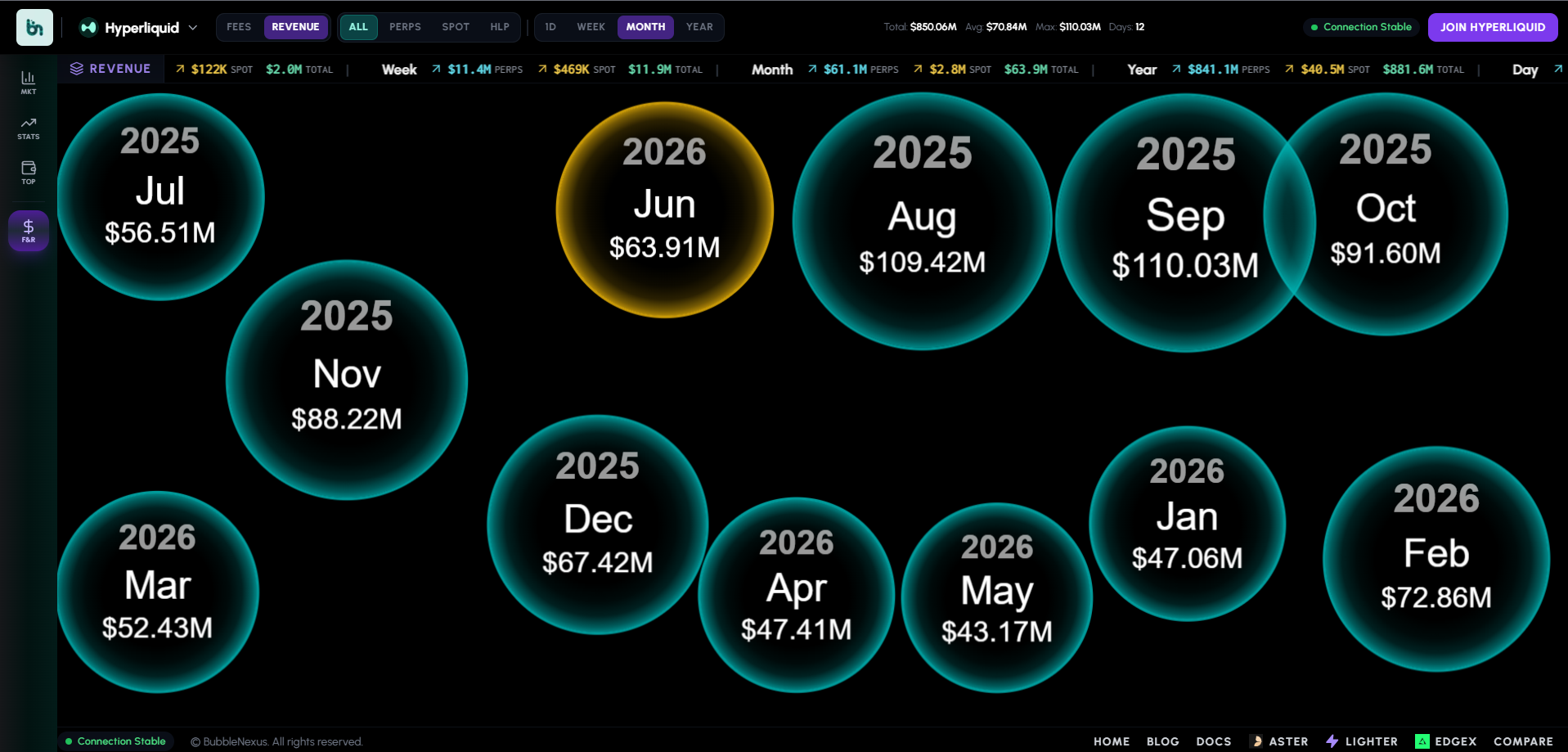
This image shows a revenue data visualization for Hyperliquid, representing monthly revenue amounts across 2025 and 2026. The Orange highlighted bubble shows the revenue generated in June. Click on the image to analyze current month's revenue.
The Financial Mechanics of Hyperliquid
Hyperliquid’s monetization strategy fundamentally deviates from traditional Layer-1 blockchains and automated market makers. By eliminating transaction gas fees completely and optimizing execution through a native order book, the protocol shifts the weight of economic value capture entirely onto specialized trading fees and structural liquidations.
I. Zero-Gas Architecture & Trade Monetization
While traditional blockchains monetize network congestion through validator gas, Hyperliquid processes all orders, adjustments, and cancellations with zero network gas fees. Instead, the protocol shifts value capture to a low-friction maker-taker model charging 0.015% / 0.045% on perpetuals and 0.040% / 0.070% on spot markets. This architecture scales protocol revenue strictly as a function of trade volume rather than network congestion, creating a predictable, institutional-grade financial engine.
II. White-Label Builder Revenue Sharing
A primary acceleration vector for Hyperliquid's fee volume is its open B2B builder ecosystem. Through programmatic HIP-3 builder setups, external front-ends—such as specialized trading interfaces—can hook directly into Hyperliquid's deep backend liquidity pools to route user trades.
To incentivize development, these ecosystems operate on custom rate structures. While standard perps run a baseline 0.045% taker fee, native HIP-3 builder markets transition onto a distinct card tier charging 0.09% taker and 0.03% maker fees. This structural adjustment splits economic rewards cleanly between independent interface developers and core protocol infrastructure, scaling L1 volume without forcing the core team into aggressive retail user acquisition campaigns.
III. Prediction Markets and Delayed Fee Settlement
The architectural rollout of HIP-4 outcome tokens shifts how prediction markets are monetized. To capture market share from legacy event-betting platforms that tax traders upon entering positions, Hyperliquid operates on a zero-fee-to-open model.
Fees are only extracted when a contract is closed out early or fully settled upon final outcome resolution. This drastically improves capital efficiency for traders trying to hedge real-time macro indicators. It delays the protocol's cash flow collection until the moment liquidity unlocks, creating an explosive fee mechanism when massive geopolitical or market milestones resolve.
Conclusion
Hyperliquid's impressive revenue generation from trading fees highlights its successful execution in the competitive perpetual DEX market. Its specialized Layer 1 architecture, efficient CLOB model, and strategic tokenomics have enabled it to capture significant market share and maintain a leading position in the DeFi derivatives landscape. The consistent growth in its revenue metrics underscores the platform's robust economic model and its continued importance within the broader Web3 financial infrastructure.
Frequently Asked Questions (FAQs)
How does Hyperliquid generate revenue?
Hyperliquid primarily generates revenue by charging maker and taker fees on perpetual futures and spot market trades executed on its platform.
What are Hyperliquid's trading fees?
The platform charges a base fee of 0.045% for takers and 0.015% for makers on perpetual futures, with separate fee rates for spot trading.
Why is Hyperliquid considered a leading perpetual DEX?
Its high trading volumes, deep liquidity, custom Layer 1 infrastructure, and dominant market share have made it one of the most successful decentralized derivatives exchanges.
How are trading fees used within the ecosystem?
A significant portion of trading fee revenue is directed toward the Assistance Fund, which supports HYPE token buybacks and burns.
Does Hyperliquid charge gas fees for trading?
No. Hyperliquid's architecture allows users to trade without paying traditional blockchain gas fees, relying instead on trading fees as its primary revenue source.
Disclaimer: This article is for informational purposes only and does not constitute financial advice. Cryptocurrency markets are highly volatile, and investments carry significant risk.