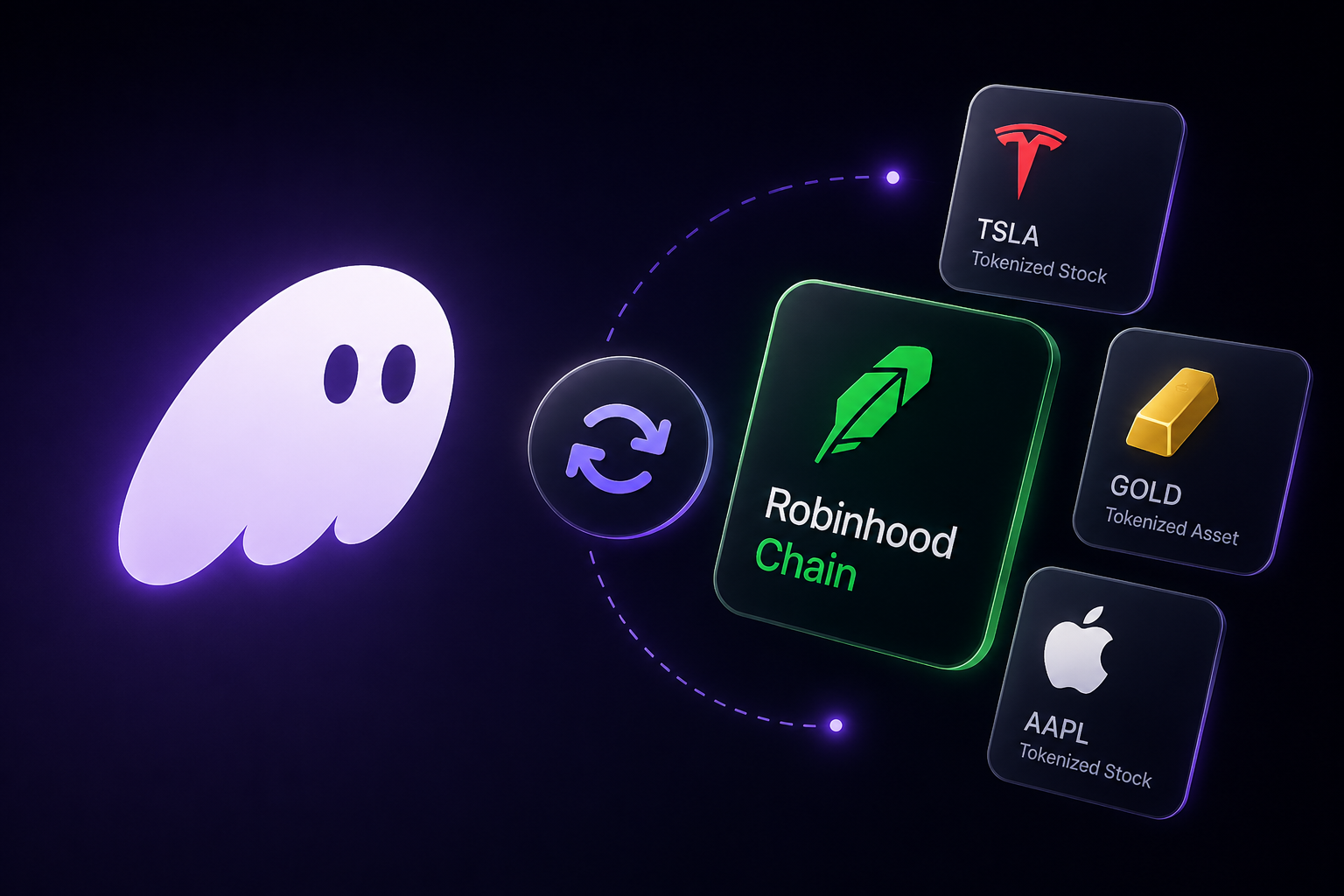
Phantom has added Robinhood Chain to its supported networks, giving users a way to view, transfer, bridge, and swap supported assets on Robinhood’s Ethereum Layer 2 without leaving the wallet.
The integration, reported as going live on July 23, extends Phantom beyond its original Solana focus and adds a direct wallet route into Robinhood Chain’s emerging tokenized-asset ecosystem. Users can activate the network through Phantom’s settings, then manage compatible assets with the same EVM wallet address used for networks such as Ethereum, Base, and Polygon.
What Phantom users can do
Robinhood Chain support covers the basic actions expected from a multi-chain wallet. Phantom’s documentation describes in-app bridging and cross-chain swaps, while the integration announcement says users can view balances, send and receive tokens, swap supported assets, and move funds into or out of the network.
- Enable Robinhood Chain from Phantom’s active-network settings.
- View balances and send or receive compatible tokens.
- Swap supported assets through Phantom’s trading interface.
- Bridge assets between Robinhood Chain and other supported networks.
- Track transactions through Robinhood Chain’s block explorer.
Cross-chain transactions can involve several steps. Phantom may swap or wrap an asset on the source network, route it through a bridge, and complete a final swap on the destination chain when necessary. The wallet uses routing infrastructure to compare available bridge and decentralized-exchange paths, but users remain responsible for checking fees, networks, slippage, and transaction status before approving a trade.
Why tokenized stocks matter
Robinhood Chain was designed for financial services and real-world assets. Its flagship Stock Tokens are standard ERC-20 tokens issued by Robinhood Assets (Jersey) Limited. They are designed to provide economic exposure to specified shares or exchange-traded funds, with on-chain prices and the ability to be held, transferred, and used in decentralized applications.
That design makes the assets compatible with familiar wallet and DeFi infrastructure. Users may be able to trade them around the clock on supported venues, while developers can build markets, lending applications, and other products around the tokens. The structure is not the same as owning the underlying shares directly: the documentation says Stock Tokens do not grant legal or beneficial rights in the underlying securities.
Access remains restricted
The integration does not make Robinhood Stock Tokens universally available. Robinhood states that the tokens are not available in the United States and are subject to restrictions in other jurisdictions. They are not registered under U.S. securities laws and may not be offered, sold, or delivered to U.S. persons.
For Phantom, the addition strengthens its multi-chain positioning and gives existing users a simpler interface for interacting with a new tokenized-asset network. For Robinhood Chain, wallet support expands access beyond Robinhood’s own products. The practical impact will depend on liquidity, eligible jurisdictions, supported assets, and whether users adopt tokenized markets as a regular part of on-chain trading.