News

Hyperliquid Price: HYPE Hits New All-Time High of ~$88

Share
Hyperliquid Price: HYPE Hits New All-Time High of ~$88

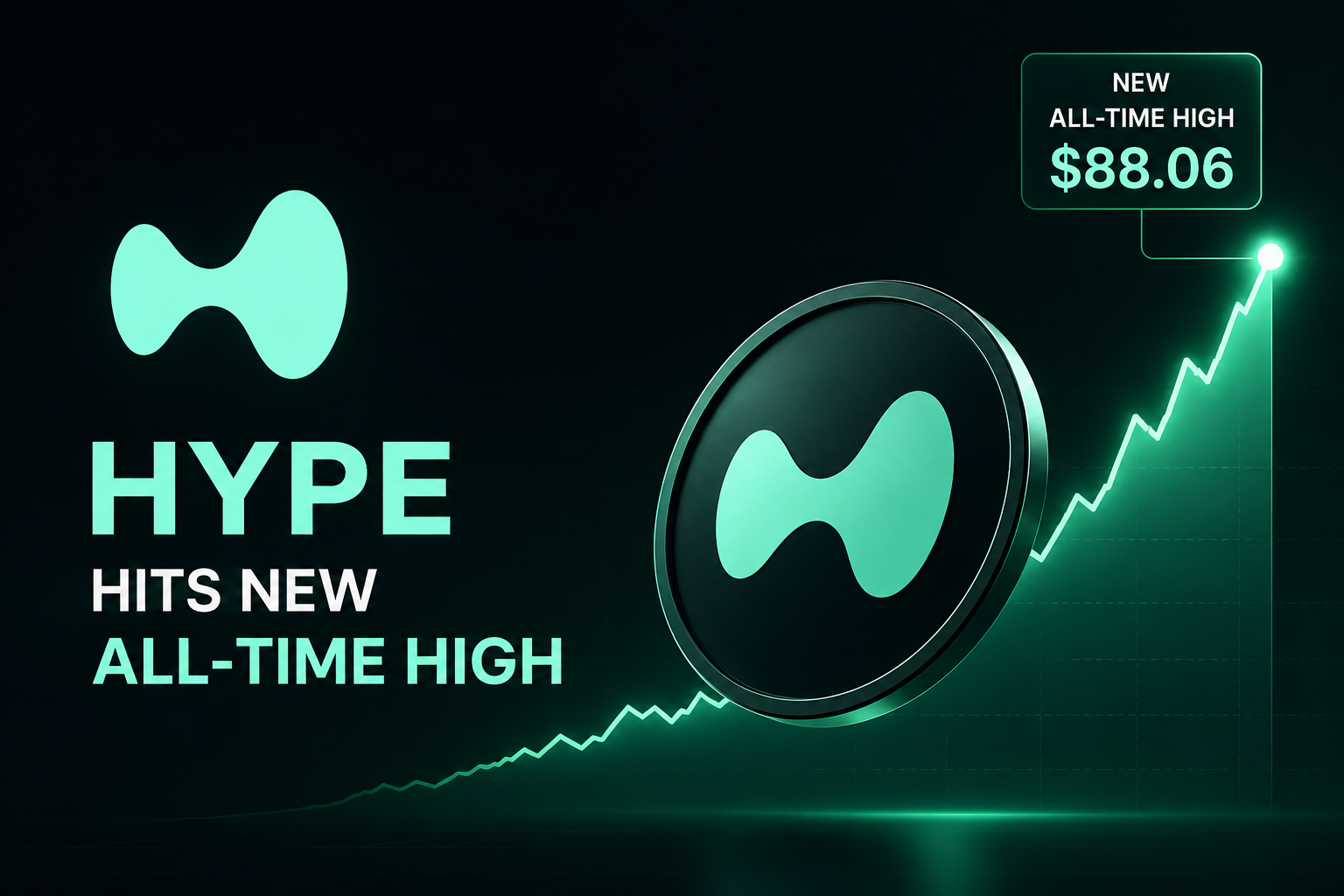
Hyperliquid’s native HYPE token climbed to a fresh record of $88.06 on September 3, extending a sharp run that has pushed the asset into the upper tier of the crypto market by valuation.
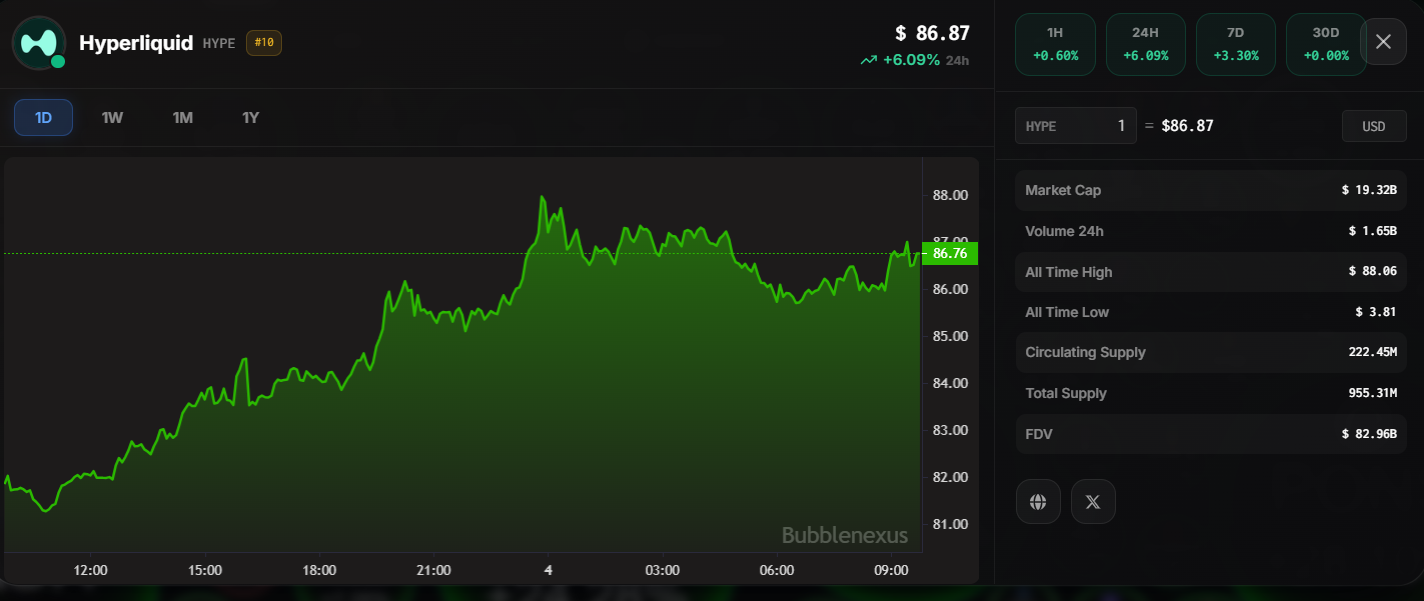
Hyperliquid HYPE chart from BubbleNexus Source: BubbleNexus Live Analysis

HYPE was trading near $86 on September 4 after briefly touching the new high, leaving it only a small distance below the peak. Market data showed the token gaining roughly 4% to 6% over the preceding 24 hours, although exact readings varied across platforms because crypto prices are aggregated from different venues and products.

A new record during a broader rally

The move marks a clear break from HYPE’s earlier trading history. CoinGecko’s historical data places the previous cycle’s low at $3.81 in November 2024, meaning the token has risen more than twentyfold from that level. The rally has also lifted HYPE’s market capitalization into the tens of billions of dollars, with circulating-supply estimates differing between data providers.

That performance has come as Hyperliquid has expanded beyond its original identity as a decentralized venue for crypto perpetual futures. The network combines an on-chain order book with spot and derivatives markets, while its broader ecosystem includes HyperEVM applications and additional financial products.

Hype's heavy derivatives activity

The CoinDuck page supplied for this analysis is a derivatives-market dashboard rather than a conventional spot-token page. Its September 4 snapshot showed active trading around the record:

  • HYPE perpetual last price: $86.2120
  • Reported 24-hour volume: approximately $728 million
  • Open interest: approximately $2.1 billion
  • Eight-hour funding rate: 0.0100%
  • Maximum listed leverage: 10 times

The funding rate was slightly positive, and CoinDuck’s derived positioning measure was close to balanced at 50.5% long versus 49.5% short. That combination points to substantial participation without an extreme directional imbalance in the snapshot. Open interest near $2.1 billion is particularly important: it indicates that a large volume of leveraged positions remained active while HYPE traded close to its record.

Read the dashboard carefully

CoinDuck’s figures should not be interpreted as a complete measure of HYPE’s spot-market capitalization or total token supply. The page is labeled for the Hyperliquid HYPE perpetual contract, and several raw fields—including circulating supply and market capitalization—were recorded as zero. It also displayed a mid-price and oracle price near $55.5 alongside a last trade near $86.2, a discrepancy that requires caution before using the page as a standalone price source.

What traders will watch next

HYPE’s next test is whether the token can hold above the former high after the initial breakout. Traders will also be watching open interest, funding, and liquidation activity. A record price supported by rising spot demand would suggest broader accumulation; a move driven mainly by leveraged contracts would leave the rally more exposed to sharp reversals.
More in

Hunter Biden Enters Crypto Market With Launch of ‘LAPTOP’ Memecoin

4d ago

Hunter Biden Enters Crypto Market With Launch of ‘LAPTOP’ Memecoin

Hunter Biden has launched a meme cryptocurrency called $LAPTOP on Base, the Ethereum layer-2 network developed by Coinbase. The token takes its name from the computer that became central to a political controversy before the 2020 U.S. presidential election and is being marketed with an airdrop aimed partly at people who lost money on President Donald Trump’s memecoin. At a glance Token: $LAPTOP Network: Base Planned supply: 1 billion tokens Launch date: September 9, 2026 Important caveat: Memecoins are highly speculative and do not represent ownership in Hunter Biden or any business. What is the LAPTOP memecoin? The token is a politically themed cryptocurrency built around Hunter Biden’s public association with the laptop controversy. Biden signaled the launch in a post on X showing the ticker “$LAPTOP,” the September 9 date and a montage of media reports and public figures discussing the laptop. The project’s reported supply is one billion tokens. Founders, including Biden, are set to receive 30% of the supply. Those tokens were reported to be locked for six months and scheduled to vest over more than two years, although the practical operation of those restrictions should be checked against the project’s published contract and documentation. Who is expected to receive the token? A further 20% of the supply has been described as an airdrop allocation. The intended recipients include crypto wallets that lost money on Trump’s $TRUMP memecoin, Hunter Biden’s Substack subscribers and a mailing list associated with video journalist Andrew Callaghan. Callaghan rejected any suggestion that his Channel 5 media operation was promoting the token. He said Biden had requested access to the subscriber list, but that the list was deleted before any emails were sent. The incident highlights the uncertainty around how eligibility and consent will work for the proposed distributions. How does the token’s planned burn mechanism work? As much as 30% of the supply is reportedly earmarked for burns linked to a list of political and market outcomes. The conditions include a Democrat winning the 2028 presidential election, Bitcoin reaching a specified all-time high and LAPTOP’s market capitalization overtaking that of $TRUMP. A burn permanently removes tokens from circulation. It can reduce supply, but it does not guarantee that the remaining tokens will rise in price. The value of any memecoin remains dependent on trading activity, liquidity, market sentiment and the credibility of the project’s rules. Why is the launch drawing attention? The launch places another high-profile political token in a market that has already seen sharp gains and losses. Trump’s memecoin and Melania Trump’s $MELANIA became prominent examples of celebrity-linked tokens, with early trading followed by steep declines from their peaks. LAPTOP also carries an unusually direct political message. Its proposed distribution to some $TRUMP holders frames the coin as both a parody of the Trump token and a vehicle for compensating, or at least targeting, traders who lost money in it. That positioning may create attention, but it also makes the token’s price especially sensitive to political events and online campaigns. What remains unknown for investors? The token’s launch announcement does not establish a stable market price, an investment value or a guaranteed distribution. Early reports also included copycat tokens and other assets using similar names, creating a risk that buyers could purchase an unaffiliated contract. Verify the official contract address through a trusted project channel before considering any transaction. Do not assume that a token carrying the LAPTOP name is the announced Base asset. Check whether the reported lock, vesting, airdrop and burn conditions are enforced on-chain. Treat claims about future price gains as speculation rather than established fact. At the time of reporting, market-data coverage for the newly launched asset was limited and not sufficient to present a reliable price or market-cap snapshot. The token’s performance will depend on actual liquidity and trading after launch, not only on the publicity surrounding its name. What does the launch mean for the wider memecoin market? $LAPTOP reinforces the shift of memecoins from internet jokes into political and celebrity branding. It also shows the limits of that model: a recognizable name can create immediate demand, while supply concentration, unclear distribution mechanics, copycat contracts and rapid sentiment changes can expose buyers to substantial losses. For now, LAPTOP is best understood as a high-profile speculative token launch rather than a cryptocurrency with an underlying product or cash flow. Its next test will be whether the project can verify its promised mechanics and sustain transparent trading after the initial attention fades.

Pendle Finance Launches on Robinhood Chain, Unlocking Fixed Yield and Leveraged Yield Trading for DeFi Users

5d ago

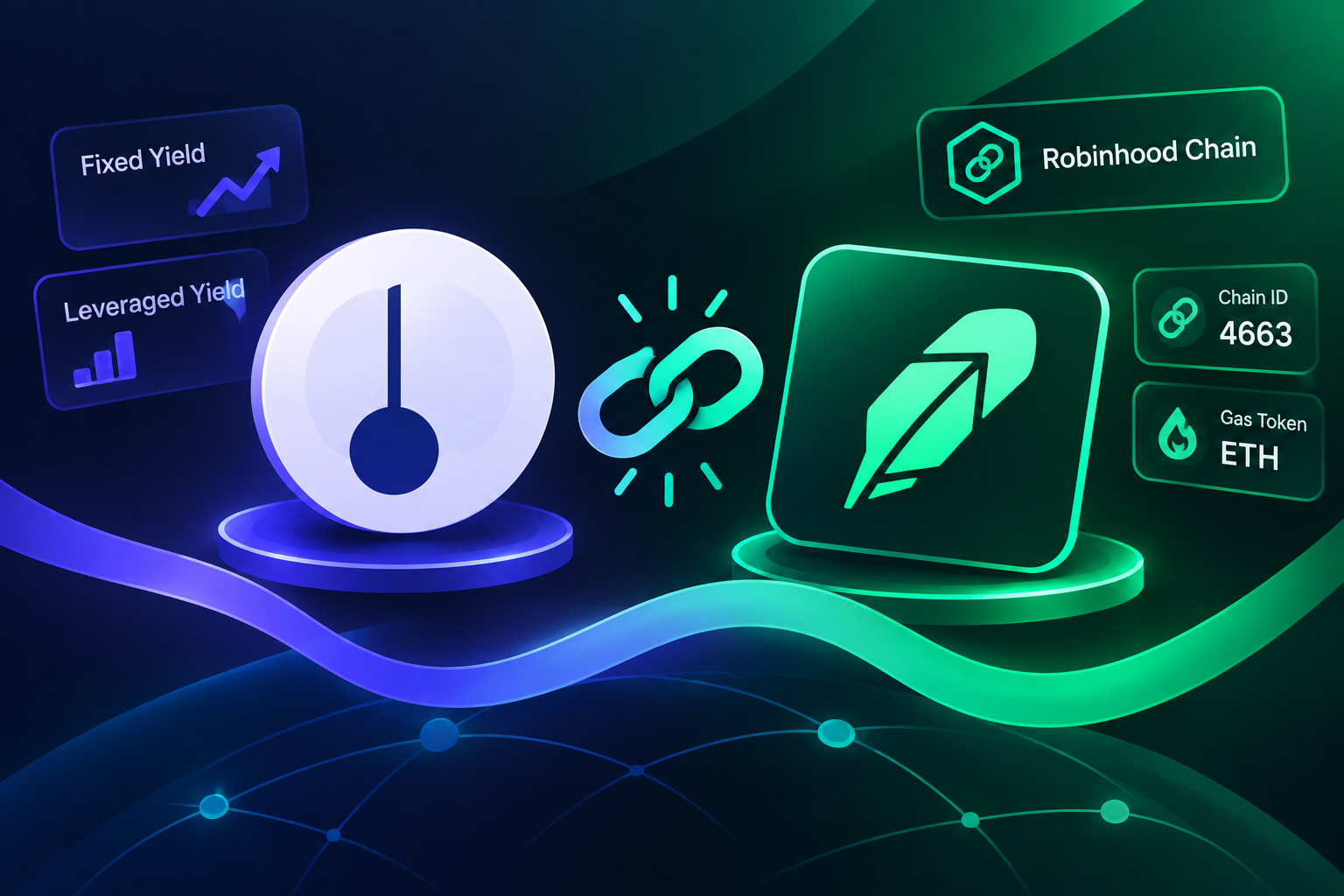
Pendle Finance Launches on Robinhood Chain, Unlocking Fixed Yield and Leveraged Yield Trading for DeFi Users

Pendle Finance has launched on Robinhood Chain with its first market, sNET, giving users access to products that separate an asset’s principal from its future yield. The initial market is scheduled to mature on September 17, 2026, marking Pendle’s first yield-trading deployment on Robinhood’s Ethereum Layer 2. Key facts Pendle went live on Robinhood Chain in early September 2026. The first supported market is sNET. The initial market matures on September 17, 2026. Pendle’s V2 products include fixed-yield exposure and leveraged positioning on yield. What Pendle is adding to Robinhood Chain Pendle’s V2 platform splits yield-bearing positions into Principal Tokens, representing the underlying principal, and Yield Tokens, representing future yield. Users can then choose between fixed-yield exposure, a view on future yield or liquidity provision. The deployment begins with sNET rather than a broad set of markets. The first pool lets users trade the asset’s principal and yield until maturity. Why the launch matters for Robinhood Chain Robinhood Chain is a permissionless Layer 2 built with Arbitrum technology and designed for financial services, tokenized real-world assets and onchain applications. Its official ecosystem materials identify trading, lending and yield as intended use cases. Pendle’s arrival adds a specialized yield market to that growing DeFi stack. The deployment creates a venue for managing interest-rate exposure without relying only on spot positions. Fixed-yield buyers can use Principal Tokens, while Yield Token traders can express a view on changes before maturity. How the structure works: One yield-bearing position can be divided into principal exposure and future-yield exposure, allowing those components to be traded separately. What the initial sNET market offers Feature What it means Underlying market sNET on Robinhood Chain Principal exposure Principal Tokens can be used to seek fixed-yield exposure through maturity. Yield exposure Yield Tokens can be used to take a position on future yield. Maturity September 17, 2026 Future expansion No additional market timetable was confirmed in the launch information reviewed for this report. Quoted yield figures are not guaranteed returns. Yield levels can change with market conditions, liquidity, incentives and the underlying asset’s value. Users also face smart-contract, bridge, liquidity and market risks. Robinhood Chain’s role in the expansion Robinhood Chain uses Ethereum-compatible infrastructure and ETH as its native gas token. The network is positioned as an open environment where users and developers can access, transfer and build applications without platform lock-in. July 1, 2026 Robinhood Chain’s public mainnet launch was reported as part of the network’s rollout. September 4, 2026 Pendle’s Robinhood Chain deployment and initial sNET market were announced. September 17, 2026 The initial sNET market is scheduled to reach maturity. What users should watch next The immediate focus will be sNET market performance and liquidity through its September maturity date. Launch materials did not provide a confirmed timetable for additional markets, so future expansion remains unannounced. Risk reminder: Pendle’s products are financial instruments within DeFi markets. Fixed-yield positioning does not eliminate smart-contract, asset, liquidity or network risk, and leveraged yield exposure can magnify losses.

Phantom Adds Robinhood Chain: Swap Tokenized Stocks & Assets In-App

Sep 4, 2026

Phantom Adds Robinhood Chain: Swap Tokenized Stocks & Assets In-App

Phantom has added Robinhood Chain to its supported networks, giving users a way to view, transfer, bridge, and swap supported assets on Robinhood’s Ethereum Layer 2 without leaving the wallet . The integration, reported as going live on July 23 , extends Phantom beyond its original Solana focus and adds a direct wallet route into Robinhood Chain’s emerging tokenized-asset ecosystem. Users can activate the network through Phantom’s settings, then manage compatible assets with the same EVM wallet address used for networks such as Ethereum, Base, and Polygon. What Phantom users can do Robinhood Chain support covers the basic actions expected from a multi-chain wallet. Phantom’s documentation describes in-app bridging and cross-chain swaps, while the integration announcement says users can view balances, send and receive tokens, swap supported assets, and move funds into or out of the network. Enable Robinhood Chain from Phantom’s active-network settings. View balances and send or receive compatible tokens. Swap supported assets through Phantom’s trading interface. Bridge assets between Robinhood Chain and other supported networks. Track transactions through Robinhood Chain’s block explorer. Cross-chain transactions can involve several steps. Phantom may swap or wrap an asset on the source network, route it through a bridge, and complete a final swap on the destination chain when necessary. The wallet uses routing infrastructure to compare available bridge and decentralized-exchange paths, but users remain responsible for checking fees, networks, slippage, and transaction status before approving a trade. Why tokenized stocks matter Robinhood Chain was designed for financial services and real-world assets. Its flagship Stock Tokens are standard ERC-20 tokens issued by Robinhood Assets (Jersey) Limited. They are designed to provide economic exposure to specified shares or exchange-traded funds, with on-chain prices and the ability to be held, transferred, and used in decentralized applications. That design makes the assets compatible with familiar wallet and DeFi infrastructure. Users may be able to trade them around the clock on supported venues, while developers can build markets, lending applications, and other products around the tokens. The structure is not the same as owning the underlying shares directly: the documentation says Stock Tokens do not grant legal or beneficial rights in the underlying securities. Access remains restricted The integration does not make Robinhood Stock Tokens universally available. Robinhood states that the tokens are not available in the United States and are subject to restrictions in other jurisdictions. They are not registered under U.S. securities laws and may not be offered, sold, or delivered to U.S. persons. For Phantom, the addition strengthens its multi-chain positioning and gives existing users a simpler interface for interacting with a new tokenized-asset network. For Robinhood Chain, wallet support expands access beyond Robinhood’s own products. The practical impact will depend on liquidity, eligible jurisdictions, supported assets, and whether users adopt tokenized markets as a regular part of on-chain trading.