News

Coinbase and Citi Partner to Bring Stablecoin Payments into Banking System

Share
Coinbase and Citi Partner to Bring Stablecoin Payments into Banking System

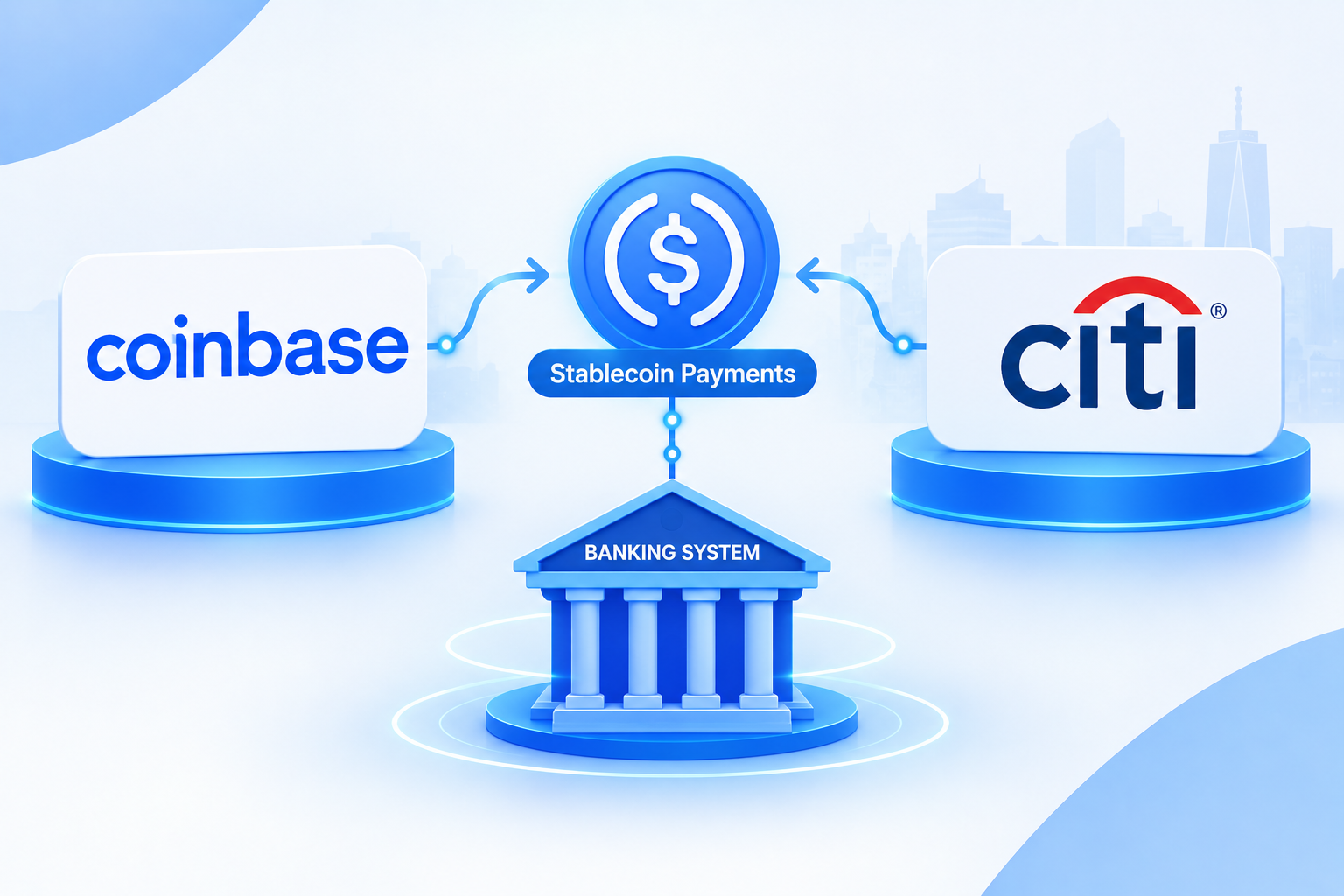
Citigroup and Coinbase are expanding their payments partnership with two services designed to link bank accounts and stablecoins for businesses. Coinbase will use Citi banking infrastructure for virtual accounts that convert incoming fiat into stablecoins, while Citi’s institutional merchants will be able to accept stablecoin payments and receive fiat settlement. The initiatives are launching first in the United States.

Two services connect fiat and digital payments

The first product, Coinbase Virtual Accounts, will use Citi Services’ Virtual Account Wallet, offered through its Banking-as-a-Service capabilities. The accounts are intended to let Coinbase payments customers accept, hold and send funds with bank-account-like functionality. Incoming fiat is automatically converted into stablecoins, creating a bridge between conventional bank payments and digital assets.

The second initiative brings stablecoin checkout to Spring by Citi, the bank’s payment acceptance platform. Coinbase Payments will handle the stablecoin acceptance and conversion into fiat. Citi will settle the resulting funds as the bank of record, allowing merchants to serve customers paying in stablecoins without directly holding, safeguarding or managing those tokens.

What the arrangement means for merchants

The model separates the customer’s payment method from the merchant’s settlement currency. A buyer can pay with a stablecoin, while the business receives fiat through Citi’s existing banking relationship. That could let companies accept digital-dollar payments without building their own wallet, conversion process or stablecoin custody operation.

The virtual-account product addresses a related but different flow: a business receives fiat into a payment account and converts it automatically into a stablecoin. Together, the services cover movement in both directions between traditional money and blockchain-based payment rails, though the companies have not published transaction limits, fees or a detailed customer rollout calendar.

Key details

  • Coinbase Virtual Accounts use Citi’s Virtual Account Wallet and automatically convert incoming fiat to stablecoins.
  • Spring by Citi will support stablecoin checkout for Citi institutional clients, with fiat settlement through Citi.
  • Merchants are not required to hold or manage stablecoins directly under the described payment flow.
  • The initial launch is in the United States, with additional capabilities planned for later months.

From an exploratory deal to payment products

The companies first announced their collaboration in October 2025, initially focusing on fiat pay-ins and payouts, payment orchestration and ways to improve access to digital-asset payments. The latest announcement moves the relationship toward specific services for business customers rather than a general exploration of potential use cases.

The deal also draws on distinct roles: Citi supplies regulated banking and merchant-settlement infrastructure, while Coinbase provides payment technology for the stablecoin side. The design aims to let businesses use digital payment options without replacing their existing banking operations.

U.S. rollout comes first

Both companies say the initiatives will launch first in the United States and that they will continue developing additional capabilities. They have not announced a full timetable for wider availability or specified which stablecoins and customer segments will be supported at launch. Those details will determine how quickly the partnership moves from newly announced infrastructure to routine use by merchants and businesses.

More in

Binance Hacked: $6.3 Billion Lost, Withdrawals Paused

2h ago

Binance Hacked: $6.3 Billion Lost, Withdrawals Paused

Binance, the world's biggest crypto exchange, says hackers hit about $6.3 billion in a security attack on Thursday. It is the largest crypto theft ever. Binance says user funds are safe and it will cover all losses. What happened in the Binance hack On Thursday, October 29, users and blockchain trackers noticed large amounts of crypto leaving Binance's hot wallets. A hot wallet is a wallet connected to the internet, used to process everyday withdrawals. Binance first said it was "actively investigating" a potential security issue. Later it confirmed a security incident and suspended withdrawals on multiple networks as a precaution. Binance said its early investigation points to a compromised laptop belonging to a DevOps engineer. A DevOps engineer manages the systems that run a company's software. The company says that access let an attacker reach a "service container" and submit unauthorized withdrawal transactions. Binance also said it found no evidence that any wallet private keys leaked, and it promised a detailed technical report after the investigation. Binance hack: key facts Amount: About $6.3 billion, and the number may change. Frozen: About $3 billion has been frozen so far. Tether froze about $1.77 billion and Circle about $825 million. Cause: Binance says a hacked laptop of one engineer let the attacker send out unauthorized withdrawals. It found no sign that wallet keys leaked. Who did it: Binance has not said. TRM Labs says it is "highly confident" the North Korea-linked group TraderTraitor is behind it. Withdrawals: Paused. Binance says they should start resuming within 48 hours. Deposits are working. Crypto market reaction Crypto prices fell. Bitcoin dropped about 2.8% to around $78,490, Ether fell about 3.8%, and BNB fell about 3.5%, according to CNBC . Why it matters Binance serves hundreds of thousands of people, so a hack of this size raises questions about the safety of funds held on exchanges. The speed of the freezes, by Tether, Circle, Ripple and others, shows that stablecoin issuers can stop some stolen money. Not all of it, though. TRM says the attacker still holds more than 420,000 ETH and 18,270 BTC, worth about $2.4 billion, which issuers cannot freeze. What users should do Use only official Binance channels for updates. Do not click unofficial links or share account details. Binance has warned about this, and scammers often copy hacks like this one. Do not trust anyone who offers to "recover" funds for a fee. What happens next Binance says withdrawals should start to resume within 48 hours, and that it will share a detailed post-mortem and publish only confirmed figures. The final totals for what was stolen, frozen and recovered may change as the investigation continues. FAQs Is my money on Binance safe? Binance says yes and promises to cover all losses. Its investigation is not finished, so watch its official channels. Can I withdraw from Binance now? Not yet. Binance says withdrawals should start resuming within 48 hours. Is Binance insolvent? Binance has not said that. It says it will cover all losses. Who hacked Binance? Binance has not named anyone. TRM Labs blames a North Korea-linked group, but this is not confirmed by Binance.

Pump.fun Launches Perpetual Futures Trading with Hyperliquid

1d ago

Pump.fun Launches Perpetual Futures Trading with Hyperliquid

Pump.fun, the app best known for Solana memecoins, has added perpetual futures trading, and the trades run on the Hyperliquid exchange. Pump.fun announced on X that the service is live, according to crypto news outlets that cite the post. What happened Pump.fun has added perpetual futures trading to its app. Users can take long or short positions on more than 300 markets covering crypto, stocks and commodities, and they trade from the USDC or SOL balance in their Pump.fun wallet. PANews and DeFiprime, citing Pump.fun's post on X, report that the company announced the service as live on October 28. Pump.fun did not build its own trading engine for this. Hyperliquid runs the trades: it matches orders, handles margin and funding payments, and carries out liquidations, while Pump.fun provides the app. Pump.fun earns a fee on each trade through Hyperliquid's builder codes, according to Hyperliquid's documentation. The service did not appear all at once. Pump.fun's data feed first showed perps data around October 9, according to Bankless. Bankless, Bitcoin.com and CryptoTicker reported trading on Bitcoin and Ether live on October 16 and 17. Then on October 28, Pump.fun posted on X that Hyperliquid perps were live in the app with 300+ markets, as reported by Altcoin Buzz, PANews and DeFiprime. What Pump.fun perpetual futures offer Markets: More than 300 Hyperliquid markets covering crypto, stocks and commodities, according to PANews, which cites Pump.fun's X post. Leverage: Up to 40x on Bitcoin, 25x on Ether, 20x on stocks such as Tesla and Nvidia, and 50x on the S&P 500. DeFiprime notes the limits vary across the app. Risk tools: Isolated margin, which keeps a position's collateral separate from the rest of a user's funds, plus take-profit and stop-loss orders. Funding: Users trade with USDC or SOL held in their Pump.fun wallet. The announcement says no cross-chain bridging is needed. DeFiprime and Bitcoin.com both report that Pump.fun's fee page still allows a bridge-transfer fee of up to 0.25%. Fees: Pump.fun charges its own builder fee when a position is opened, increased or closed. Hyperliquid's usual trading fee is charged on top. Outlets disagree on the maximum Pump.fun fee: DeFiprime reports up to 0.05% (0.04% with a referral code), while Bitcoin.com reports up to 0.10%. Hyperliquid's documentation caps builder fees on perps at 0.1%. Check Pump.fun's fee page for the current figure. Who cannot use it: Bankless and Bitcoin.com report that people in the United States and Ontario, Canada, are barred. DeFiprime says other jurisdictions are also excluded. Bitcoin.com adds that using a VPN to get around the limits is not allowed. Why it matters Bitcoin.com reports that the move gives Pump.fun a new source of revenue without the cost of building its own derivatives exchange. Bankless says it follows Pump.fun's August integration of spot trading on Hyperliquid's HyperEVM network. Hyperliquid's documentation says a user must approve a maximum builder fee before an app can charge it, and users can revoke that approval at any time. Bitcoin.com also notes that small price moves against a leveraged trader can wipe out collateral. This article is news, not investment advice. DeFiprime reports that Pump.fun says it does not operate or control the Hyperliquid protocol, and that prices and liquidation levels shown in its app are only indicative. What happens next PANews reports that Pump.fun later added support for Arbitrum, so users can trade any token on that network with their USDC balance. The report gives no date. No other next steps have been confirmed. Frequently asked questions Does Pump.fun have perpetual futures trading? Yes. Reports say Pump.fun added perpetual futures to its app in mid-October 2026. On October 28, it posted on X that Hyperliquid perps were live with more than 300 markets. Does Pump.fun run its own exchange for perps? No. Reports say Hyperliquid matches the orders, tracks funding payments and handles liquidations. Pump.fun provides the app that users trade in. DeFiprime reports that Pump.fun says it does not operate or control the Hyperliquid protocol. What markets can I trade? PANews, citing Pump.fun's X post, says there are more than 300 Hyperliquid markets covering crypto, stocks and commodities. What leverage does Pump.fun perps offer? Reported limits are up to 40x on Bitcoin, 25x on Ether, 20x on stocks such as Tesla and Nvidia, and 50x on the S&P 500. DeFiprime says the limits vary across the app. What are the fees? Pump.fun charges its own builder fee when a position is opened, increased or closed, and Hyperliquid's usual trading fee is added. Outlets report different maximums for Pump.fun's fee: up to 0.05% (DeFiprime) or up to 0.10% (Bitcoin.com). Hyperliquid caps builder fees on perps at 0.1%. A bridge-transfer fee of up to 0.25% is also reported. Check Pump.fun's fee page for current figures. What funds do I need, and do I have to bridge? Users trade with USDC or SOL held in their Pump.fun wallet, and the announcement says no cross-chain bridging is needed. PANews adds that Arbitrum support was added later, so users can trade any token on Arbitrum with their USDC balance. Is Pump.fun perps available in the US? No. Bankless and Bitcoin.com report that people in the United States and Ontario, Canada, are barred. DeFiprime says other jurisdictions are also excluded. Bitcoin.com adds that using a VPN to get around the limits is not allowed. What are the risks? Bitcoin.com notes that small price moves against a leveraged trader can wipe out collateral, and Hyperliquid automatically liquidates positions that fall below margin requirements. DeFiprime reports that prices and liquidation levels shown in Pump.fun's app are indicative only. This article is news, not investment advice.

Binance to Delist QuickSwap (QUICK) and Epic Chain (EPIC) on Oct. 28, 2026

Oct 15, 2026

Binance to Delist QuickSwap (QUICK) and Epic Chain (EPIC) on Oct. 28, 2026

Oct. 15, 2026 — Binance says it will remove all spot trading pairs for Epic Chain (EPIC) and QuickSwap (QUICK) at 03:00 UTC on Oct. 28, 2026. The exchange says open orders will be cancelled once trading stops. The delisting applies to spot markets first; other Binance products have their own cutoffs, some of which come earlier. Why Binance says it is delisting QUICK and EPIC Binance said it reached the decision after its latest review of listed digital assets. The exchange periodically checks whether a listed token continues to meet its standards and industry requirements. Its notice lists general review factors such as a project team’s commitment, development activity, trading volume and liquidity, network security, communication with the community, responses to due-diligence requests, regulatory requirements, token-supply or tokenomics changes, ownership or team changes, and community sentiment. Those items describe Binance’s general review criteria, not a finding about either project. Binance did not say which specific factor led it to remove EPIC or QUICK, nor did it identify a particular violation. U.Today’s independent report also notes that the exchange did not specify an individual reason for the two decisions. Key dates for the Binance delisting Binance has not set one single deadline for every service. The dates below are in UTC and come from the exchange’s notice. Binance’s announced 2026 dates for QUICK and EPIC services (all times UTC) Date and time Binance service What changes Oct. 15, 03:00 Buy & Sell Crypto EPIC, QUICK and associated pairs removed. Oct. 15, 06:00 Margin Borrowing of the affected tokens suspended. Oct. 20, 08:30 Futures Opening new positions in affected contracts stops. Oct. 20, 09:00 Futures Remaining positions automatically settled; contracts delisted. Oct. 20, 10:00 Margin Tokens removed from cross, isolated and portfolio margin; applicable positions settled and orders cancelled. Oct. 21, 03:00 Spot Copy Trading Affected pairs delisted; remaining assets may be sold at market price or moved to Spot if unsellable. After Oct. 21, 07:00 Simple Earn Support ends; unredeemed Flexible and Locked positions are automatically redeemed and transferred to Spot with accrued rewards. Oct. 27, 02:00 Convert Low-Value Assets Tokens removed from the service. Oct. 28, 02:00 Convert Tokens and associated pairs removed. Oct. 28, 03:00 Spot trading All affected pairs removed; open orders cancelled and applicable trading-bot services end. Oct. 29, 03:00 Deposits Deposits of EPIC and QUICK are no longer credited. Dec. 28, 03:00 Withdrawals Binance says withdrawals will no longer be supported after this time. For margin users, Binance says remaining collateral may be applied to liabilities during settlement. The exchange also describes circumstances in which collateral may be sold to repay liabilities or the delisted token may be sold into USDT or USDC. The exact handling depends on the user’s account and position type, as detailed in the notice. After Dec. 29 at 03:00 UTC, Binance may convert remaining delisted tokens into stablecoins for users, but the exchange says this is not guaranteed. Binance says it will issue a separate notice before a conversion where applicable. If conversion is not feasible, withdrawals may remain open, subject to network availability. independent report What the Oct. 28 spot cutoff means The spot-trading deadline is when Binance plans to remove the trading pairs involving QUICK and EPIC. It is separate from the deposit deadline on Oct. 29 and the withdrawal deadline on Dec. 28. Binance says users should check their holdings and any related products because trading, automated strategies, margin, and earning products can stop on different dates. The exchange’s notice also says availability of the products and services mentioned may vary by region. The announcement does not say that the two tokens themselves will cease to exist or that all other platforms will stop supporting them. It sets out Binance’s planned removal of the affected tokens from its own services. FAQs about Binance delisting QUICK and EPIC When will Binance delist QUICK and EPIC? Binance plans to stop spot trading for all pairs involving QuickSwap (QUICK) and Epic Chain (EPIC) at 03:00 UTC on Oct. 28, 2026. Will open QUICK and EPIC spot orders remain after delisting? No. Binance says it will automatically remove open orders after trading ceases in each affected spot pair. Applicable trading-bot services for those pairs will also end at the spot cutoff. What happens to EPIC and QUICK futures positions? Binance says users will not be able to open new positions in the affected futures contracts from 08:30 UTC on Oct. 20. Remaining positions will be automatically settled at 09:00 UTC that day. Can users deposit QUICK or EPIC after spot trading ends? Binance says deposits will not be credited after 03:00 UTC on Oct. 29, 2026. This is one day after the scheduled spot-trading cutoff. Until when can users withdraw QUICK and EPIC from Binance? Binance says withdrawals will not be supported after 03:00 UTC on Dec. 28, 2026. The notice also says that, where token conversion is not feasible, withdrawals may remain open subject to network availability. Why is Binance delisting QuickSwap and Epic Chain? Binance says it reviewed the assets against its listing standards, but it did not identify a specific reason for delisting either token. The exchange lists general review factors such as development activity, trading volume and liquidity, network security, regulatory requirements and team commitment.