



Summary
- Use a payment provider that accepts the stablecoins you want and converts payments to fiat for settlement.
- Choose a fiat payout currency and route funds to your provider balance or business bank account. Don’t direct customer payments to a business wallet if you don’t want to receive crypto.
- Check provider eligibility, supported tokens and networks, payout timing, fees, refund rules, and dispute handling before launch.
- You avoid managing a crypto wallet, but still depend on the provider to process and convert the payment.
 Source: Coinbase X post
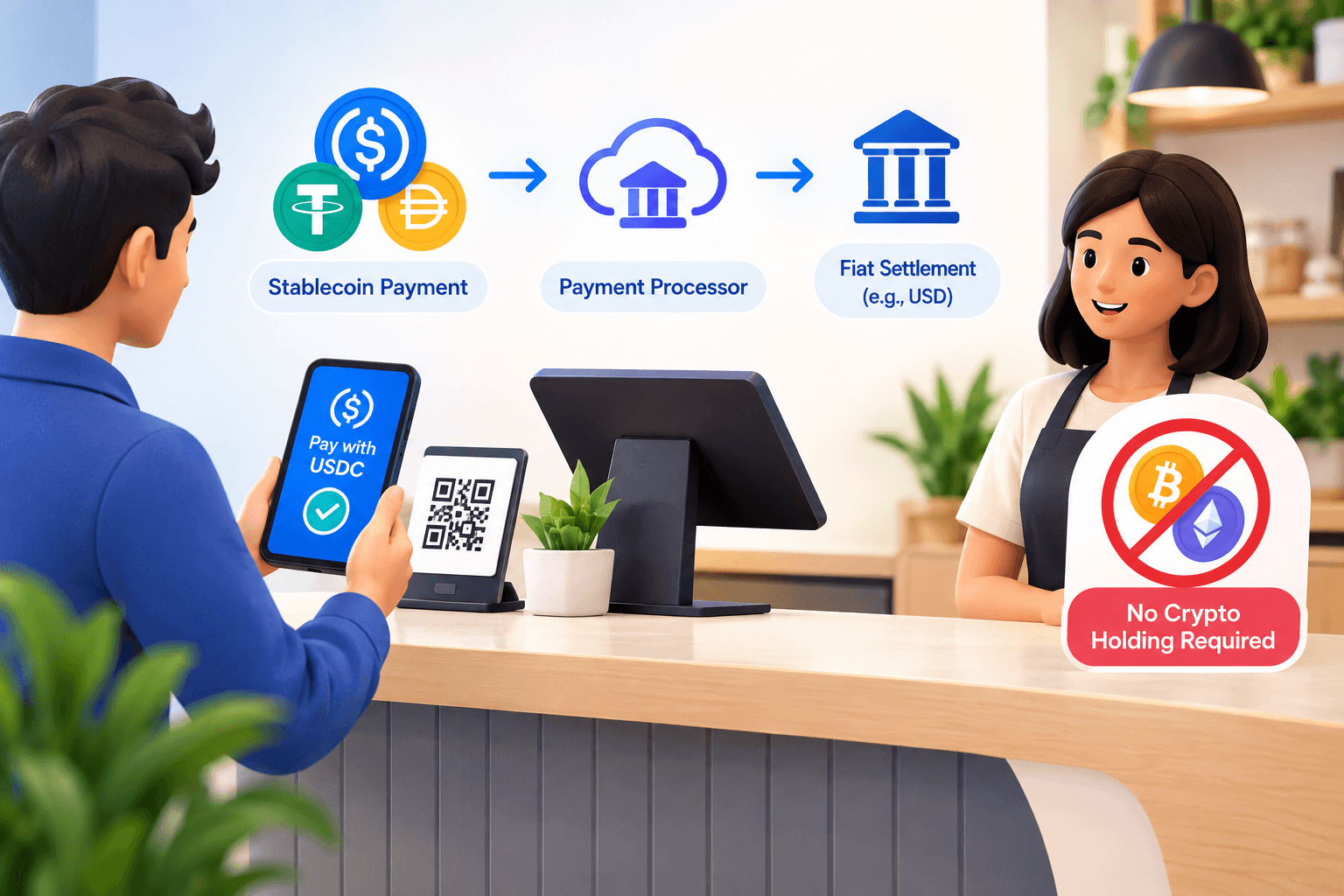
To accept stablecoin payments without holding crypto, use a payment processor that receives or routes the customer’s stablecoin payment, converts it to fiat, and settles to your provider balance or bank account. The exact process depends on your location and the provider’s supported payment options. Here’s what to check before enabling it.
How can a business accept stablecoins without holding them?
Choose a processor with fiat settlement, enable a supported stablecoin payment method, and set your settlement currency to fiat. The processor handles the crypto payment flow; your business receives fiat according to that provider’s payout process.
- Pick an eligible provider. Confirm it accepts merchants in your country and can settle to your business bank account or fiat balance.
- Choose supported payment options. Check the exact token and network combinations. A token sent on an unsupported network may not be treated as a valid payment.
- Set fiat settlement. Choose the payout currency and bank account. Avoid any option that settles to a crypto wallet or splits settlement between fiat and crypto.
- Add checkout or invoicing. Use a supported hosted checkout, payment link, ecommerce integration, point-of-sale tool, or API.
- Test the full payment and refund flow. Confirm how your system receives payment status, how late or incorrect payments are handled, and how refunds are issued.
- Reconcile the records. Match customer invoices with gross payment amounts, processor fees, refunds, conversion information, and net fiat payouts.
In a processor-based setup, the customer pays from a compatible wallet. The provider processes the stablecoin payment and converts it under its terms. Your business receives fiat through the provider’s balance or payout process.
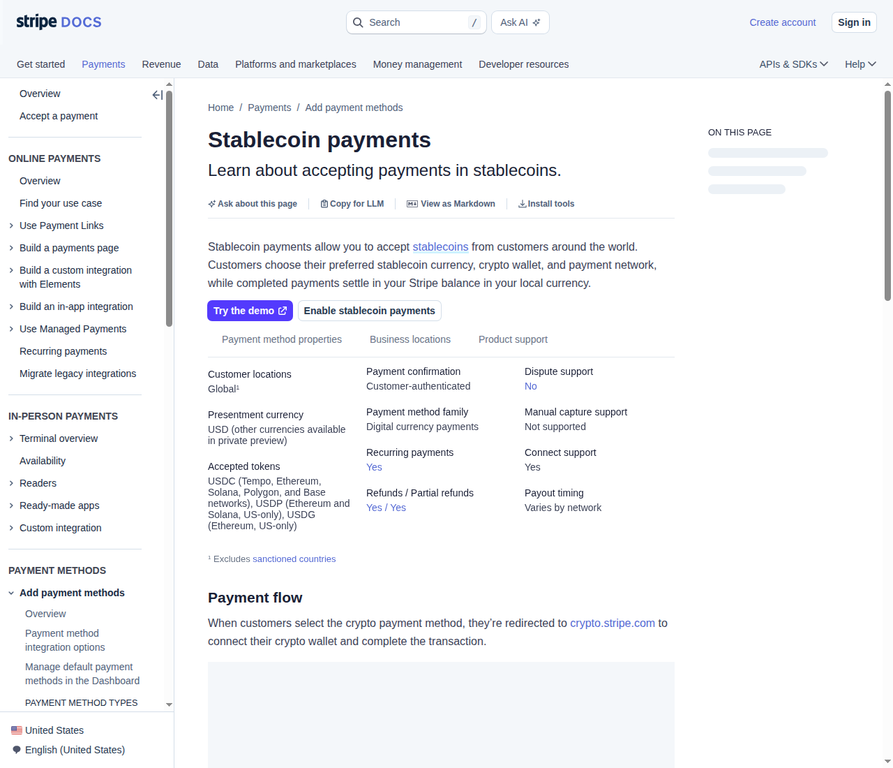 Source: Stripe Docs
Key point: “Without holding crypto” means the merchant does not receive and manage the payment in its own crypto wallet. The merchant still relies on a provider to process the payment and convert it.
Which payment-provider options can settle stablecoin payments in fiat?
Stripe and BitPay both publish options for accepting digital-asset payments with fiat settlement, but their eligibility, supported assets, payout mechanics, and pricing differ. Availability changes, so treat this table as a starting point—not a substitute for checking the provider’s current terms for your business.
| Provider or model | Published payment and settlement details | Important checks |
|---|---|---|
| Stripe stablecoin payments | Completed payments settle in the Stripe balance in the business’s local currency. Stripe’s documentation lists USDC on supported networks; it also lists USDP and USDG with US-only restrictions. | Stripe lists U.S. businesses as supported and says the service is in private preview for businesses in the EU, Hong Kong, Mexico, and Switzerland. Its documentation gives a US$10,000 customer transaction limit and says payout timing varies by network. |
| BitPay merchant payments | BitPay says businesses can accept stablecoins and choose fiat, crypto, or mixed settlement. Its merchant materials describe converting the customer’s payment into local currency and initiating bank settlement. | Settlement currencies, country eligibility, minimum payout amounts, and bank arrival times vary. BitPay’s settlement documentation lists automatic business-day settlements; for example, it describes USD ACH deposits arriving two business days after payout issuance and EUR SEPA deposits arriving one business day after issuance in select countries. |
| Direct payment to your own wallet | The customer sends crypto directly to an address controlled by the business. | This does not meet the “without holding crypto” goal: the business must receive, secure, reconcile, and potentially convert the asset itself or arrange another service to do so. |
Stripe’s documentation currently lists USDC on Tempo, Ethereum, Solana, Polygon, and Base; its documentation notes that transfers on Tempo use USDC.e. It also lists USDP on Ethereum and Solana, and USDG on Ethereum, both with US-only restrictions. Check the live documentation for the exact combination enabled for your account.
Location matters: A provider may let customers pay from many countries while limiting which countries’ businesses can accept payments or receive particular fiat payouts. Check merchant eligibility and bank-settlement coverage separately.
What fees and payout timing should a business expect?
Compare the payment-processing fee, any conversion charge, payout costs, and the time between customer payment and funds arriving in your bank. A quoted “next business day” settlement initiation is not necessarily the same as the day money becomes available in your account.
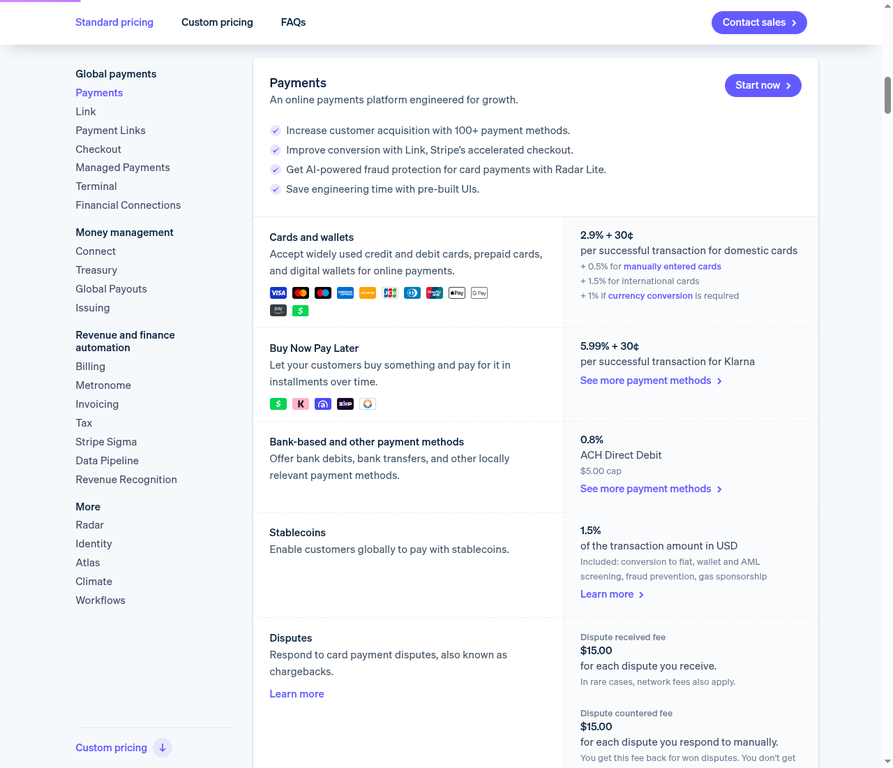 Source: Stripe Payment page
- Stripe: Its public pricing page currently lists a 1.5% fee on the transaction amount in USD for stablecoin payments. The page says the listed fee includes conversion to fiat, wallet and AML screening, fraud prevention, and gas sponsorship. Confirm the rate that applies to your business and country.
- BitPay: Its public pricing page lists crypto-acceptance fees of 2% plus US$0.25 per transaction below US$500,000 in monthly transaction volume; 1.5% plus US$0.25 from US$500,000 to US$999,999; and 1% plus US$0.25 at US$1 million or more. BitPay says higher fees apply to high-risk industries.
- Payouts: Ask when the provider initiates settlement, when your bank normally credits it, which minimums apply, and whether conversion or bank-transfer fees are separate.
These are provider-published rates, not a like-for-like quote for every business. Your country, business category, contract, and payment configuration can affect what you actually pay.
What should a business check before enabling stablecoin checkout?
Verify the operational details that determine whether a payment is accepted, converted, refunded, and reconciled correctly. Do this before adding a stablecoin option to a live checkout.
- Merchant eligibility: Is the feature available to a business registered in your country and industry?
- Token and network: Which stablecoins and networks are supported for your account? What happens if a customer sends the wrong asset or uses the wrong network?
- Fiat payout: Which currencies and bank destinations are supported? Are there payout minimums or currency-conversion charges?
- Timing and status: When does the provider mark the payment complete, and when does it initiate the fiat payout?
- Refunds: How does the provider return funds, in what asset, and to which customer destination? Stripe says refunds for stablecoin payments go back in stablecoins to the customer’s original wallet.
- Disputes: Stripe’s documentation lists dispute support as unavailable for this payment method. Confirm how complaints, refunds, and payment mistakes are handled by the provider you choose.
- Records: Make sure your accounting system can reconcile the sale, provider fees, conversion, payout, and any refund.
Warning: Stablecoins are designed to track a reference currency, but that does not make them risk-free. The Federal Reserve has documented a past episode in which USDC traded below its dollar peg during market stress. Fiat settlement can reduce the merchant’s direct exposure to holding tokens, but it does not remove provider, processing, or settlement risk.
Does accepting stablecoins change a business’s tax or compliance duties?
Using a processor and receiving fiat does not answer every tax, recordkeeping, or compliance question. The rules depend on the transaction structure and the jurisdictions where the business and its customers operate.
Keep the provider’s transaction and settlement records, and ask an accountant how to report the arrangement in your jurisdiction. The IRS has guidance on digital-asset transactions and recordkeeping, including payment flows involving processors; U.S. businesses should not assume that fiat settlement alone determines their reporting treatment. Check local tax, consumer-protection, sanctions, and licensing requirements as well.
What should a business do next?
Start with your location, expected payment volume, checkout platform, and required payout currency, then compare eligible providers against those needs. Run a small end-to-end test before advertising the payment option to customers.
- Check the official provider pages below for current country, asset, network, payout, and fee details.
- Confirm in writing that the account will settle in fiat and that no payout is routed to a crypto wallet.
- Document payment confirmation, refunds, customer support, and reconciliation procedures.
- Review tax and compliance treatment with a qualified adviser familiar with your jurisdiction.
Frequently Asked Questions (FAQs)
Q: Do I need a crypto wallet to accept stablecoin payments through a processor?
A: Not necessarily. Providers such as Stripe and BitPay document fiat-settlement options that can avoid sending the business’s proceeds to its own crypto wallet. Check your account settings to ensure fiat settlement is selected.
Q: Will my customers still need a crypto wallet?
A: The payment flow depends on the provider. Stripe’s documented checkout redirects customers to connect a crypto wallet and complete payment.
Q: Does fiat settlement mean there are no crypto-related risks?
A: No. It can avoid the business directly holding the received tokens, but the business still relies on the provider’s processing, conversion, and payout arrangements.
Q: Can a stablecoin payment be refunded?
A: Provider rules differ. Stripe says stablecoin refunds are returned in stablecoins to the customer’s original wallet, so explain the refund process in your customer-service policy.
Q: Are stablecoin processing fees always lower than card fees?
A: Not always. Compare your actual provider rate, fixed transaction charges, conversion and payout costs, and the payment methods your customers use.
Disclaimer: The information provided on this blog is for informational and educational purposes only and does not constitute financial, investment, legal, or tax advice. Cryptocurrency investments are highly volatile and carry a high risk of financial loss.