



The crypto market moves fast, and for beginners, jumping directly into real trading can be risky. Many new traders lose money simply because they do not fully understand market behavior, volatility, or risk management.
This is where PaperTrade becomes valuable. Instead of risking real funds, users can simulate crypto trading using virtual money while experiencing real market conditions.
Paper trading allows traders to test strategies, understand price movements, and build confidence before entering the live market. In this guide, we’ll explain how PaperTrade works, why it matters for beginners, and how it can help improve long-term trading performance.
Table of Contents
1. What is PaperTrade?2. How Paper Trading Works
3. Why Beginners Use PaperTrade
4. Key Benefits of Paper Trading
5. Practicing Trading Strategies
6. Risk Management & Psychology
7. Limitations of Paper Trading
8. Future of Trading Simulators
9. Final Verdict
10. FAQ
1. What is PaperTrade?
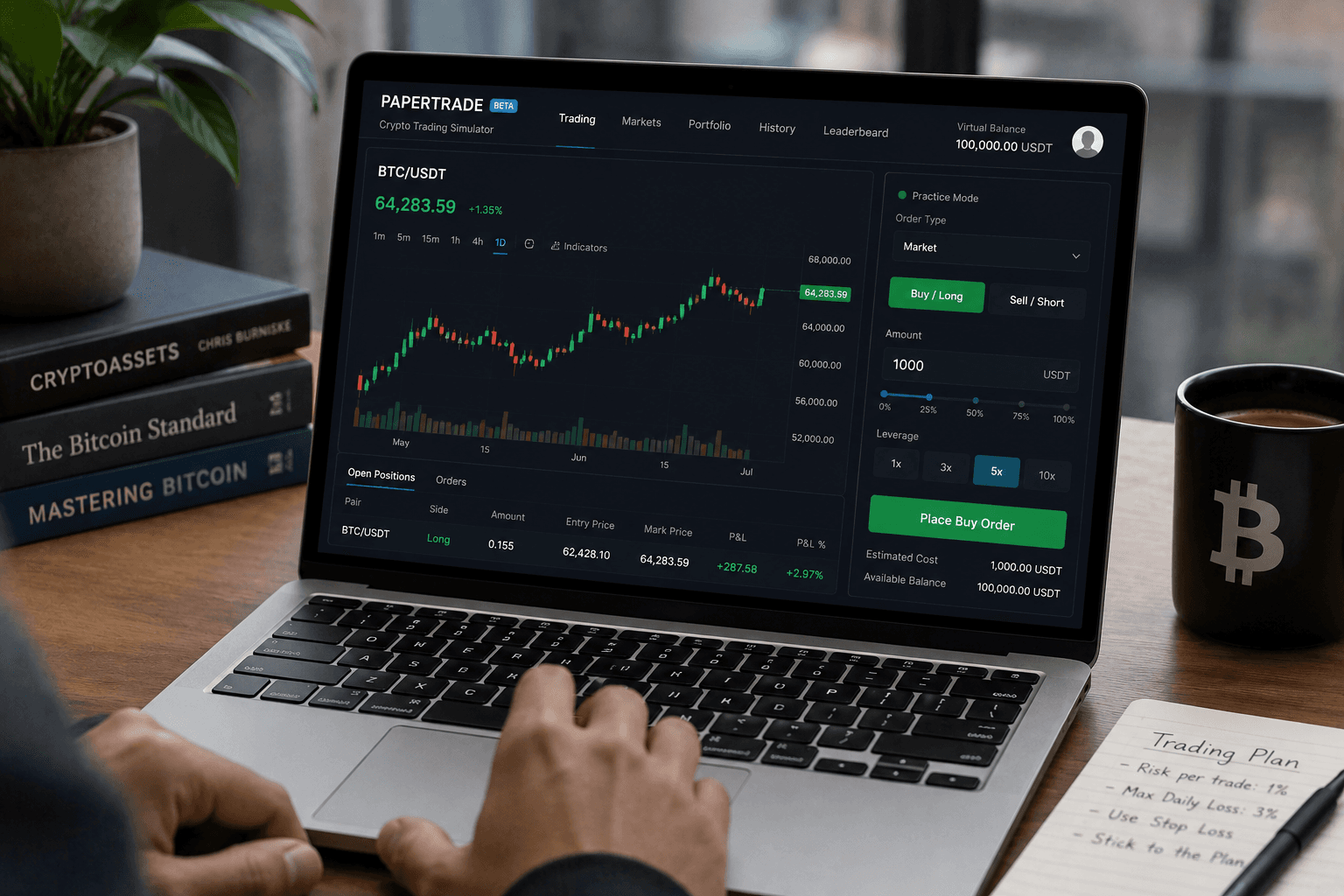
PaperTrade is a crypto trading simulator that allows users to practice trading using virtual funds instead of real money. It recreates real market conditions so traders can learn how buying, selling, leverage, and price movement work without financial risk.
The platform is especially useful for beginners who want to understand market behavior before entering live crypto markets.
- Trade with virtual money
- Practice in real market conditions
- Test strategies safely
- Learn risk management
2. How Paper Trading Works
Paper trading platforms mirror real crypto market prices while giving users simulated balances instead of actual capital.
For Example:
A beginner using PaperTrade might receive $10,000 in virtual funds and decide to buy 0.1 BTC at $60,000 because they expect the market to rise after positive crypto news. If Bitcoin later climbs to $64,000, the trader earns a simulated profit and learns how market momentum works in real conditions. On the other hand, if BTC drops to $57,000, the portfolio reflects a virtual loss, helping the user understand volatility, risk management, and emotional decision-making — all without losing any real money.
- Real-Time Market Prices: Users can trade using live crypto market data that reflects actual BTC, ETH, and altcoin price movements in real time, helping them experience realistic market volatility and trading conditions.
- Simulated Portfolio Balances: The platform provides virtual funds and automatically tracks account balance, open positions, and portfolio value just like a real crypto exchange trading dashboard.
- Virtual Profits and Losses: Every trade generates simulated gains or losses based on real market performance, allowing users to measure strategy effectiveness without risking actual capital.
- Safe Learning Environment: Beginners can experiment with different trading strategies, leverage levels, and risk management techniques in a completely risk-free environment before moving to live trading.
3. Why Beginners Use PaperTrade
Most beginner traders struggle because crypto markets are highly volatile. Sudden price swings can quickly lead to emotional decisions and financial losses.
PaperTrade provides a risk-free environment where users can understand how markets react to news, momentum, support levels, and trading volume before investing real capital.
| Feature | Real Trading | PaperTrade |
|---|---|---|
| Capital Risk | Real money at risk | No real financial loss |
| Learning Environment | High pressure | Stress-free practice |
| Strategy Testing | Risky experimentation | Safe experimentation |
| Confidence Building | Slow & costly | Faster learning curve |
4. Key Benefits of Paper Trading
-
Risk-Free Learning: Users can make mistakes without losing real funds.
Example: A beginner can test leveraged BTC trades without worrying about liquidation losses. -
Market Understanding: Traders learn how volatility, liquidity, and trends impact prices.
Example: Users can observe how Bitcoin reacts during major economic announcements or market crashes. -
Strategy Testing: Traders can evaluate different approaches before using real capital.
Example: A user can test scalping, swing trading, or breakout strategies to see which performs better. -
Confidence Building: Repeated practice helps reduce fear and hesitation.
Example: After weeks of simulated trading, a user may feel more prepared to trade small real positions. -
Portfolio Tracking: Traders can monitor virtual profits, losses, and trade history.
Example: A user can review why certain trades succeeded while others failed and improve decision-making. -
Learning Order Types: Traders understand market orders, limit orders, and stop losses.
Example: A beginner can place a stop-loss order below BTC support levels to learn how risk protection works.
5. Practicing Trading Strategies
One of the biggest advantages of PaperTrade is the ability to test different trading strategies without financial pressure.
For example, traders can practice:
- Scalping: Taking multiple small trades throughout the day.
- Swing Trading: Holding positions for several days based on market trends.
- Breakout Trading: Entering trades when price breaks key resistance levels.
- Trend Following: Trading in the direction of overall market momentum.
By reviewing trade history and performance metrics, users can identify which strategies are profitable and which need improvement.
6. Risk Management & Psychology
Successful trading is not only about finding winning trades — it is also about controlling risk and emotions.
PaperTrade helps users understand important risk management concepts such as:
- Position sizing
- Stop-loss placement
- Risk-to-reward ratios
- Avoiding emotional trading
For example, many new traders panic during sudden price drops and sell too early. Practicing in a simulated environment allows users to experience volatility without emotional financial pressure.
Over time, this can improve discipline, patience, and long-term trading consistency.
7. Limitations of Paper Trading
Although paper trading in crypto is one of the best ways to learn market behavior, it still cannot fully replicate the experience of live trading with real money. A trading simulator helps users practice strategies and understand price movement, but real markets introduce emotional and psychological pressures that are difficult to simulate.
The biggest difference is trading psychology. When actual capital is at risk, traders often react emotionally due to fear, greed, panic selling, or overconfidence. A strategy that feels easy during paper trading may become much harder to execute consistently in real crypto market conditions.
Live crypto trading also involves additional market factors such as slippage, liquidity shortages, spread widening, funding fees, and execution delays. During periods of high volatility, orders may not always execute at the expected price, especially in fast-moving BTC or altcoin markets.
Example: A trader may earn consistent virtual profits during paper trading by scalping Bitcoin in calm market conditions. However, during a real market crash or sudden volatility spike, emotional decision-making and slippage could turn the same strategy into a losing trade.
This is why experienced traders view PaperTrade as educational tools rather than guaranteed profit systems. The primary goal is to build market knowledge, discipline, and confidence before transitioning into live crypto trading with real funds.
8. Future of Trading Simulators
As crypto adoption continues to grow globally, educational trading platforms are becoming increasingly important.
Modern trading simulators are evolving beyond simple practice tools and now include advanced analytics, leaderboard systems, AI-driven insights, and social trading features.
Global Crypto User Growth & Trading Education Demand (Estimated Trend-Based Data)
2024: ~420 Million Global Crypto Users
2025: ~560 Million Global Crypto Users
2026: Increased Demand for Crypto Trading Education & Simulators
2027: Widespread Adoption of AI-Based Trading Simulators (Projected)
As more retail users enter crypto markets, platforms like PaperTrade may become an essential first step before live investing.
Sources: Global crypto adoption estimates from industry reports (e.g., Consensys Web3 Survey, exchange user growth reports, and market analytics platforms). 2026–2027 values are forward-looking projections based on current adoption trends.
9. Final Verdict
PaperTrade offers a practical and safe way for beginners to learn crypto trading without risking real money.
By simulating real market conditions, it helps users understand trading mechanics, test strategies, and build confidence before entering live markets.
While paper trading cannot fully replicate the emotions of real investing, it remains one of the smartest tools for developing trading skills and reducing beginner mistakes.
After practicing with virtual funds, If you want to experience how crypto trading works, you can explore Crypto Bubble Chart to analyze real market trends.
Frequently Asked Questions (FAQ)
What is PaperTrade?
PaperTrade is a crypto trading simulator that allows users to practice trading with virtual money.
Is paper trading safe?
Yes, because no real funds are used during trading simulations.
Can beginners learn crypto trading through PaperTrade?
Yes, it is specifically designed to help beginners understand market behavior and trading strategies.
Does paper trading guarantee real profits later?
No, it is a learning tool and real market emotions can still impact live trading performance.
Why do traders use paper trading?
Traders use it to practice strategies, improve discipline, and gain confidence before risking real capital.