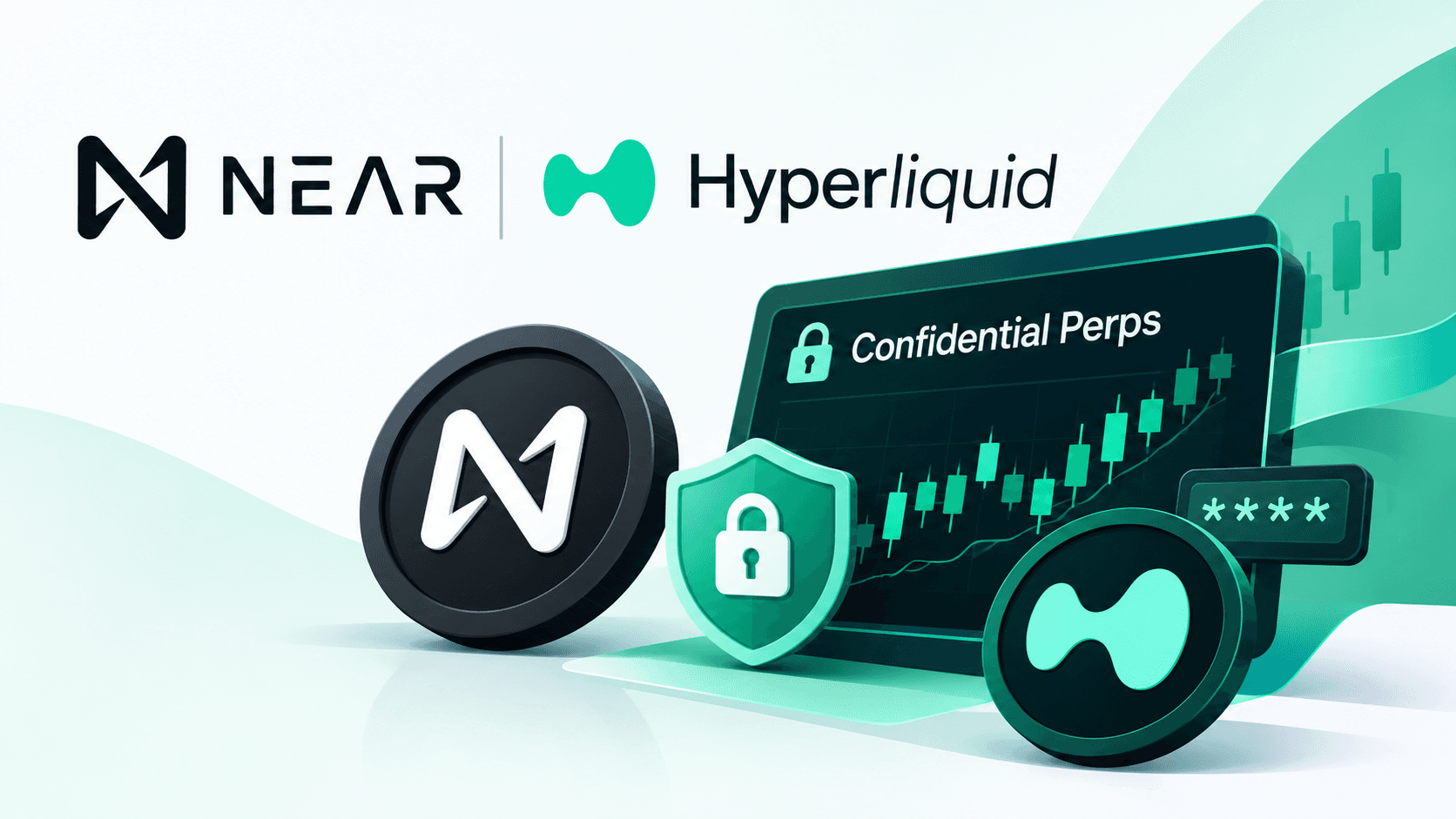
NEAR has introduced confidential-by-default perpetual futures trading through near.com, using a direct integration with Hyperliquid. The product allows traders to fund positions with assets from supported chains while separating the trader’s identity and funding trail from the publicly visible position.
Summary
- NEAR’s near.com now offers Hyperliquid perpetuals with confidentiality enabled by default.
- Users can fund positions using supported assets from more than 30 chains through NEAR Intents.
- The product page advertises more than 50 perpetual markets and leverage of up to 40x.
- The position itself remains visible on the order book; the confidential element is the link between the position, the trader and the deposit.
- Perpetual trading is unavailable to U.S. persons and users in other restricted jurisdictions.
What did NEAR launch?
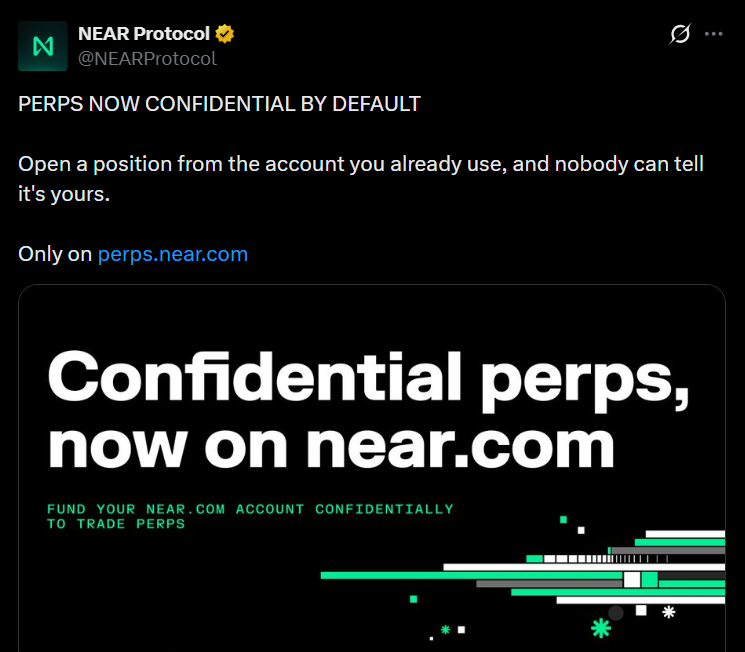
NEAR launched confidential perpetuals on near.com, allowing users to open Hyperliquid positions from their existing near.com account without publicly linking the position to the trader’s identity.
 Source: Official NEAR Protocol announcement
NEAR Protocol announced the change on September 17, stating that users could open a position from the account they already use and that other users would not be able to identify the trader behind it. The announcement links to the near.com perpetuals interface.
How Do NEAR Confidential Perpetuals Work on Hyperliquid?
Near.com provides the account and funding experience, NEAR Intents routes supported cross-chain assets, and Hyperliquid provides the perpetual-market infrastructure. The workflow below describes the user-facing process; the exact assets, markets, fees, quotes and availability may vary by account, jurisdiction and market conditions.
Step-by-Step: Funding a Perpetual Position Through NEAR Intents
-
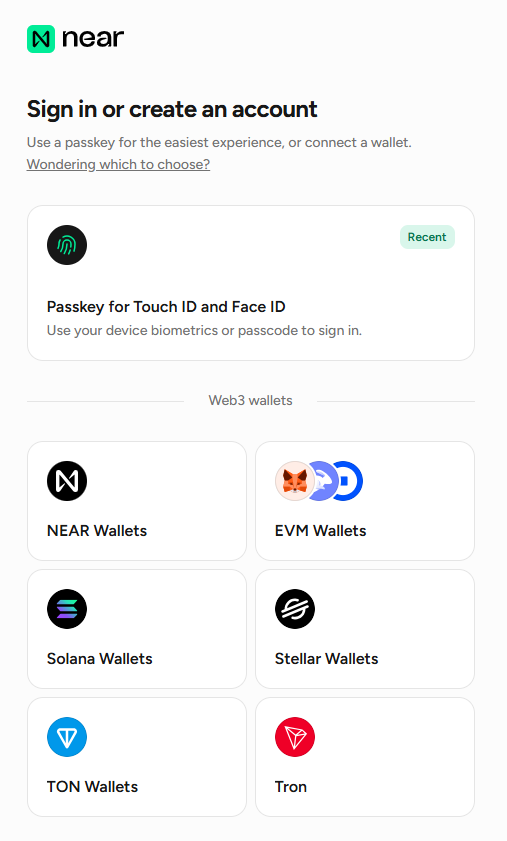
Connect a wallet or passkey. Open the near.com interface and choose the available wallet or passkey sign-in option.
 Source: NEAR.com Passkey or Wallet Configuration
-
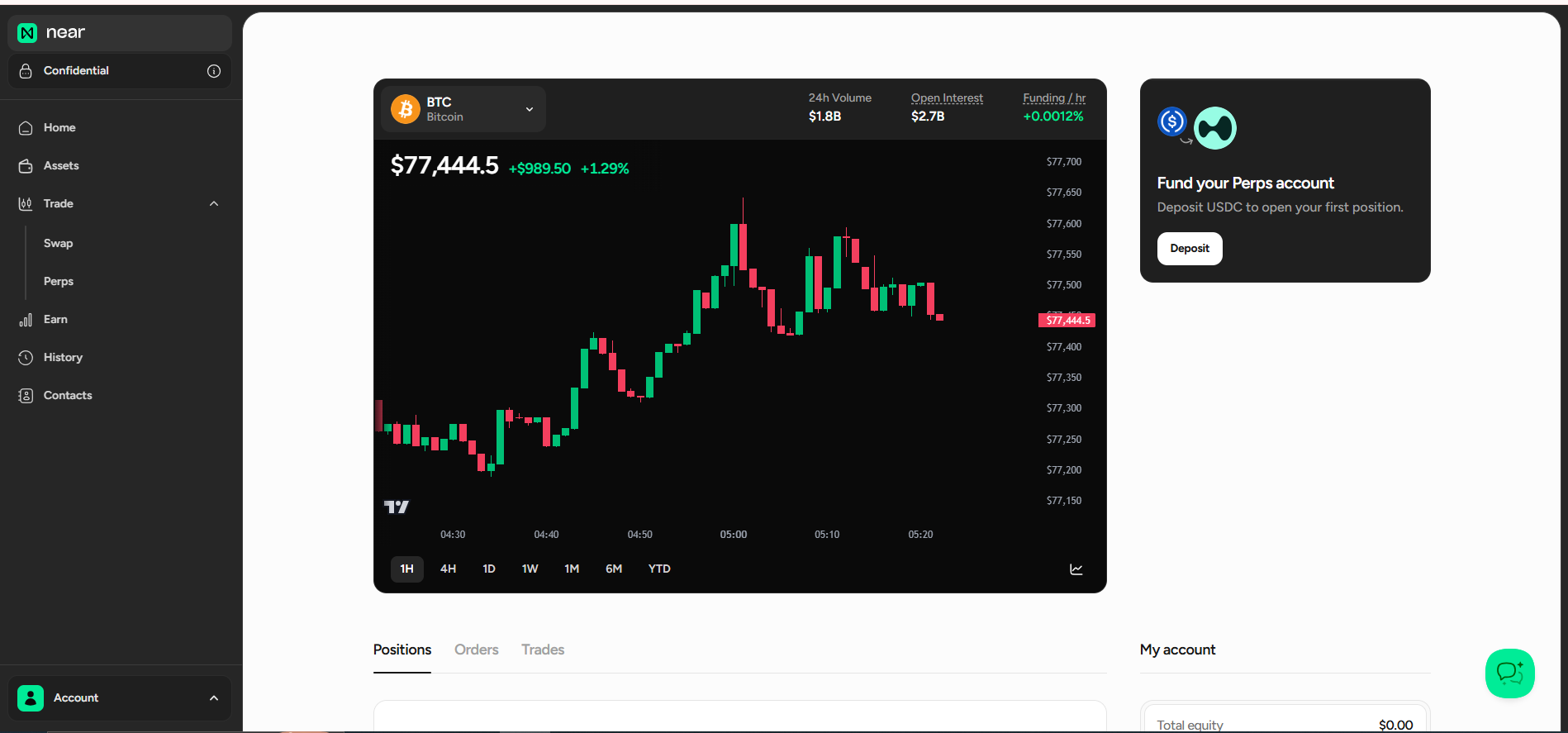
Open the perpetuals interface. Select the perpetual market you want to review, then check the displayed margin currency, leverage settings, available balance and risk information before placing an order.
 Source: Near Protocol Perps
-
Select the funding asset. Choose an asset and network supported by the interface. Before confirming, review the quoted exchange rate, estimated amount received, network details and any displayed maximum-slippage setting.
-
Submit the cross-chain intent. NEAR Intents can coordinate the requested asset conversion across supported networks by allowing market makers or solvers to compete to fulfill the requested outcome. The user should confirm only after checking the final quote and minimum amount received.
-
Confirm the transaction. Approve the required wallet or passkey action. The transaction then proceeds according to the route and settlement information shown in the interface.
-
Verify the margin balance before trading. Confirm that the converted asset has arrived in the account and that the perpetual order form reflects the available margin. Do not assume that submitting a cross-chain swap automatically opens a perpetual position.
-
Review the position after execution. Check entry price, mark price, leverage, unrealized profit or loss, margin, liquidation information and any funding or trading charges shown in the interface.
Important: The screenshots show the near.com interface and navigation context. They do not prove that every displayed asset, perpetual market, leverage level or cross-chain route is available to every user at all times.
How Do Fees and Slippage Compare With Standard Hyperliquid Trading?
A direct trade on Hyperliquid generally begins with an asset that is already deposited and available in the relevant trading account. Funding through near.com may add a cross-chain routing and conversion step, so the user should evaluate the complete quoted outcome rather than comparing only the visible trading fee.
| Cost or execution factor | NEAR Intents route through near.com | Standard Hyperliquid trade |
|---|---|---|
| Asset conversion | May be required when the supplied asset or network differs from the asset needed for the account or market. | Usually begins with an asset already deposited and available for the selected trading environment. |
| Cross-chain costs | May include network costs or route-specific execution costs shown in the quote. | Does not require a separate cross-chain route when the funds are already on the required network. |
| Solver or route execution | The final received amount depends on the route and quote returned by the participating liquidity providers or solvers. | Execution takes place through Hyperliquid’s own trading interface and order-book environment. |
| Slippage | Review the quoted exchange rate, maximum-slippage setting and minimum amount received before confirming the intent. | Review the order-book depth, order type, estimated fill price and price impact before submitting the order. |
| Perpetual trading fee | After funding, the perpetual position remains subject to the applicable perpetual-market trading charges displayed by the interface. | Subject to the applicable Hyperliquid trading-fee schedule and the selected order’s execution conditions. |
The available product materials do not establish one universal fee or slippage figure for every NEAR Intents route. Fees and execution outcomes can depend on the asset pair, network, liquidity, order size, route and market conditions. The displayed quote is therefore the relevant figure to review before confirmation.
How Does Liquidation Compare With Standard Hyperliquid Trading?
The main liquidation difference is the additional funding step, not a separate promise of protection. Once a perpetual position is open, the position remains exposed to leverage, margin requirements, mark-price movements, funding and the liquidation rules applied by the trading venue.
| Stage | NEAR Intents route before trading | Standard Hyperliquid trading |
|---|---|---|
| Before the position opens | The user faces cross-chain execution, conversion and quote risks. A failed or incomplete route should be checked before placing a perpetual order. | The user primarily checks the deposited balance, market conditions, order execution and margin settings. |
| After margin is available | The resulting collateral is subject to the selected account and perpetual-market margin rules. | The deposited collateral is subject to the selected account and perpetual-market margin rules. |
| When the market moves against the position | Leverage and unrealized losses can reduce available margin and increase liquidation risk in the same way as other leveraged positions. | Leverage and unrealized losses can reduce available margin and increase liquidation risk. |
| During a cross-chain delay | Funds that have not arrived or settled should not be treated as available margin. The user must rely on the balance and status shown in the interface. | There is no additional cross-chain settlement step after funds are already available in the trading account. |
Liquidation warning: Leverage can magnify losses. A cross-chain funding route does not remove liquidation risk, guarantee execution at a quoted price, or protect a perpetual position from adverse market movements.
Near.com’s product materials state that its perpetuals interface supports more than 50 markets and leverage of up to 40x, while also warning that leveraged trading can cause substantial losses. The available public materials do not establish that every market or leverage level is available to every user, so traders should rely on the parameters displayed for their own account and selected market.
What exactly is confidential?
The trader’s identity and the deposit used to open the position are designed not to be publicly traceable to the position. The position itself is still visible on the order book.
Key distinction: This is identity and funding confidentiality, not an invisible order book.
NEAR’s own frequently asked questions make this distinction explicit. Positions remain visible on the order book, as they are on other perpetual venues. What changes is that the deposit opening the position is not tied publicly to the trader’s identity.
| Feature | near.com confidential perps | Direct Hyperliquid trading |
|---|---|---|
| Perpetual-market infrastructure | Provided through a direct Hyperliquid integration | Provided by Hyperliquid |
| Funding experience | Fund with eligible assets from supported chains through NEAR Intents | Uses the direct Hyperliquid account and funding process |
| Order-book visibility | Positions remain visible | Orders, trades and liquidations are publicly verifiable on Hyperliquid |
| Identity linkage | NEAR says the funding deposit is not publicly tied to the trader | Depends on how the user’s account and wallet activity are identified |
| Leverage and markets | More than 50 markets and up to 40x leverage, according to near.com | Market availability and leverage depend on Hyperliquid’s interface and rules |
Why does the integration matter?
The recent integration combines Hyperliquid’s high-performance onchain derivatives infrastructure with NEAR’s cross-chain funding and confidentiality layers. This creates a secure environment where traders can execute high-speed trades without exposing their personal wallet identities.
- Hyperliquid’s Layer-1 Backbone: All orders, cancellations, trades, and liquidations happen entirely onchain. This ensures complete transparency and verifiable execution for perpetual futures and spot trading.
- NEAR’s Confidentiality Layer: It masks the public link between a trader’s identity, their funding assets, and their active positions. This protects trading strategies from being copied or tracked.
- Cross-Chain Funding Liquidity: Traders can seamlessly fund their accounts across different networks. This eliminates the friction of moving assets between separate blockchains.
- Pseudonymous Public Order Books: Individual trading positions remain visible to ensure market health and auditability. However, the real-world identity of the trader remains strictly private.
Who can use NEAR’s confidential perpetuals?
The service is not available to U.S. persons or users in other restricted jurisdictions.
- Users need an eligible wallet or passkey account.
- Funding can come from supported assets and chains available through NEAR Intents.
- Leverage increases both potential gains and potential losses.
- Access restrictions apply based on jurisdiction and the platform’s terms.
What should traders understand before using the product?
Confidentiality does not remove trading, liquidation, smart-contract, counterparty or regulatory risks.
Risk warning: A perpetual contract has no expiry date, but leveraged positions can be liquidated when losses reduce available margin. Confidential funding also does not make the position risk-free or invisible to the market.
The verified product information supports a precise conclusion: NEAR is offering a more private access route to Hyperliquid perpetuals, not a fully private perpetuals order book. The position remains observable, while the link between the trader, the deposit and the position is designed to remain confidential.
Frequently Asked Questions (FAQs)
Q: Are NEAR’s perpetual positions completely private?
A: No. NEAR says positions remain visible on the order book. The confidential element is the public link between the position, the trader and the deposit used to open it.
Q: Which protocol powers the perpetual markets?
A: The near.com product page identifies Hyperliquid as the direct perpetual-markets integration.
Q: How many markets and how much leverage are available?
A: NEAR’s product page advertises more than 50 perpetual markets and leverage of up to 40x. Availability can vary by market and user jurisdiction.
Q: Can users fund positions from another blockchain?
A: NEAR says users can fund positions with eligible assets from supported chains through NEAR Intents, which can route and convert assets into the required margin currency.
Q: Can U.S. residents use the service?
A: The official near.com perpetuals page says the service is unavailable to U.S. persons and users in other restricted jurisdictions.
Disclaimer: The information provided on this blog is for informational and educational purposes only and does not constitute financial, investment, legal, or tax advice.