



Last Updated: 17 August 2026
Summary:
- The FCA banned the sale, marketing and distribution of crypto derivatives (including perpetual futures, CFDs, options and ETNs) to retail consumers from 6 January 2021, and confirms the ban remains in place in 2026.
- The ban targets firms acting in or from the UK, not the individual consumer — trading on an offshore platform is not a criminal offence for the trader, but UK-regulated platforms must not serve you, and you get no FCA/FSCS protection.
- Professional clients are the exception. Individuals who meet the FCA's elective professional client criteria (portfolio over €500,000, significant transaction history, or relevant professional experience) can access crypto derivatives.
- August 2026 landmark: Coinbase, holding an FCA MiFID investment services licence granted on 7 July 2026, opened over 170 derivatives contracts to professional investors in the UK — including perpetual futures with up to 50x leverage.
- Warning: the FCA states that any firm offering crypto derivatives to retail consumers is "likely to be a scam". The FCA Warning List and Firm Checker exist for exactly this reason.
What did the FCA ban in 2021, and why?
On 6 October 2020 the FCA published final rules PS20/10 banning the sale, marketing and distribution of any derivatives (CFDs, options and futures) and exchange-traded notes that reference unregulated transferable cryptoassets to retail consumers, effective 6 January 2021.
The ban applies to firms acting in or from the UK. That means any UK-authorised exchange, broker or firm — and any foreign firm with a UK place of business — is prohibited from offering these products to anyone classified as a retail consumer. The FCA estimated the ban would save retail consumers around £53 million a year.
"Significant price volatility, combined with the inherent difficulties of valuing cryptoassets reliably, places retail consumers at a high risk of suffering losses from trading crypto-derivatives. We have evidence of this happening on a significant scale. The ban provides an appropriate level of protection". By Sheldon Mills, interim Executive Director of Strategy & Competition at the FCA (October 2020)
The FCA cited five specific harms when it made the rules:
- No reliable basis for valuation of the underlying unregulated transferable cryptoassets (such as Bitcoin, Ether or Ripple).
- Prevalence of market abuse and financial crime in the secondary market, including cyber theft.
- Extreme volatility in cryptoasset price movements.
- Inadequate understanding of cryptoassets by retail consumers.
- No legitimate investment need for retail consumers to hold these products.
Is it illegal for me, as an individual UK resident, to trade crypto perps?
Trading crypto perpetual futures is not a criminal offence for an individual UK resident. The FCA's ban restricts firms that sell, market or distribute these products to retail consumers from within the UK, it does not criminalise the retail customer who trades on an offshore platform.
This distinction matters more than most people realise. Here is where the boundary actually sits:
- The firm's side: A UK-regulated firm that sells crypto derivatives to a retail client breaches FCA rules and faces enforcement. A foreign firm actively marketing these products into the UK without authorisation may also be in breach of UK law.
- The trader's side: A UK retail individual placing a perp trade on an offshore exchange is not committing an offence under the current regime. The trade is, however, unprotected, no FSCS compensation, no Financial Ombudsman Service recourse, and no FCA dispute resolution if the platform fails, freezes withdrawals or turns out to be fraudulent.
- The practical reality: Because UK-regulated platforms cannot serve retail derivatives customers, offshore venues became the main route for individual traders. The FCA's response to this gap is blunt: "As the sale of derivatives and ETNs that reference certain types of cryptoassets to retail consumers is now banned, any firm offering these services to retail consumers is likely to be a scam."
What changed in the UK crypto regulatory landscape between 2024 and 2026?
The UK has moved from a pure ban and AML enforcement posture to a full regulatory framework, this ban was lifted on 8 October 2025, Parliament passed the Cryptoassets Regulations 2026 in February 2026, the FCA finalised the complete rulebook in June 2026, and a licensed UK exchange began offering perpetual futures to professional clients in August 2026. The derivatives ban on retail consumers, however, remains untouched.
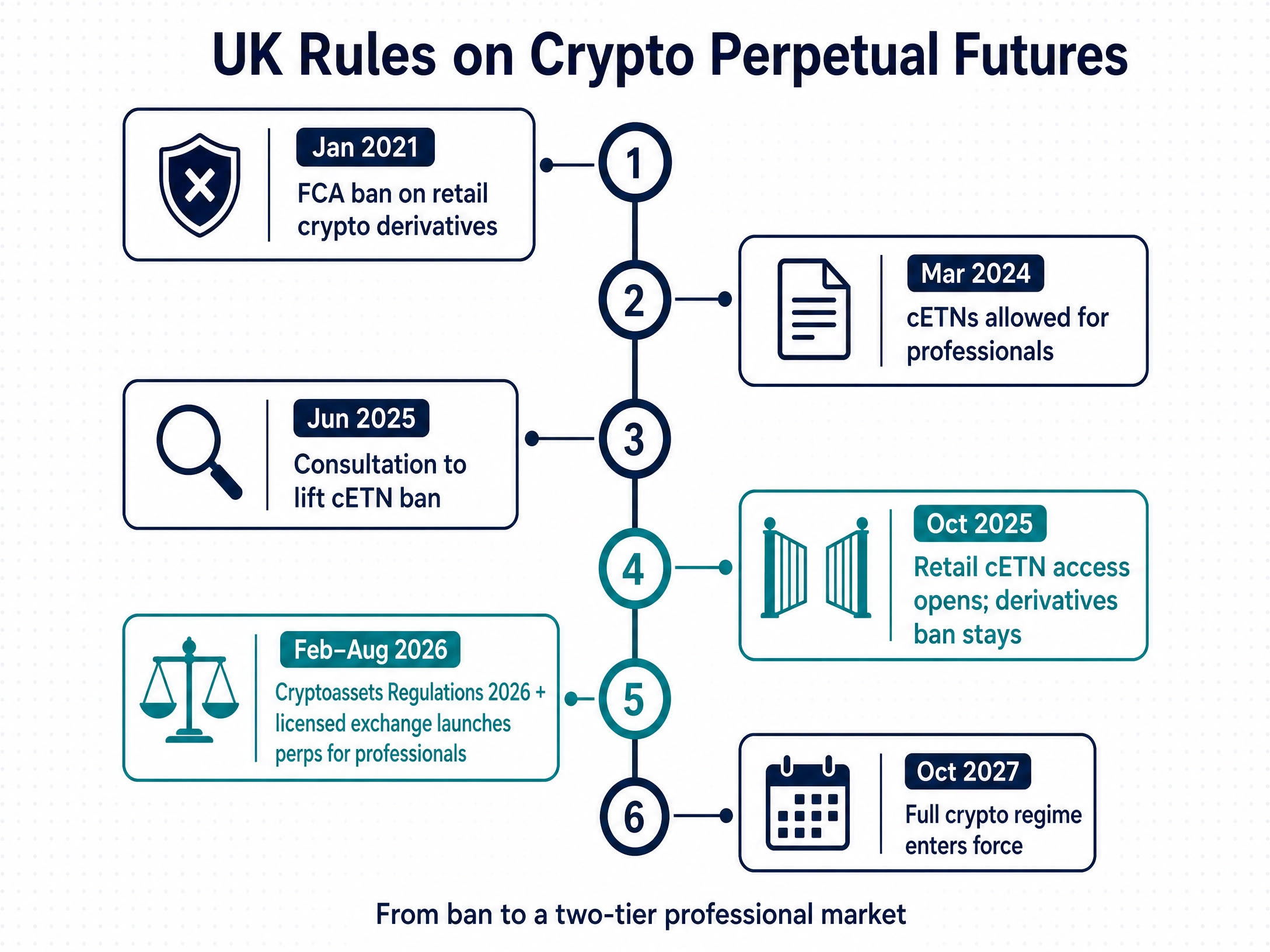 Source: FCA Official News
Who qualifies as a Professional Client under FCA rules?
Under the FCA's COBS 3 client categorisation rules, only professional clients can trade crypto derivatives in the UK. An individual can qualify as an "elective professional" by meeting at least two of three criteria and passing a knowledge assessment, the most commonly cited route is holding a financial instrument portfolio above €500,000.
| Criterion | Requirement | What counts / doesn't count |
|---|---|---|
| 1. Significant transaction history | 10+ leveraged derivative/structured product trades per quarter, for the last 4 quarters | Each trade must be £10,000+ (stocks/crypto) or £40,000+ (debt/index/commodity). Activity must be consistent across quarters, not concentrated in one. |
| 2. Portfolio size | Financial instrument portfolio above €500,000 | Counts: cash, stocks, bonds, SIPPs, ISAs. Does not count: property, commodities, direct crypto holdings. |
| 3. Professional experience | 1+ year in a financial sector role requiring knowledge of leveraged instruments | Requires employer confirmation of role, responsibilities and length of employment. |
Firms must also run a qualitative assessment of your knowledge and experience before confirming the classification. And there is a trade-off you should not underestimate: professional clients give up the retail protection package, including access to the Financial Ombudsman Service and negative balance protection that retail CFD clients on other asset classes receive.
Can I still trade crypto perps through UK-regulated platforms in 2026?
Yes, but only if you are classified as a professional client. In August 2026 Coinbase became the first major licensed exchange to offer UK-regulated perpetual futures, a move made possible by the MiFID investment services licence the FCA granted it on 7 July 2026.
The rollout includes more than 170 derivatives contracts spanning crypto, commodities, equities and foreign exchange. Perpetual contracts carry no expiry date, trade around the clock, and go up to 50x leverage, while dated futures cap out at 20x and crypto options are limited to crypto underlyings. Access is progressive and requires completing the platform's eligibility checks and being classified as a professional client first.
The 2026 Coinbase development is significant not because it "legalised" retail perp trading — it did not. It signals the UK is building a two-tier market: professionals can access regulated crypto derivatives, while retail consumers remain outside the perimeter, exactly as the FCA stated in August 2025.
How are crypto perpetual futures profits taxed in the UK?
Unlike buying and selling crypto tokens directly (which falls under HMRC's capital gains rules for cryptoassets), perpetual futures are derivative contracts, and HMRC treats profits on futures and CFDs as capital gains in most cases, unless your trading pattern looks like a trade, in which case profits become trading income.
HMRC's Capital Gains Manual states that retail contracts for differences are financial futures and, "unless the profits are taxable as trading income, in almost every case TCGA92/S143 charges the outcomes under the capital gains regime." HMRC guidance SP03/02 sets out when profits count as trading income instead a frequent, speculative, short-lived positions can push you over that line.
| Aspect | Spot crypto (buying tokens) | Perpetual futures / CFDs |
|---|---|---|
| Governing framework | HMRC Cryptoassets Manual (CGT on token disposals) | Capital Gains Manual CG56100 (financial futures) / trading income via SP03/02 |
| Default tax treatment | Capital Gains Tax on disposals | Capital Gains Tax in most cases; trading income if activity amounts to "badges of trade" |
| Loss treatment | Capital losses pool with other CGT losses | CGT losses follow derivative rules; trading losses follow income tax rules |
| Annual exempt amount | £3,000 (2024/25, frozen at 2025/26 and 2026/27) | Same allowance applies if taxed under CGT |
| Rates | 18% basic rate / 24% higher rate (since 30 October 2024, for non-property assets) | Same CGT rates if charged under the capital gains regime |
| Reporting | Self Assessment; dedicated cryptoasset section from tax year 2024/25 | Self Assessment (CGT pages, or trading income pages) |
What happens when the full crypto regime launches in October 2027?
From 25 October 2027 the Financial Services and Markets Act 2000 (Cryptoassets) Regulations 2026 will bring a broad range of cryptoasset activities into the FCA perimeter, including regulated Qualifying Cryptoasset Trading Platforms (QCATPs), custody rules, lending and borrowing, and staking.
The FCA published the full rulebook on 30 June 2026: five policy statements (PS26/9 on admissions, disclosures and market abuse; PS26/10 on stablecoin issuance; PS26/11 on regulated cryptoasset activities; PS26/12 on prudential requirements; PS26/13 on applying the FCA Handbook), three pieces of finalised guidance and two guidance consultations. Nothing in the 2026 package reverses the retail derivatives ban, PS26/11 governs how authorised trading platforms must conduct themselves, not what retail consumers may buy.
Whether the regime eventually opens the door to regulated retail perp access is an open question. The FCA has said it will "continue to monitor market developments and consider its approach to high-risk investments", and the momentum of 2025-2026 the cETN lift, the licensed Coinbase derivatives launch, and the comprehensive 2027 rulebook suggests the regulator is rethinking the perimeter rather than standing still. Until a formal change is announced, the ban holds.
What should UK traders do next?
Direct answer: If you are a retail consumer, treat any offer of crypto perpetual futures access as high-risk and verify every firm through the FCA; if you believe you qualify as a professional client, complete the platform's formal assessment and understand exactly which protections you are giving up.
- Step 1: Determine your client category honestly, misrepresenting yourself as a professional client is not a route to legal access and voids any claim to professional competence-based protections.
- Step 2: If pursuing professional status, gather the evidence: four quarters of trade records, portfolio statements above €500,000, or employer confirmation of relevant experience, and complete the knowledge assessment.
- Step 3: Check the platform on the FCA Firm Checker and confirm which entity you would actually be trading with, including whether that entity is UK-regulated or offshore.
- Step 4: Size positions for the worst case — with leveraged perps, liquidation can arrive on a single volatile session. Low leverage (3x-5x) is the standard risk-management practice among experienced traders.
- Step 5: Keep records for HMRC from day one, and remember derivatives profits generally follow CGT or trading income rules rather than the spot-token regime.
- Step 6: Watch the policy space — the 2027 regime and any future FCA review of high-risk investments are the most likely paths to a change in retail access.
Frequently Asked Questions
Q1: Can I legally trade crypto perpetual futures in the UK as a retail investor in 2026?
A: No UK firm can lawfully sell or market crypto derivatives to retail consumers under the FCA ban effective since 6 January 2021. Trading on an offshore platform is not a criminal offence for the individual, but you would have no FCA or FSCS protection and the FCA warns such offers often come from scammers.
Q2: When did the FCA ban crypto derivatives, and does it include perpetual futures?
A: The ban was announced on 6 October 2020 (PS20/10) and took effect on 6 January 2021. It covers all derivatives referencing unregulated transferable cryptoassets — CFDs, options, futures, and by extension perpetual futures — plus ETNs.
Q3: Did the FCA lift the ban in 2025 when crypto ETNs returned for retail?
A: No. From 8 October 2025 retail consumers can buy crypto ETNs on FCA-approved UK investment exchanges, but the FCA stated explicitly that the ban on retail access to cryptoasset derivatives remains in place.
Q4: Who can legally trade crypto perpetual futures in the UK?
A: Professional clients only — either "per se" professionals (financial institutions, large corporates) or individuals who meet at least two of the COBS 3 elective professional criteria (e.g. a portfolio above €500,000 or 10+ large leveraged trades per quarter) and pass a knowledge assessment.
Disclaimer: This article is for informational and educational purposes only and does not constitute financial, investment, or legal advice. Cryptoassets and derivatives are highly volatile and involve significant risk of loss.