



As of July 10, 2026
Key Feature Comparison
Hyperliquid Strengths
- Native CLOB for derivatives
- Microsecond execution
- Maximum capital efficiency
- Lowest fees (0.015% maker)
- Proven product-market fit
Robinhood Chain Strengths
- Ethereum security inheritance
- RWA tokenization support
- AI-native architecture
- Retail user base (23M+)
- Chainlink oracle integration
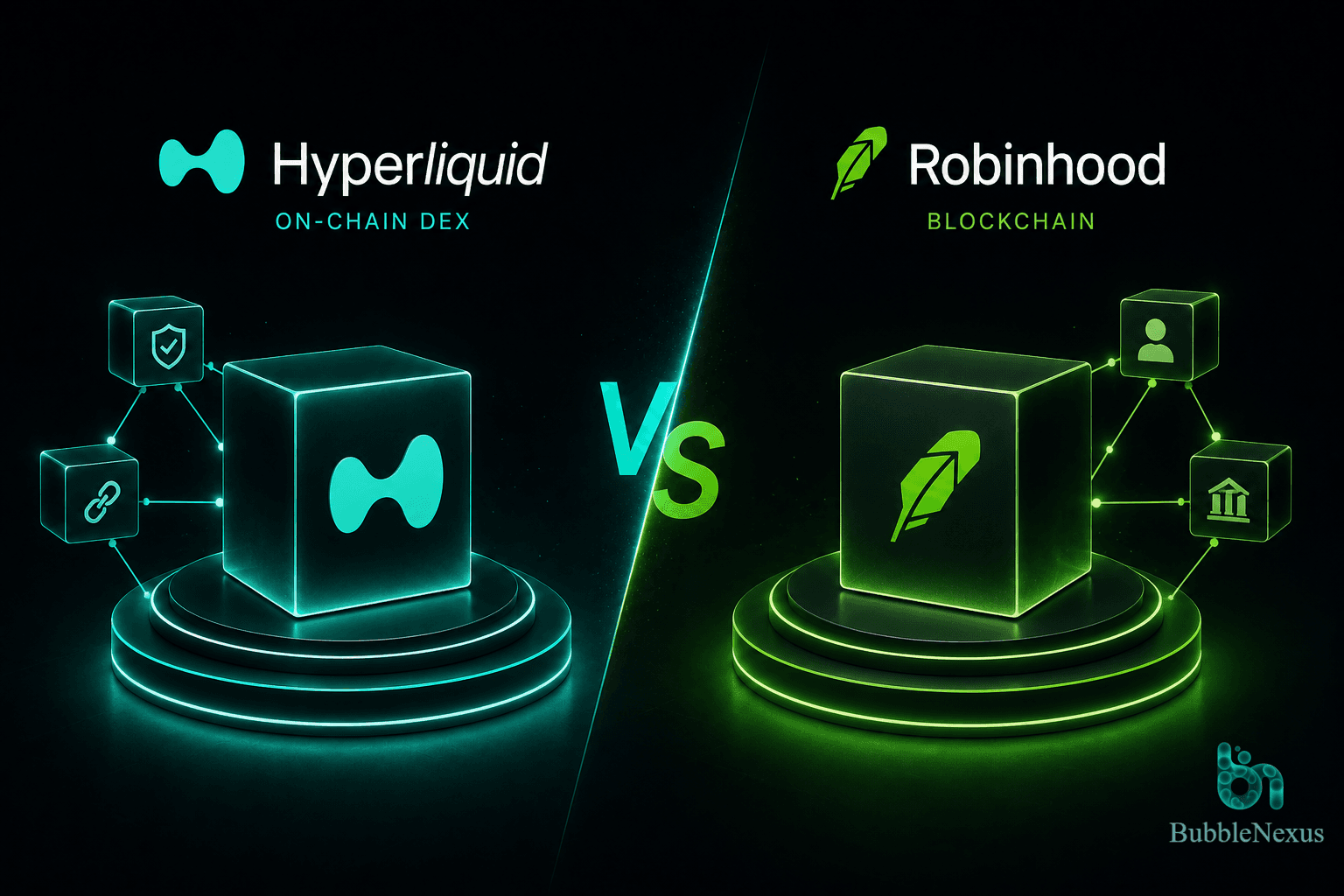
Both platforms launched with strong momentum. Robinhood Chain processed 4 million testnet transactions in its opening week and exceeded $560 million in 24-hour DEX volume following its mainnet launch, while Hyperliquid commands between 32% and 44% of the decentralized perpetuals market and retained $192 million in gross profit during Q1 2026 from its 1.4 million users. The real question is not whether blockchain can compete with traditional finance, but which on-chain architecture will lead its future.
L1 vs L2: Different Approaches, Different Strengths
Hyperliquid
Hyperliquid is an independent Layer 1 blockchain built for decentralized derivatives trading. Its native on-chain order book delivers fast execution, low latency, and high capital efficiency.
Robinhood Chain
Robinhood Chain is an Ethereum Layer 2 designed to bring tokenized real-world assets on-chain. It combines Ethereum's security with lower fees and broad developer access.

Hyperliquid
Layer 1
Derivatives Focus
Robinhood Chain
Ethereum Layer 2
RWA Focus
Technical Comparison
| Specification | Hyperliquid (L1) | Robinhood Chain (L2) |
|---|---|---|
| Consensus Mechanism | Proof of Stake (HL Native) | Arbitrum Nitro (Ethereum Security) |
| Block Time | Microsecond order matching | 100 milliseconds |
| Oracle Integration | Native data feeds | Chainlink |
| Primary Use Case | Decentralized perpetuals trading | Tokenized real-world assets |
Target Audience: Traders vs. Retail Investors
Hyperliquid
Hyperliquid serves active traders with fast derivatives markets, low fees, and capital-efficient trading. Its ecosystem focuses on perpetual futures, spot trading, and trading tools.
Robinhood Chain
Robinhood Chain targets retail investors by bringing "tokenized stocks" and "real-world assets" on-chain. Its ecosystem emphasizes accessibility, AI-powered applications, and traditional financial products.
The Launch Momentum: Early Indicators
February 10, 2026: Robinhood Chain Testnet Launch
Robinhood Chain's public testnet goes live on the Arbitrum tech stack, ultimately processing over 200 million transactions during its testing phase to demonstrate its throughput capabilities.
May 2026: Hyperliquid Dominance Solidifies
Hyperliquid commands a dominant 32% to 44% market share of the decentralized perpetuals sector, with open interest in its native real-world asset (RWA) perpetual contracts peaking at $2.6 billion.
July 1, 2026: Robinhood Chain Mainnet Launch
Robinhood Chain launches its public, permissionless mainnet, introducing native tokenized Stock Tokens for equities like NVIDIA and Apple alongside a decentralized lending suite.
July 2026: The Competition Intensifies
The L2 ecosystem heats up as Robinhood Chain's daily DEX volume spikes past $560 million on July 8, propelled by retail trading frenzy. Both platforms now vie for market liquidity, with Hyperliquid leading in synthetic RWA perpetuals and Robinhood targeting spot retail investors.
Conclusion
Hyperliquid excels in decentralized derivatives, while Robinhood Chain focuses on bringing traditional financial assets on-chain. The better choice depends on your trading goals and investment needs.
Frequently Asked Questions (FAQs)
1. Is Robinhood Chain as fast as Hyperliquid?
No. Hyperliquid's native CLOB matches orders in microseconds, while Robinhood Chain has 100ms block times. For high-frequency trading, Hyperliquid is significantly faster. However, for most retail use cases, Robinhood Chain's speed is sufficient.
2. Can I trade stocks on Hyperliquid?
Currently, Hyperliquid is focused on crypto perpetuals and spot trading. Robinhood Chain is the platform for tokenized stocks and real-world assets. However, Hyperliquid has announced plans to support tokenized equities in the future.
3. Which blockchain is more secure?
Robinhood Chain inherits Ethereum's security, making it extremely secure. Hyperliquid maintains its own validator set and security model, which is also secure but relies on a smaller validator community. Both are secure, but Robinhood Chain has the advantage of Ethereum's battle-tested security.
4. What are the fees on each platform?
Hyperliquid: 0.015% maker, 0.045% taker. Robinhood Chain fees vary by application but are generally competitive with Ethereum L2s. For active traders, Hyperliquid's fees are lower.
This article is for informational purposes only and does not constitute financial, legal, or investment advice. Cryptocurrency and blockchain investments involve risk. Always do your own research before making any financial decisions.