


Summary: What This Guide Covers
- Base perpetual fees are 0.045% taker / 0.015% maker (0.07% / 0.04% on spot), charged in USDC on the full notional of each trade.
- Trading on Hyperliquid itself is gasless, but depositing USDC from Arbitrum costs Arbitrum L1 gas, and withdrawals cost a flat 1 USDC.
- Hourly funding is the recurring cost that silently drains leveraged positions — a 0.01% per-8-hours interest component plus a floating premium, capped at 4% per hour.
- A 4% referral discount (first $25M in volume) and HYPE staking discounts up to 40% can cut your effective rates by a third or more.
Most traders judge a derivatives platform by one number: the taker fee. Hyperliquid is often described as having roughly "0.05% taker / 0.02% maker" rates, and while that framing captures the ballpark, the official schedule is actually 0.045% taker and 0.015% maker on perpetuals. But the headline rate is only the surface. The real cost of trading on Hyperliquid is built from several interacting layers base fees, bridge gas, hourly funding, liquidation mechanics, and withdrawal costs and most of them only appear after you have already placed the trade.
The Base Layer: Hyperliquid Maker and Taker Fees
Hyperliquid's base rates are 0.045% taker and 0.015% maker on perpetuals, and 0.07% taker / 0.04% maker on spot all charged in USDC and assessed on the full notional value of each trade, not on your margin.
- Fees are charged on notional value, not margin. A 10x leveraged $10,000 position pays fees on the full $10,000, not on the $1,000 of collateral behind it. Leverage multiplies your fee bill exactly as it multiplies your position.
- Fees come out of your USDC balance, not your PnL. On a losing trade, your account shrinks by both the loss and the fee, which means a high-leverage scalping strategy degrades faster than the chart suggests.
- Tiers are based on a rolling 14-day weighted volume, recalculated daily in UTC. Spot volume counts double toward your tier:
(14d weighted volume) = perps volume + 2 × spot volume.
Perpetuals Fee Tiers
Fees drop in steps as your 14-day weighted volume rises. The table below shows the full official schedule at the entry tier (Base rate) and the top staking tier (Diamond) for comparison:
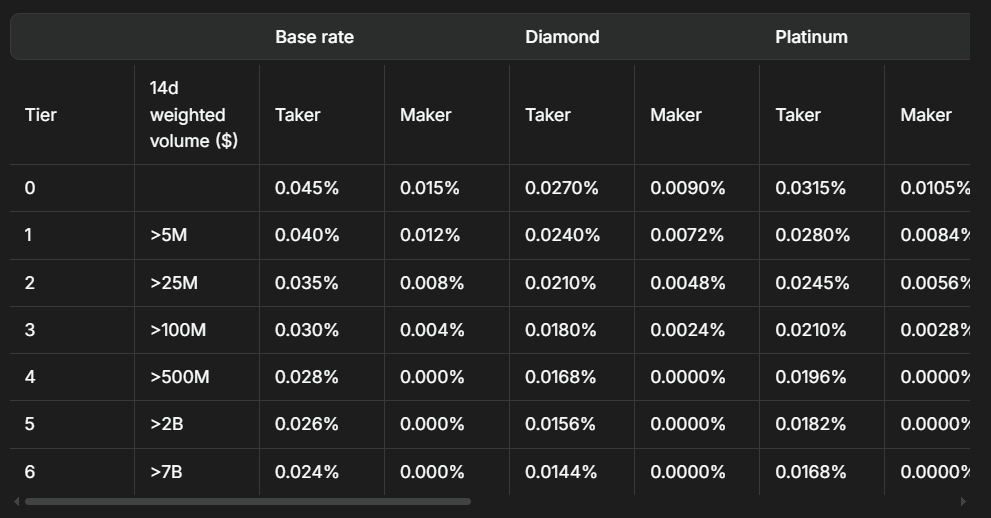 Source: Hyperliquid Fee Tiers
If you open a $1,000-margin, 10x long on BTC, your position size is $10,000. At the 0.045% base taker rate you pay $4.50 to open and roughly $4.50 to close, a round-trip cost of about 0.9% of your margin, before funding. This is why leveraged scalpers with tight profit targets bleed the most from the fee structure, even on a platform where the trades themselves carry no gas cost.
Hidden Cost #1: The HyperBridge and Arbitrum Gas Layers
Trading on Hyperliquid is completely gasless, positions are validated and settled on-chain by the protocol's own validators, so you never pay per-transaction gas to open, modify, or close a trade. But money still has to move through the HyperBridge, and those bridge hops carry small, real costs that the fee schedule never shows.
- Depositing from Arbitrum: Hyperliquid charges nothing for deposits, but the USDC transfer itself is an on-chain transaction on Arbitrum, so you pay Arbitrum L1 gas in ETH. On Arbitrum this is usually small (often well under a dollar at normal congestion), but it is a cost on every deposit and it scales with Ethereum gas prices, not Hyperliquid's rules.
- Withdrawing to Arbitrum: Costs a flat 1 USDC per withdrawal, typically settling in 3-7 minutes. There is no percentage fee and no gas charged on the Hyperliquid side (you only sign an EIP-712 message), because Hyperliquid L1 transactions are gasless for users. A 5-minute validator dispute window protects withdrawals before they finalize.
- Reaching other chains: Hyperliquid only releases funds to Arbitrum. Getting to Ethereum, Base, Solana, or other networks requires a second hop through a bridge (such as Circle's CCTP), which adds its own gas and fees on top of the 1 USDC, the second hop is almost always the more expensive leg of the off-ramp.
Why this is a hidden cost: frequent depositors and withdrawers pay it repeatedly while never seeing it in any fee table. A trader moving $10,000 in and out of Hyperliquid a few times a week can quietly spend a few dollars per week on Arbitrum gas and withdrawal fees — a percentage that becomes meaningful when your strategy's edge is measured in tenths of a percent.
Batch Your Bridge Transfers: Because deposits cost Arbitrum gas and withdrawals cost a flat 1 USDC, the cheapest bridge strategy is to move capital in larger, less frequent batches rather than many small deposits. Ten deposits of $1,000 cost ten Arbitrum gas payments; one deposit of $10,000 costs one.
Hidden Cost #2: How Hourly Funding Fees Drain Your Balance
Funding is the largest recurring cost on perpetual platforms that never appears on a fee schedule, because it is not a protocol fee at all — it is a peer-to-peer payment between long and short holders that keeps perp prices anchored to spot, and on Hyperliquid it settles every single hour.
- A fixed interest rate of 0.01% per 8 hours (equivalent to 0.00125% per hour, or about 10.95% APR) is baked into the rate, and for crypto perpetuals it flows to short holders. This reflects the cost difference between borrowing USD and holding spot crypto.
- A floating premium component is calculated from the gap between the perpetual price and the spot oracle price. When the perp trades above spot, longs pay shorts; when below, shorts pay longs.
- The rate is paid hourly at one-eighth of the computed rate, using the formula
F = Premium Index + clamp(interest rate − Premium Index, −0.05%, +0.05%). The payment equalsposition size × oracle price × funding rate, computed on the oracle price. Funding is capped at 4% per hour. - No protocol fee is collected on funding payments — the entire amount passes between the two sides of the market.
Warning: Funding Can Outweigh Your Trading Fees
On a 10x long during a parabolic run, high annualized funding premiums vastly outweigh round-trip taker fees. These hidden costs do not impact your fee tier and must be paid even on losing positions, making it vital to check the funding comparison view before holding leverage for more than a few hours.
How to Lower Your Hyperliquid Fees
Most fee comparisons stop at the base rate, but Hyperliquid offers two official mechanisms that cut it substantially, and they stack with each other. Here is how to prove to yourself what the savings look like in practice.
The 4% Referral Discount
Entering a referral code gives you a 4% discount on your fees for your first $25M in volume. The referrer earns 10% of your fees, less your discount, and referral rewards accrue on their side for their first $1B in referred volume. Two caveats from the official docs: referral discounts do not apply to vaults or sub-accounts (the clearinghouse treats those as independent accounts), and "you need to create the code after doing $10,000 in volume if you want to refer others".
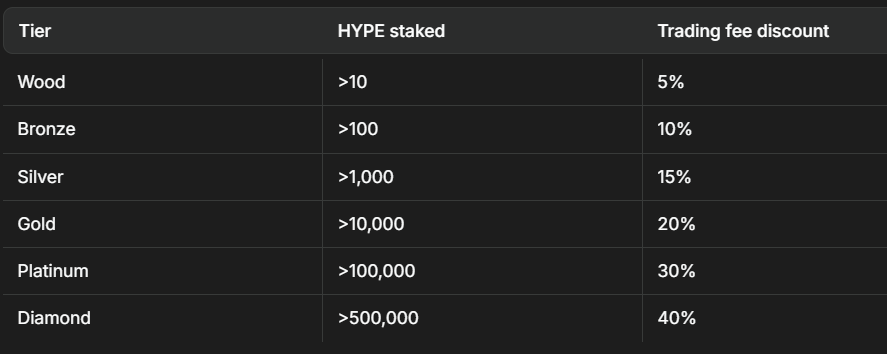
HYPE Staking Tiers
Staking HYPE, Hyperliquid's native token, applies an additional trading fee discount on top of your volume tier, across both perps and spot:
 Source: Hyperliquid Staking Tiers
What the Stack Actually Saves: Take a Tier 1 trader (above $5M in 14-day volume) with a referral code and a Gold-level HYPE stake. Their base 0.040% taker fee becomes 0.040% × (1 − 0.20) × (1 − 0.04) = 0.0307% — a 23% total reduction. Traders who set up the referral code and staking link before scaling volume pay one-third less than the headline rate on every trade, and both discounts apply across perps and spot.
The Full Cost-Cutting Checklist
Beyond the two headline discounts, these practices reduce total cost of trading based on the official mechanics:
- Use limit orders whenever possible. Maker fees (0.015% base) are one-third of taker fees, and maker rebates of up to −0.003% can turn the fee into a credit.
- Link your staking address to your trading address in the portfolio settings before you start scaling — linking is permanent, so set it up once, correctly.
- Monitor funding before holding. Hourly settlement rewards scalpers but punishes passive longs during elevated premiums; the funding comparison view shows rates across markets.
- Prefer the native Arbitrum route. Depositing and withdrawing via Arbitrum avoids the extra bridge fees of reaching other chains, and batching transfers cuts repeated Arbitrum gas payments.
- Size leverage to maintenance margin, not entry margin. Maintenance margin ranges from 1.25% (40x assets) to 16.7% (3x assets), and a backstop liquidation, while fee-free, unlike most CEXs — does not return your maintenance margin.
Quick Reference: Costs at a Glance
| Cost Component | Perps | Spot | Notes |
|---|---|---|---|
| Taker fee (Tier 0) | 0.045% | 0.070% | Charged on full notional, in USDC |
| Maker fee (Tier 0) | 0.015% | 0.040% | Rebates down to −0.003% |
| Trading gas | None | None | Validated on-chain by protocol validators |
| Deposit from Arbitrum | Free | Free | You pay small Arbitrum L1 gas in ETH |
| Withdrawal | 1 USDC flat | 1 USDC flat | 3-7 min settlement |
| Funding | Hourly | N/A | Peer-to-peer; capped at 4% per hour |
| Liquidation fee | None | N/A | Maintenance margin withheld in backstop liquidations |
| Discounts | Up to ~40%+ (when stacking referral + staking + volume tiers) | Up to ~40%+ (when stacking referral + staking + volume tiers)l | 4% referral + up to 40% HYPE staking, stacked with volume tiers |
Frequently Asked Questions
Q1: What are Hyperliquid's exact base fees?
A: 0.045% taker and 0.015% maker on perpetuals, and 0.07% taker / 0.04% maker on spot, charged in USDC on the full notional value. Fees decrease with your rolling 14-day volume.
Q2: Does Hyperliquid charge gas fees for trading?
A: No. Trades are validated and settled on-chain by Hyperliquid's validators, so positions cost no per-transaction gas. Gas only appears on the Arbitrum side when depositing or withdrawing USDC via the HyperBridge.
Q3: How much does funding cost me?
A: Funding is a peer-to-peer payment between longs and shorts, settled hourly, with a fixed interest component of 0.01% per 8 hours (flowing to shorts) plus a floating premium based on the perp-vs-spot gap. It is capped at 4% per hour and no protocol fee is collected on it.
Q4: How much can staking HYPE reduce my fees?
A: Up to 40% for traders staking more than 500,000 HYPE (Diamond tier). Combined with a 4% referral code, total discounts can exceed 40% off the base rate.
Q5: Is there a fee when my position is liquidated?
A: Hyperliquid charges no liquidation clearance fee, unlike most centralized exchanges. However, in a backstop liquidation your maintenance margin is not returned, and liquidations execute at mark price, which can differ from the book price during volatility.
Q6: How much does it cost to withdraw funds?
A: A flat 1 USDC to withdraw back to Arbitrum, with no percentage fee or Hyperliquid-side gas. Onward transfers to other chains via bridges incur their own fees.
Q7: Where do Hyperliquid's trading fees go?
A: All fees go to the community: the HLP vault, deployers of custom assets, and the assistance fund, which converts fees to HYPE and burns them permanently, removing tokens from both circulating and total supply.
Q8: Do referral discounts apply to vaults and sub-accounts?
A: No. Referral discounts apply only to the main account; vaults and sub-accounts are treated as independent accounts in the clearinghouse.
Disclaimer: This article is for informational and educational purposes only and does not constitute financial, investment, or legal advice. Cryptoassets and derivatives are highly volatile and involve significant risk of loss.