

Robinhood Chain is Robinhood's public, permissionless Layer-2 blockchain, and since its mainnet launch it has become one of the fastest-growing venues for launching new tokens. This guide explains exactly what Robinhood Chain is, what you need before you start, and how to launch a token on it in two ways: a no-code route using a token generator, and a code route using Robinhood's official deployment tooling. Every detail below is verified against Robinhood's official documentation and announcements, plus independent confirmation from Uniswap, the chain's primary decentralized exchange.
Summary — The short version
Everything you need to launch a token on Robinhood Chain, in one place.
- Robinhood Chain is a permissionless, EVM-compatible Layer 2 built with the Arbitrum platform, launched on public mainnet on July 1, 2026, and uses ETH as its gas token (Chain ID 4663).
- Anyone can deploy a token contract — no whitelist, no approval process — using either standard Ethereum tooling (Hardhat, Foundry) or a no-code token generator.
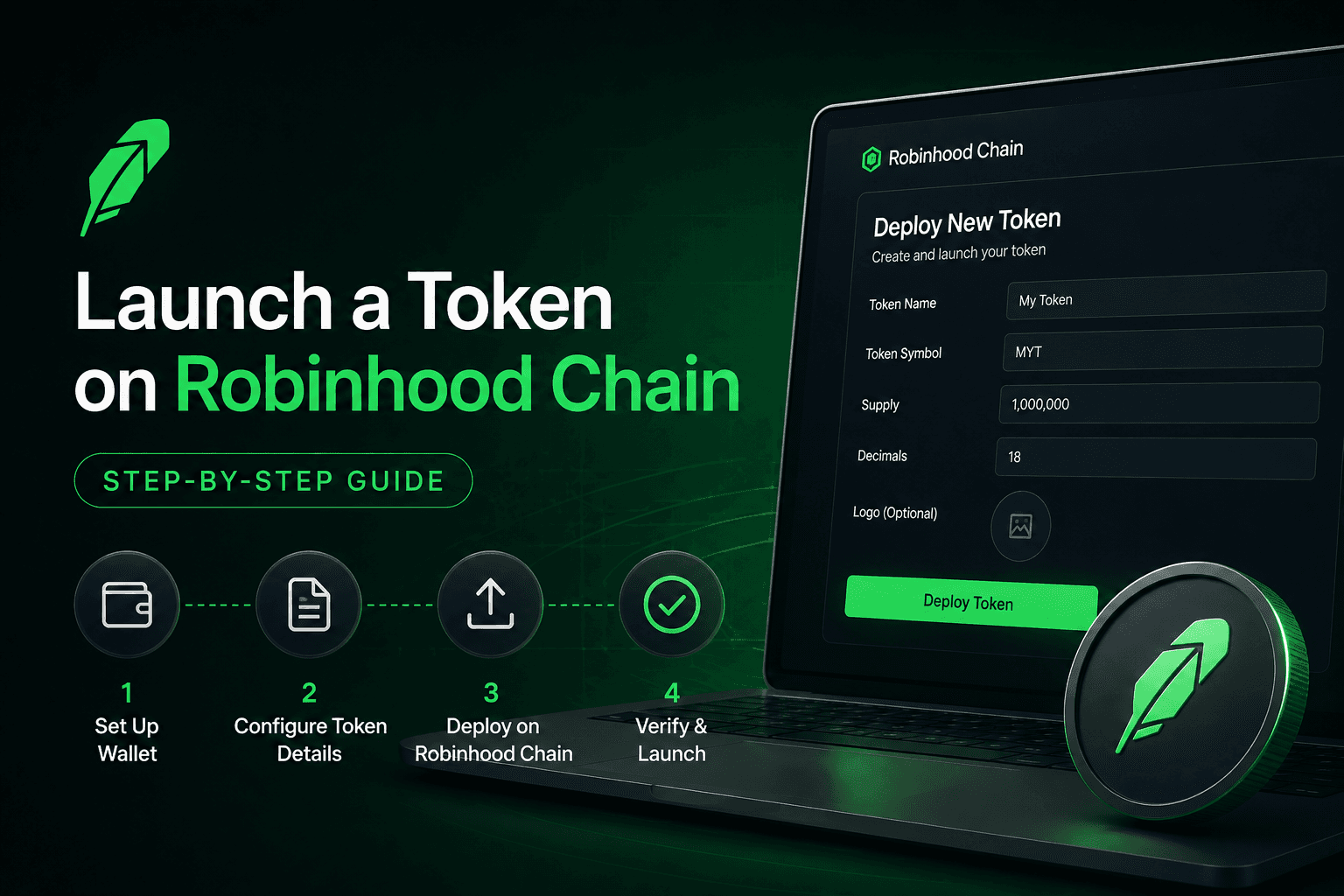
- The no-code path takes roughly four steps: connect an EVM wallet (MetaMask or Trust Wallet) on Robinhood Chain, pick a contract template, configure your token, and confirm the deployment transaction.
- Your new token is not tradeable until you add liquidity — the standard route is a Uniswap pool, since Uniswap v2, v3, v4, and UniswapX are all live on Robinhood Chain.
- Always test on the public testnet (Chain ID 46630, free faucet) before deploying with real ETH on mainnet.
What is Robinhood Chain, and why launch a token there?
Robinhood Chain is a permissionless, Ethereum-compatible Layer-2 blockchain built to bring traditional markets, crypto, and real-world assets together on one network.
- Runs on Arbitrum Dedicated Blockchains: inherits Ethereum’s security while delivering fast block times and low transaction costs.
- Strict first-come, first-served transaction ordering at the sequencer: prevents priority-gas attacks so no one can jump your transaction by paying a higher fee.
- Fully EVM-compatible: any existing Solidity ERC-20 token contract deploys without modification using the same wallets and tools you already use on Ethereum.
| Property | Mainnet | Testnet |
|---|---|---|
| Network name | Robinhood Chain | Robinhood Chain Testnet |
| Chain ID | 4663 | 46630 |
| Native gas token | ETH | ETH (no real value) |
| Public RPC | rpc.mainnet.chain.robinhood.com | rpc.testnet.chain.robinhood.com |
| Block explorer | robinhoodchain.blockscout.com | explorer.testnet.chain.robinhood.com |
| Testnet faucet | — | faucet.testnet.chain.robinhood.com |
| Launch date | July 1, 2026 | February 10, 2026 |
The Robinhood Chain ecosystem matured rapidly, launching with Uniswap as its primary liquidity protocol supporting v2, v3, v4, and UniswapX. On August 5, 2026, Uniswap Labs introduced pools.trade, a dedicated token launchpad for the network. Key verified infrastructure and DeFi partners include Chainlink, Alchemy, LayerZero, BitGo, Fireblocks, Morpho, Lighter, and Arcus.
What do I need before I can launch?
You need an EVM-compatible wallet with a small amount of ETH, plus the network configured. That is essentially the full list of prerequisites. Because Robinhood Chain is permissionless, there is no application, whitelist, or approval process, deploying a token is the same action as deploying any smart contract.
Pre-launch checklist
- MetaMask and Trust Wallet both support Robinhood Chain, Robinhood Wallet supports it natively with no manual setup.
- Robinhood Chain added to your wallet: Chain ID 4663, RPC https://rpc.mainnet.chain.robinhood.com, currency symbol ETH.
- A small amount of ETH on Robinhood Chain for gas bridge it over using the canonical Arbitrum bridge or a partner bridging route.
- Token fundamentals decided: name, symbol, total supply, and decimals.
- Optional but strongly recommended: one full test run on the testnet (Chain ID 46630) using free faucet tokens first.
Key Insight Robinhood Chain operates independently of the main Robinhood brokerage app. Your token deployment has no connection to your brokerage or crypto account balances, and the chain is not itself a Robinhood product listing, it is an open network where anyone can deploy, exactly like Ethereum mainnet.
Which path should I take: no-code or code?
The no-code route is fastest for simple community and utility tokens, while the code route gives you full control and auditability, both are legitimate, and both deploy standard ERC-20 contracts that live on-chain in exactly the same way. Here is how the two paths compare.
| Factor | No-code token generator | Official code route (Hardhat / Foundry) |
|---|---|---|
| Who it suits | Beginners, meme coins, community projects | Developers, teams needing custom logic |
| Technical skill | None — form fields and clicks | Solidity plus Hardhat or Foundry tooling |
| Contract control | Fixed templates (standard, mintable, taxable) | Write any ERC-20 contract from scratch |
| Verification | Contract visible on Blockscout explorer; source verification depends on the generator | Official one-command verification on Blockscout, per Robinhood's deployment docs |
| Security review | Depends on the third-party generator's code quality | You own the code and can audit every line |
| Cost | Generator service fee, if any, plus network gas in ETH | Gas only (plus optional tooling setup time) |
| Official support | Not affiliated with Robinhood | Documented directly in Robinhood Chain developer docs |
Warning Third-party token generators are completely independent of Robinhood. Their templates often include risky permissions like minting, pausing, or taxing, which traders treat as red flags. Always audit the contract logic before deployment, and consider renouncing ownership after launch to build trust.
How do I launch a token without writing code?
Using a token generator, the entire launch takes four steps: The process below follows the documented workflow of the CoinFactory Robinhood Token Generator.
- Open the token generator and pick your network. Navigate to the generator's Robinhood Chain page. Confirm the tool targets Robinhood Chain (Chain ID 4663) before entering any details.
- Connect your wallet. Click Connect Wallet and choose MetaMask or Trust Wallet. If your wallet does not yet know Robinhood Chain, add the network using the standard details above or the generator's one-click network setup. Make sure your wallet holds enough ETH to cover the deployment transaction.
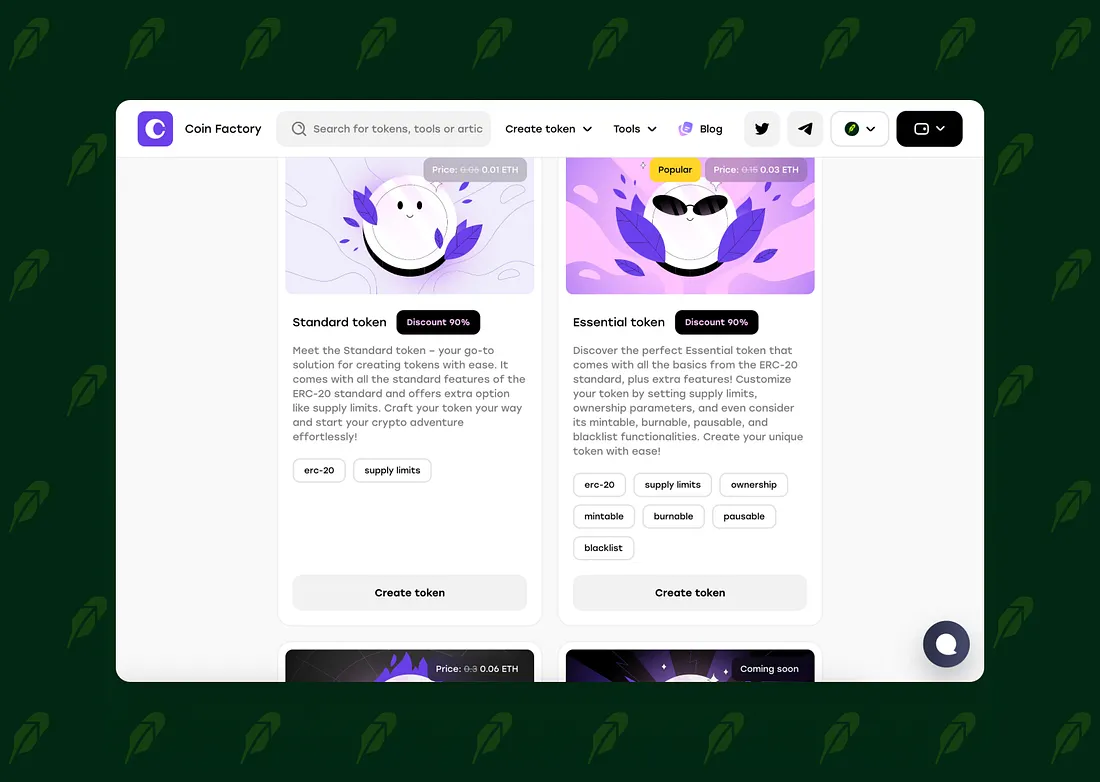
- Choose your contract template. The typical options are a Standard contract (fixed supply, no owner permissions after deployment — the most community-trusted design), an Essential contract (adds minting, burning, transfer pausing, and ownership controls), or a Taxable contract (adds configurable buy and sell taxes on top of the Essential features).
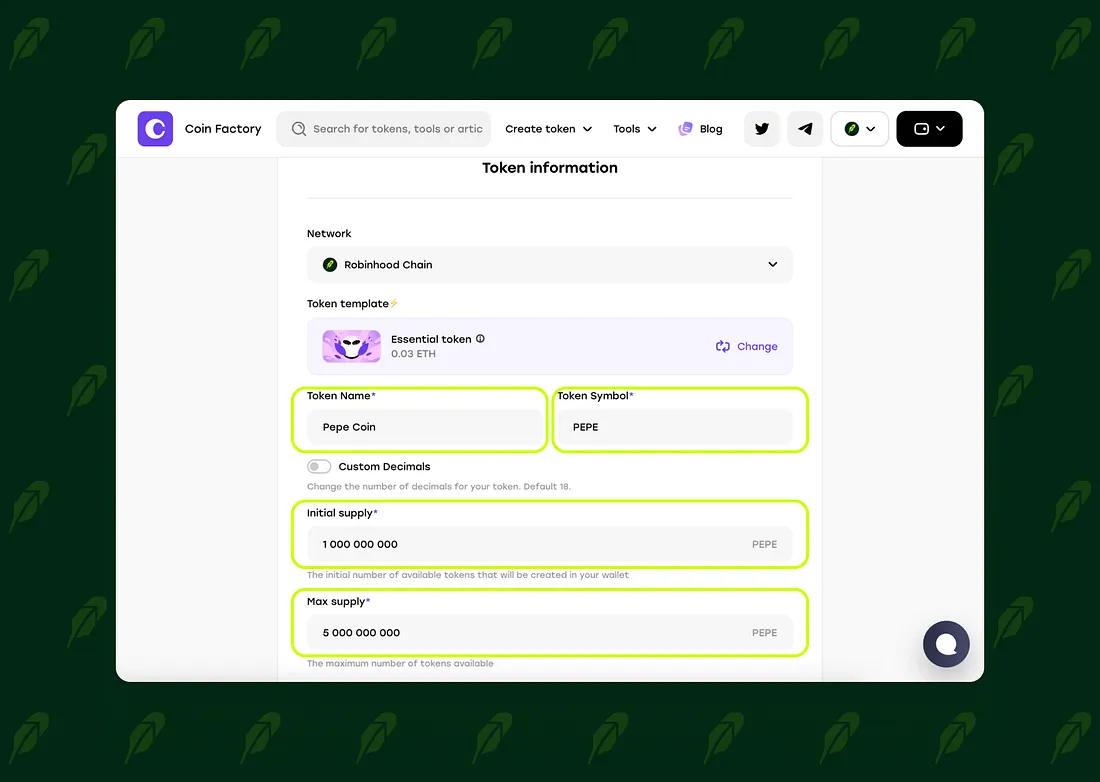
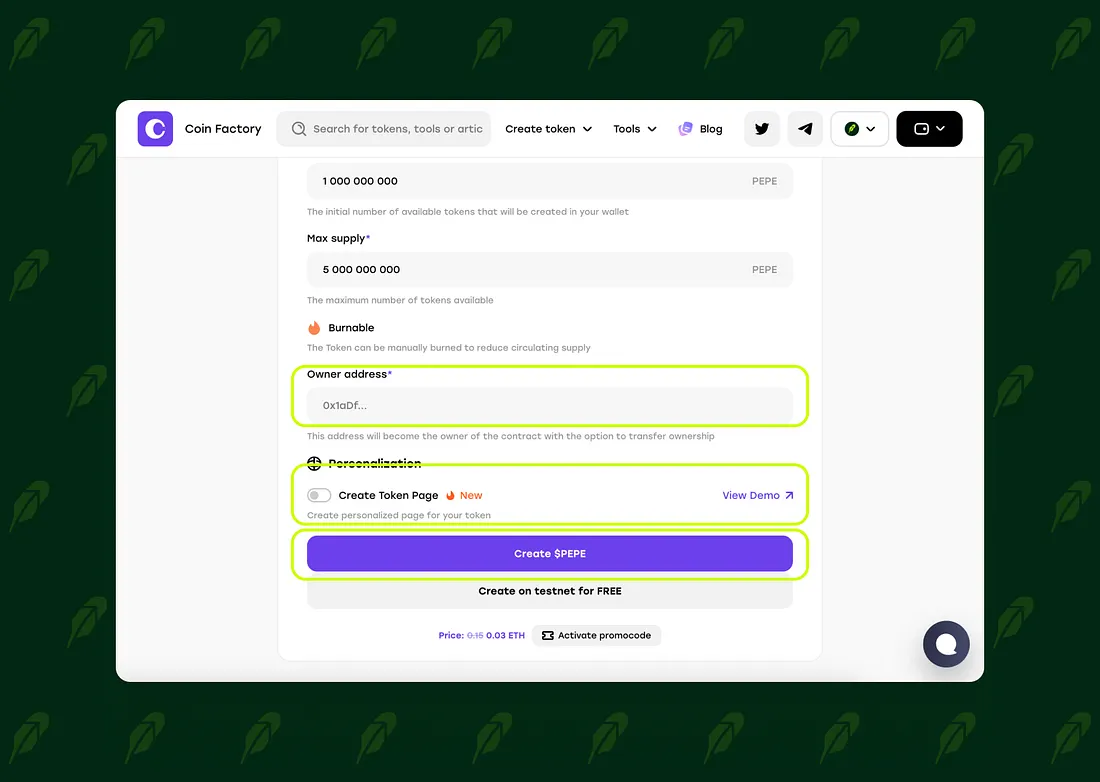
- Configure, review, and deploy. Enter your token name, symbol, total supply, and decimals, plus any optional settings. Review everything carefully, click Create Token, and confirm the transaction in your wallet. Within a few block confirmations, your token contract is live on-chain.
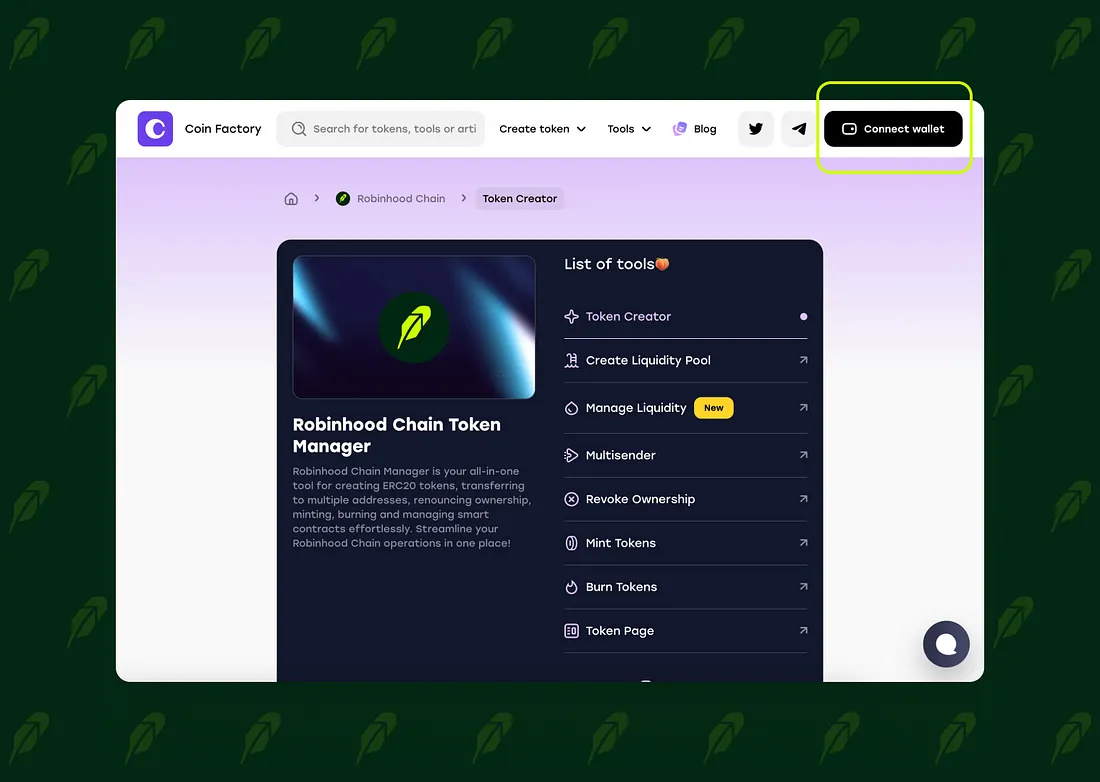
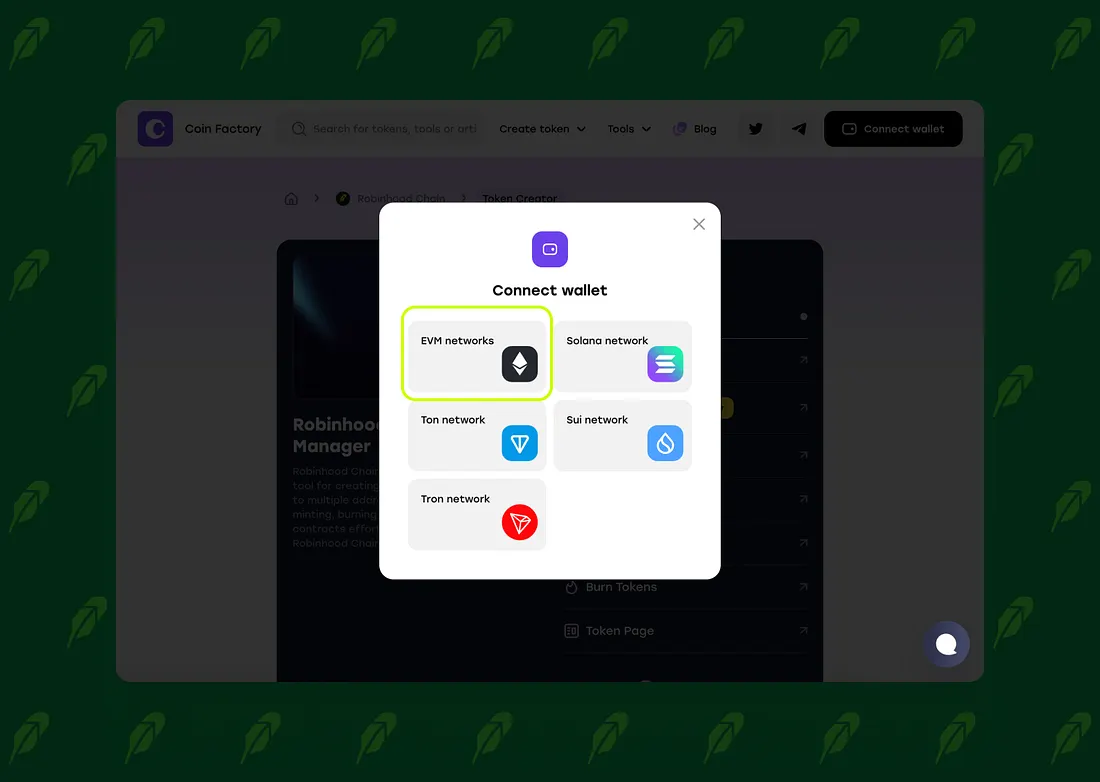
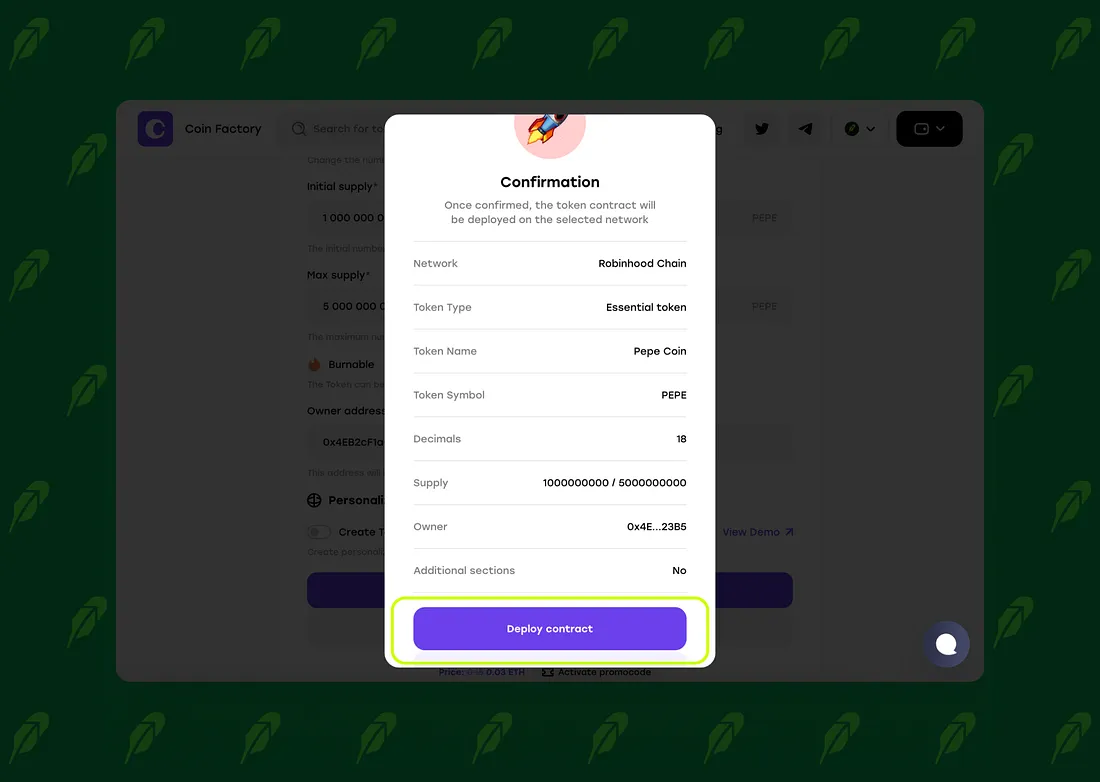
Once the transaction confirms, you can view your contract address, transaction details, and all on-chain activity at robinhoodchain.blockscout.com, the official Robinhood Chain block explorer.
How do I launch a token the developer way?
Robinhood officially documents deployment with Hardhat or Foundry, the two standard Ethereum development frameworks. The process is identical to deploying on any EVM chain: initialize a project, write or import an ERC-20 contract (OpenZeppelin's audited templates are the common starting point), point your tooling at the Robinhood Chain RPC with chain ID 4663, and deploy. Robinhood's documentation recommends deploying to testnet first, and includes explicit verification commands so your contract source appears publicly verified on Blockscout.
A sensible token project then goes further: audit the contract (or at minimum have the code reviewed), verify it on the explorer, revoke or disable any admin permissions the community does not need, and publish the contract address so traders can independently check the code rather than trusting screenshots.
How do I make my new token tradeable?
A freshly deployed token is not tradeable until liquidity exists — launching the contract is only half the job. The standard path on Robinhood Chain is to create a liquidity pool on Uniswap, which went live with v2, v3, v4, and UniswapX from day one of mainnet and serves as the chain's primary public AMM. Alternatively, Uniswap's pools.trade launchpad, released August 5, 2026, lets you launch a token and create its initial pool in a single flow — over 340,000 new tokens launched through Robinhood Chain launchpads on Uniswap in July 2026 alone.
Key Insight There is no minimum liquidity requirement on Robinhood Chain or Uniswap, but a pool with too little liquidity will suffer severe slippage and price manipulation. The depth of your initial pool, not the existence of a pool, determines whether traders will actually use your token.
What risks and responsibilities should I know about?
Launching a token is easy but running a legitimate project is not, and Robinhood Chain's openness cuts both ways. Because anyone can deploy, the chain hosts a mix of serious projects and scams, and traders check contracts for known manipulation functions before buying.
- Contract permissions: Mintable, pausable, and taxable templates give the deployer ongoing control. Traders check Blockscout for these, and heavy admin powers typically depress trust. Renounce or revoke ownership when your project does not need it.
- Legal compliance: How your token is marketed determines its legal character. Promising profits or framing the token as an investment can trigger securities rules in many jurisdictions — this guide is not legal advice, and serious projects consult counsel before launch.
- Liquidity responsibility: Removing your pool's liquidity or manipulating the market is fraudulent in most jurisdictions. Uniswap's pool mechanics record every action permanently on-chain.
- Security hygiene: If you use third-party tools, keep your private keys out of them — token generators interact with your wallet through transaction requests, which is safe; never paste your private key anywhere.
Frequently Asked Questions (FAQs)
Q1: Is Robinhood Chain permissionless — can anyone really launch a token?
A: Yes. Robinhood's official documentation states that anyone can interact with the network, build applications, and deploy smart contracts, with no whitelist or approval process. Deploying a token works the same way as deploying any ERC-20 contract on Ethereum.
Q2: How much does it cost to launch a token on Robinhood Chain?
A: You pay gas in ETH for the contract deployment transaction, which on this Arbitrum-based Layer 2 is typically only a small fraction of Ethereum mainnet cost, plus any fee charged by a third-party token generator if you use one. The exact gas cost depends on contract complexity and network conditions.
Q3: Which wallets can I use to launch a token on Robinhood Chain?
A: Any EVM-compatible wallet that lets you add a custom network works — MetaMask and Trust Wallet are the commonly cited options. Robinhood Wallet supports Robinhood Chain natively with no manual network setup.
Q4: Do I need coding skills to launch a token on Robinhood Chain?
A: No. Third-party token generators let you launch a fully deployed ERC-20 contract by filling in a form — name, symbol, supply, decimals — and confirming a wallet transaction. Developers who want full control can use Robinhood's officially documented Hardhat or Foundry deployment flow instead.
Q5: Where do I add liquidity so my token becomes tradeable?
A: The primary venue is Uniswap (v2, v3, v4, and UniswapX), which is live on Robinhood Chain and serves as the chain's primary public AMM. Uniswap's pools.trade launchpad, released August 5, 2026, combines token creation and initial pool creation in one flow.
Q6: Is the Robinhood Chain testnet still available?
A: Yes. The testnet (Chain ID 46630) remains open for development and testing, with free test tokens available at faucet.testnet.chain.robinhood.com. Testnet tokens have no real-world value.
Disclaimer: This article is for informational and educational purposes only and does not constitute financial, investment, or legal advice. Cryptoassets and derivatives are highly volatile and involve significant risk of loss.