



As of July 01, 2026
Introduction
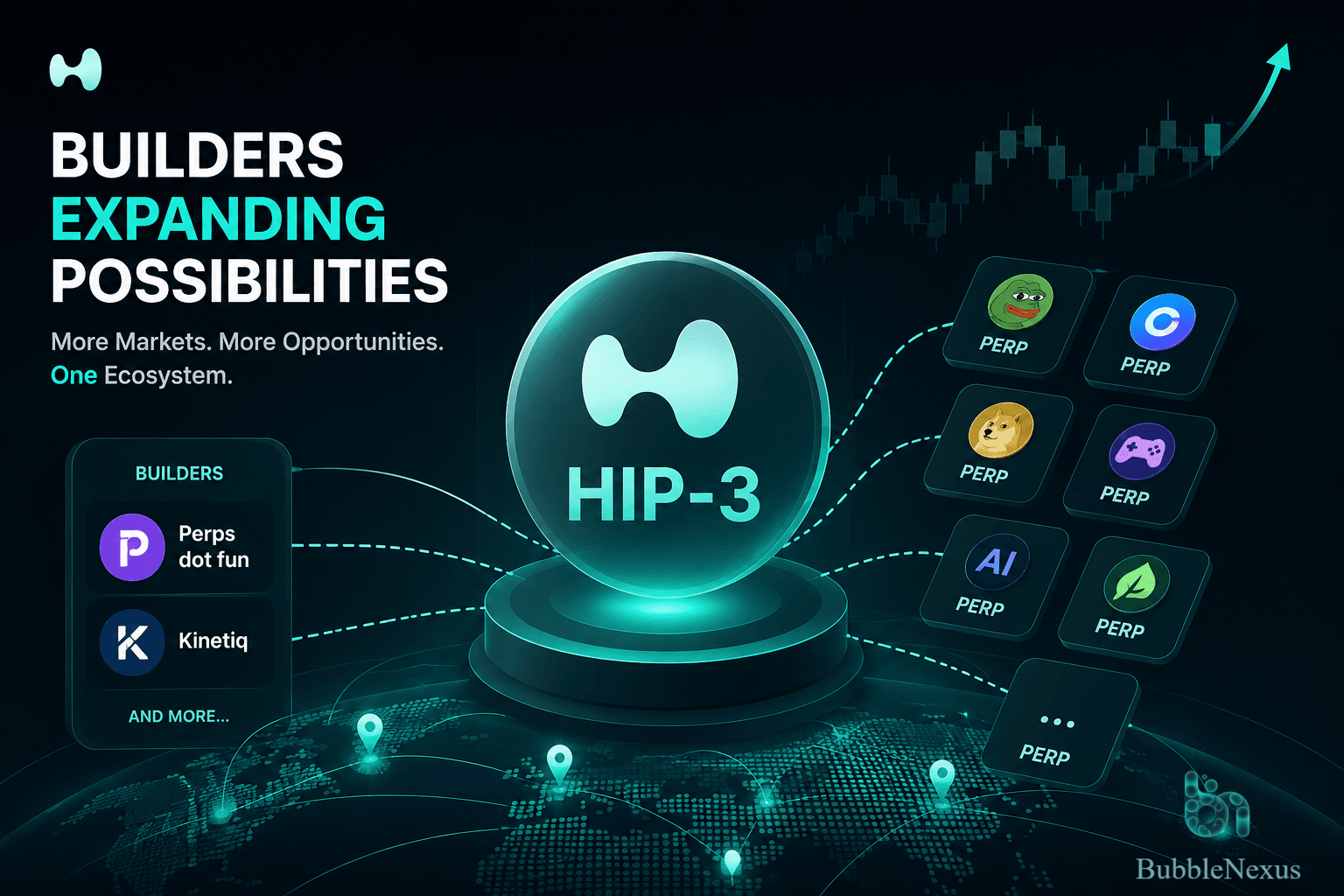
The Hyperliquid Improvement Proposal 3 (HIP-3) introduces permissionless deployment of perpetual futures markets, allowing independent builders to launch and operate their own perpetual DEXs on the Hyperliquid protocol. By decentralizing the market listing process, HIP-3 expands access to long-tail perpetual markets, encourages ecosystem innovation, and strengthens Hyperliquid's role as a scalable infrastructure for decentralized derivatives trading. If you're looking for live Hyperliquid ecosystem metrics, including protocol activity and market statistics, explore the BubbleNexus Hyperliquid Dashboard.
How HIP-3 Is Revolutionizing Perpetual Market Creation
HIP-3 replaces Hyperliquid's centralized listing model by allowing independent builders to deploy and operate their own perpetual DEXs. Builders define key market parameters, including oracle configuration, contract specifications, price feeds, and leverage limits. To launch a HIP-3 DEX, builders must stake 500,000 HYPE tokens for a minimum of 183 days, ensuring long-term commitment and maintaining market quality.
Asset Deployment and Fee Structures
Under HIP-3, the first three assets deployed within any new perpetual DEX do not require participation in an auction. However, additional assets must go through a Dutch auction process, which shares hyperparameters with the existing HIP-1 auction and is common across all perpetual DEXs. This mechanism ensures fair and transparent asset listing while managing market saturation. Furthermore, HIP-3 provides flexibility in fee structures, allowing deployers to configure an additional fee share ranging from 0% to 300% (0-100% in growth mode). This customizable fee model enables builders to tailor their economic incentives and attract specific types of traders to their markets.
Slashing and Risk Management in Hyperliquid HIP-3
To protect users and maintain market integrity, HIP-3 incorporates robust risk management mechanisms, including slashing. If a builder operates a market maliciously or fails to meet protocol standards, validators can vote to slash a portion of the builder's staked HYPE—even if it is in the unstaking queue—ensuring accountability. HIP-3 also enforces strict eligibility requirements for cross-margin trading, allowing only assets with sufficient liquidity, reliable oracle data, and resistance to price manipulation. Together, these safeguards help maintain secure, stable, and high-quality perpetual markets.
What is Slashing?
Slashing is a security mechanism that allows validators to penalize builders by reducing their staked HYPE if they violate protocol rules or operate markets irresponsibly, helping protect traders and maintain market integrity.
Slashing Mechanism
Builders stake 500,000 HYPE as collateral. Validators can slash part of this stake if a builder violates protocol rules or operates markets irresponsibly, helping protect traders and maintain market integrity.
Cross-Margin Protection
Cross-margin is restricted to assets with strong liquidity, trustworthy oracle feeds, and resistance to price manipulation, reducing systemic risk during volatile market conditions.
Market Performance and Community Insights
HIP-3 has experienced strong adoption since its launch, with builder-deployed markets contributing significantly to Hyperliquid's trading activity. The key performance metrics are summarized in the table below.
| Metric (HIP-3) | Value |
|---|---|
| Cumulative Trading Volume | ~$300 Billion+ |
| Open Interest | ~$3.08 Billion |
| May 2026 Trading Volume | ~$60 Billion (est.) |
| Total Fees Generated (30-day aggregate) | ~$4.5 Million |
HIP-3 has been widely welcomed as a major step toward making Hyperliquid a leading decentralized trading infrastructure. The 500,000 HYPE staking requirement strengthens the token's utility by creating sustained demand, while the builder framework has attracted interest from institutions and researchers exploring new market designs, including pre-IPO price discovery and other innovative trading applications.
The Role of Backstop Liquidation in Market Safety
Each HIP-3 DEX includes an on-chain backstop liquidation mechanism that automatically takes over risky positions when standard liquidations are insufficient, especially during periods of high market volatility. By absorbing undercollateralized positions, it reduces the likelihood of auto-deleveraging (ADL) events and helps maintain market stability. This built-in safeguard strengthens the solvency of HIP-3 markets and provides traders with a more secure and reliable trading environment.
What is Backstop Liquidation?
Backstop liquidation is an automated safety mechanism that takes over risky positions when regular liquidations cannot be completed efficiently, helping prevent bad debt, reduce auto-deleveraging (ADL), and keep HIP-3 markets stable during high volatility.
Implications for Traders and Market Makers
The permissionless nature of market creation leads to a broader array of trading instruments, allowing users to access niche or innovative perpetuals that might not be available on traditional exchanges. For market makers, the ability to deploy their own DEXs with customizable fee structures and robust risk management tools provides unprecedented control and flexibility. The enhanced liquidity and diverse market offerings driven by HIP-3 contribute to a more efficient and dynamic trading environment, ultimately benefiting all participants in the Hyperliquid ecosystem.
Conclusion
HIP-3 marks a major milestone for Hyperliquid by enabling permissionless, builder-driven perpetual markets. It expands the platform's trading ecosystem, encourages innovation, and broadens access to long-tail assets. Strong growth in trading activity and community adoption highlights HIP-3's success, positioning Hyperliquid as a leading infrastructure for decentralized perpetual trading.
Frequently Asked Questions (FAQs)
1. Will HIP-3 dilute liquidity across too many perpetual markets?
While HIP-3 significantly increases the number of tradable markets, only assets with sufficient liquidity and reliable pricing are expected to attract sustained trading activity. The protocol's staking and market requirements also help discourage low-quality market creation.
2. Can HIP-3 builders earn meaningful revenue from their markets?
Yes. HIP-3 allows builders to receive a share of trading fees, creating a sustainable incentive to launch, maintain, and grow active perpetual markets. Revenue ultimately depends on trading volume and user adoption.
3. Could HIP-3 make Hyperliquid the largest permissionless perpetual exchange?
Many community members believe HIP-3 strengthens Hyperliquid's competitive position by enabling third-party builders to rapidly launch new perpetual markets. Its long-term success, however, will depend on builder participation, liquidity growth, and continued user adoption.