



- MOZI is a perpetual trading aggregator that routes orders directly to Hyperliquid’s on-chain order book (and to Aster and Lighter). It never takes the other side of your trade.
- One dashboard, one wallet gives you access to Hyperliquid's 300+ perp and spot markets plus its HIP-3 real-world-asset (RWA) perps, without switching tabs, wallets, or venues.
- Pair Trading (live since July 8, 2026) lets you long one asset and short another in a single order flow — a market-neutral strategy that works in any market direction.
- Funding rate arbitrage is scanned across venues in real time: Mozi spots where one venue pays longs and another pays shorts on the same asset, then auto-populates both legs.
What is MOZI, and how does it relate to Hyperliquid?
MOZI is a routing layer, not a counterparty. Mozi is a perpetual trading aggregator. It gives you unified access and one-click execution across multiple PerpDEXs (Hyperliquid, Aster, Lighter) from a single interface. Your orders route directly to the venue’s own order book (e.g. Hyperliquid’s on-chain book). Mozi never takes the other side of your trade.
Why Hyperliquid matters here:
It is gasless, has sub-second finality, and uses no off-chain matching engine. Its state splits into HyperCore (perps) and HyperEVM. The app lists 300+ on-chain, non-custodial perpetual and spot markets.Deep native liquidity, a transparent on-chain order book, and a growing range of crypto, commodity, stock, and forex perps are why Mozi makes Hyperliquid its primary venue.
Key insight: Aggregators like MOZI exist because perp liquidity is fragmented. Hyperliquid, Aster, and Lighter each run their own order books, and the same asset can carry materially different funding rates and prices on each. MOZI’s value is unifying that fragmentation under one account, one balance view, and one execution path.
How does MOZI connect to Hyperliquid? A quick-reference table
The integration is an execution and account layer on top of Hyperliquid's mainnet. Mozi's official X account announced: "MOZI is live on the HyperliquidX mainnet. With MOZI, easily execute pair trades, find funding opportunities, manage grouped positions, and much more". The table below maps each component of the integration to what it means in practice.
| MOZI Component | How It Hooks Into Hyperliquid | What It Means for the Trader |
|---|---|---|
| Order execution | Orders route directly to Hyperliquid's on-chain order book; Mozi is not the counterparty | You get Hyperliquid's sub-second finality and native liquidity without leaving the aggregator dashboard |
| Account & custody | Non-custodial: Mozi never holds private keys; deposits go to your Mozi Main Wallet and then to venue margin | Positions remain under your control at all times; withdraw anytime, subject to open positions |
| Market access | Full catalog of Hyperliquid perp/spot markets, including HIP-3 RWA perps (metals, energy, forex, indices, tokenized stocks) | 500+ symbols across 3+ exchanges in one terminal, from BTC to tokenized TSLA and gold futures |
| Fees | Single unified fee of 1.45 BPS (0.0145%) per trade, applied as a builder code on top of Hyperliquid's native fees | Transparent, venue-agnostic pricing shown before order confirmation and no hidden charges |
What does the MOZI and Hyperliquid architecture actually look like?
One trader account, one routing layer, multiple venues. A trader signs in (via X, email, or Google and no external wallet connection is required to create the account), deposits USDC into their Mozi Main Wallet in a non-custodial way Mozi states it never holds your private keys and then allocates that capital across any integrated venue from a single screen. The diagram below summarizes how orders, strategies, and margin flow between the trader and Hyperliquid's mainnet.
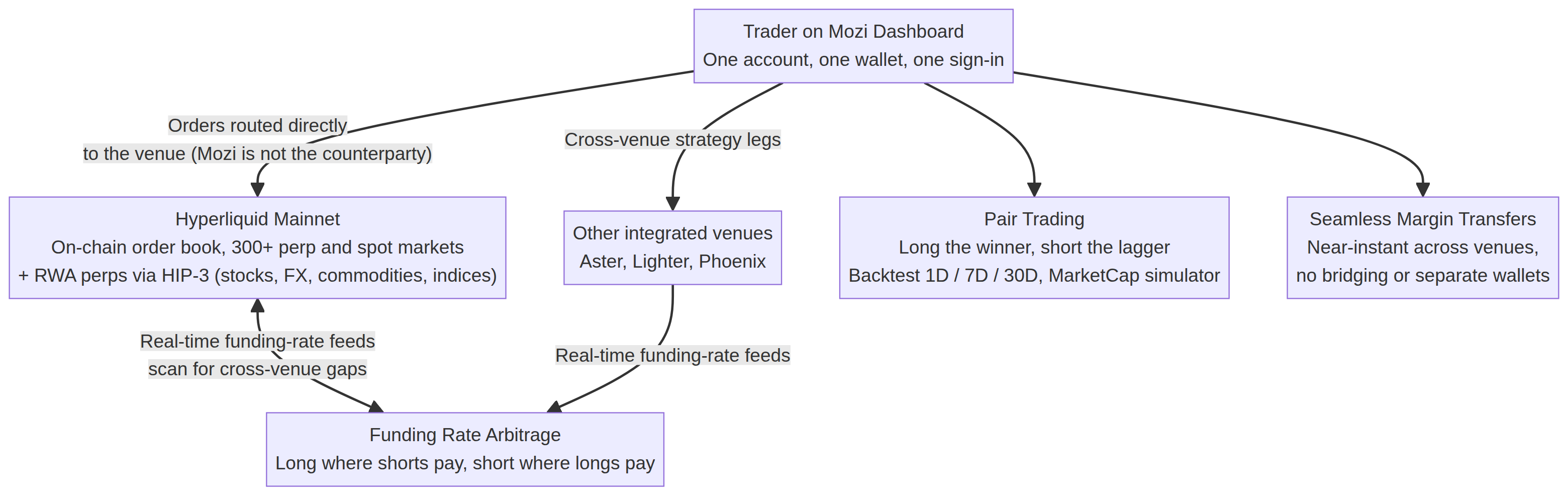
From a mechanics standpoint, three things are happening at once.
- Direct order routing: Market and limit orders placed in the Mozi terminal land on Hyperliquid's on-chain order book like any native order.
- Unified portfolio management: Mozi consolidates wallet balances, allocated margin per venue, and aggregate unrealized using each venue's own mark prices, into one dashboard with Balances, Positions, and Deposits & Withdrawals views.
- Internal margin transfers: USDC moves between Hyperliquid, Lighter, and Aster through Mozi's routing layer near-instantly, without on-chain withdrawals or deposits between contracts.
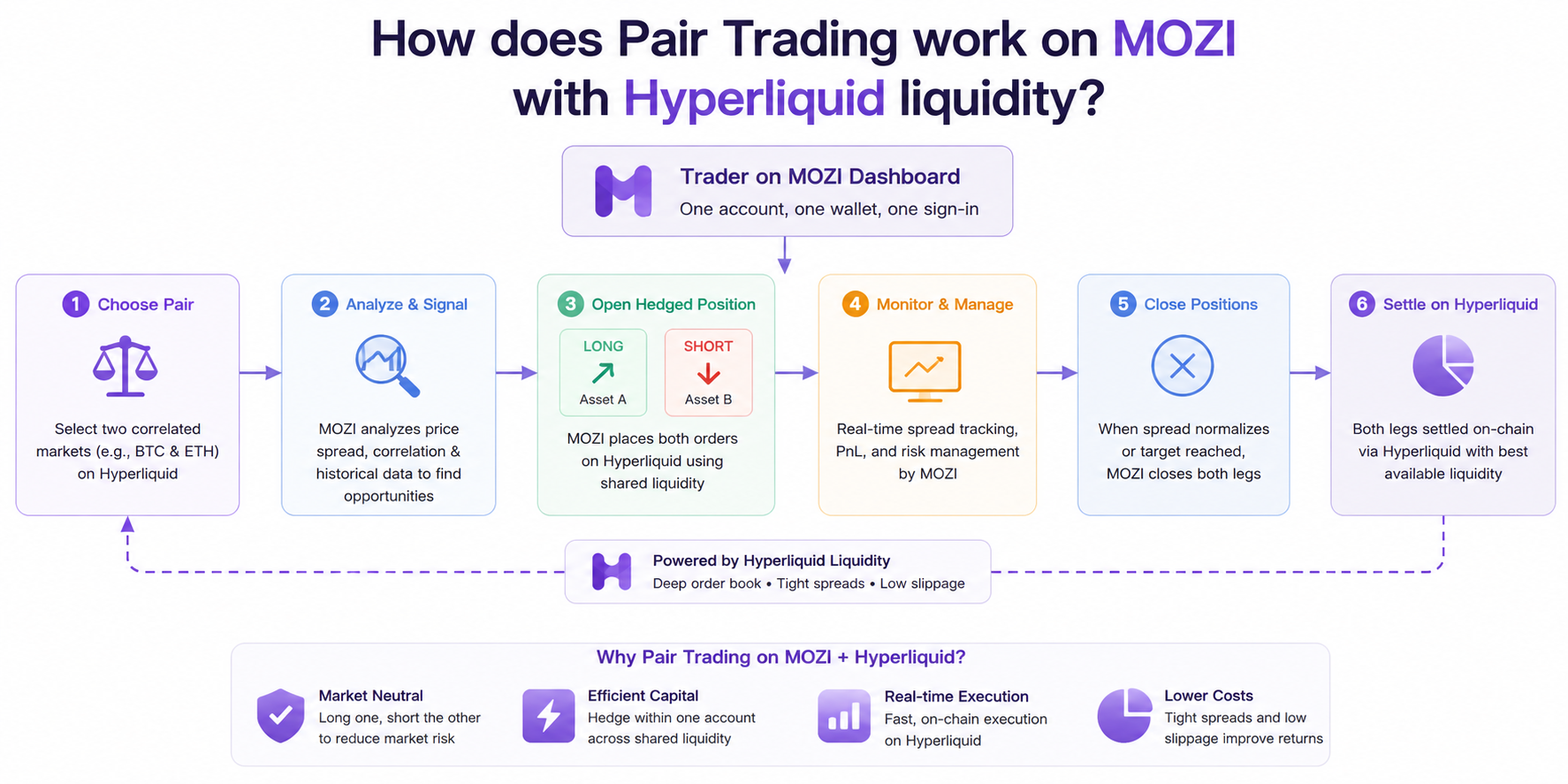
How does pair trading work on MOZI with Hyperliquid liquidity?
Pair trading lets you express a relative view instead of a directional one. On July 8, 2026, Mozi's pinned announcement says that Pair Trading is live on MOZI. You don't need a bull market. You need a better thesis. Long what wins. Short what lags. Rather than betting that the whole crypto market goes up or down, you construct a thesis on the relative performance of two assets: buy the one you expect to outperform, and short the one you expect to underperform.
Here is the structural setup:
- Strategy: Market-neutral pair trade over a 7-day window.
- Long Leg: Eli Lilly ($LLY) → Settled at +$15.70
- Short Leg: Hyperliquid ($HYPE) → Settled at +$78.84
- Total Profit: +$94.54 (Independent of directional market volatility).
Tip: A pair trade does not eliminate risk. It replaces directional risk with relative-performance risk. If both legs move against your thesis (for example, the long lags and the short rallies), the position loses money.
How does Cross-Pair Trading differ from simple pair trading?
| Aspect | Simple Pair Trading | Cross-Pair Trading |
|---|---|---|
| Legs | 2 (1 long + 1 short) | Multiple longs + multiple shorts |
| Assets | Two assets (e.g. BTC vs ETH) | Multiple assets (e.g. BTC/ETH/MON/SUI vs OP/ARB/SOL) |
| Venues | Same or different | Multi-venue (e.g. Hyperliquid + Lighter longs, Aster shorts) |
| Execution | One dashboard, combined PnL | One strategy, one click, unified interface |
| Thesis | One asset outperforms another | Group of assets outperforms another group |
What risks or limitations should I watch for with MOZI on Hyperliquid?
The aggregator inherits the risks of its venues, plus a few of its own. Keep the following on your radar:
-
Market volatility and total loss of capital
Official Mozi Terms explicitly list market volatility and the possibility of total loss of capital among the risks users must accept. Leveraged Hyperliquid perps amplify this. -
Non-custodial but still dependent on routing
Mozi states it never holds private keys and is non-custodial. Orders and margin transfers still rely on Mozi’s routing layer to reach Hyperliquid. Any outage, data inaccuracy, or failure in that layer (or on Hyperliquid itself) can delay or disrupt execution. -
No guarantees, no advice, past results not indicative
Mozi’s Terms state the platform provides no investment advice, does not guarantee outcomes or profits, and that past performance (including any shared pair-trade examples) is not indicative of future results. All use is at the user’s own risk. -
Regulatory and access restrictions
Mozi geo-blocks users fromrestricted territories(including the United States and United Kingdom). Regulatory changes affecting Hyperliquid or Mozi can limit access or functionality without notice.
Frequently Asked Questions (FAQs)
Q1: Is MOZI a centralized exchange?
A: No. MOZI is a non-custodial aggregator: it routes orders directly to venues like Hyperliquid, states it never holds private keys, and does not act as the counterparty to trades.
Q2: Does MOZI hold my funds when I trade on Hyperliquid?
A: No. Positions and margin remain under your control at all times, per Mozi’s official documentation, with deposits going through a non-custodial Mozi Main Wallet first.
Q3: What markets on Hyperliquid can I trade through MOZI?
A: Hyperliquid's full perp and spot catalog (300+ markets) including HIP-3 real-world-asset perps such as gold, crude oil, forex majors, S&P 500/Nasdaq indices, and tokenized stocks like TSLA and NVDA.
Q4: Can I trade pair trades and funding arbitrage on Hyperliquid without MOZI?
A: Yes, manually, but it requires separate long and short tickets, separate wallet/venue management, and manual coordination; MOZI consolidates both legs and margin transfers into one dashboard.
Disclaimer: This article is for informational purposes only and is not financial advice. Trading perps involves significant risk of loss.