



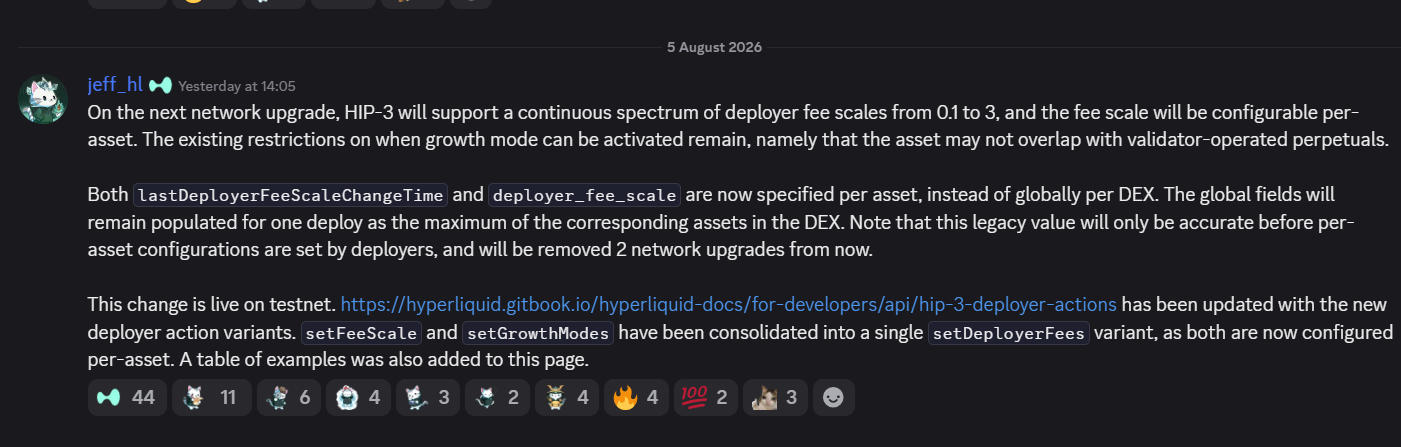
Source: Hyperliquid Discord api-Announcements
Summary:
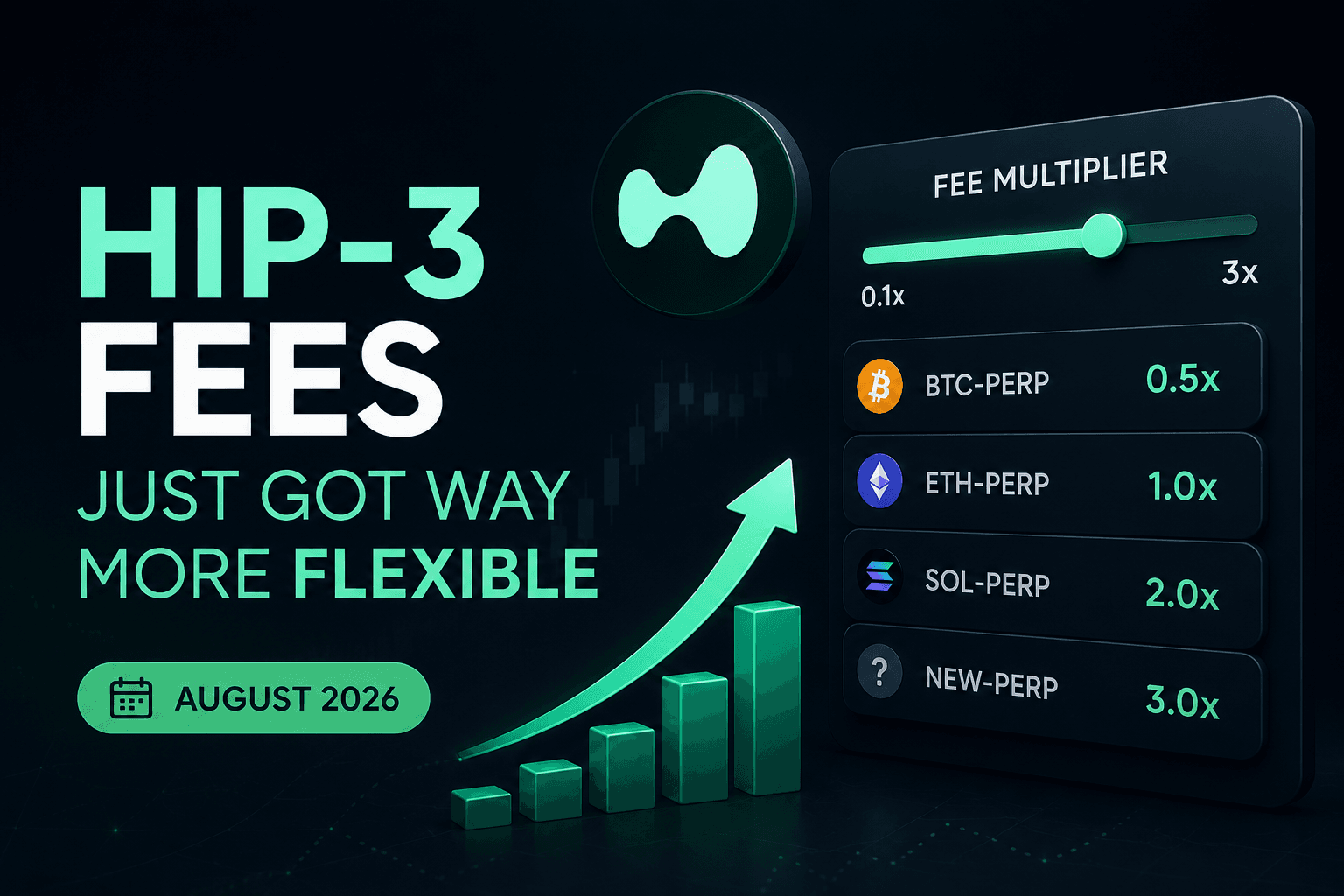
- HIP-3 now allows deployers to set flexible fee scales for each asset instead of using one fee across the entire DEX.
- Builders can customize revenue strategies with fee multipliers ranging from 0.0x to 3.0x.
- Growth Mode continues to support new market launches while maintaining safeguards against validator-operated market overlap.
- The update gives developers greater control over market configuration and encourages ecosystem growth.
What changed with HIP-3 fee in August 2026?
The core update centers on the SetDeployerFees L1 action, which introduces expanded multiplier caps and a new growthMode switch designed to optimize protocol and deployer fee distribution.
- Expanded Multiplier Range:
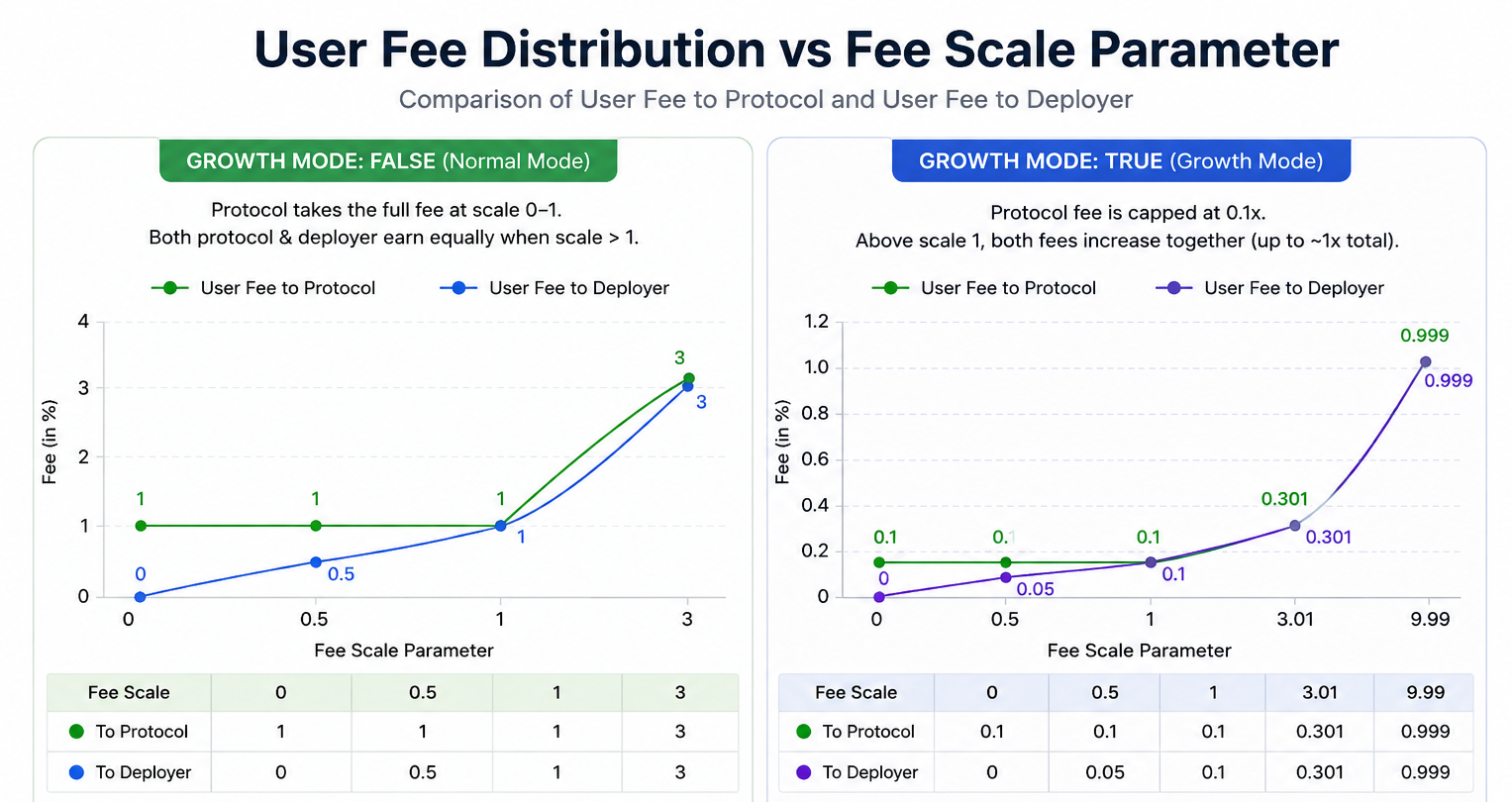
Standard fee scale parameters range from 0.0 to 3.0, while enablinggrowthModeextends the scale ceiling from 0.0 to 10.0 (exclusive). - Optimized Protocol Overhead:
WhengrowthModeis active, base protocol fees are reduced to 0.1 of standard rates across baseline tiers to incentivize trading volume. - Mainnet Governance Rate Limits:
Fee updates executed viaSetDeployerFeeson Mainnet are rate-limited to one change per 30 days.
How does growthMode alter protocol and deployer fee calculations?
Enabling growthMode fundamentally modifies how trading fees are split between the underlying protocol and the independent deployer.
When normal user fees are denoted as baseline units, activating growth mode ensures that protocol friction is minimized, allowing deployers to capture flexible rebates or allocate competitive maker/taker fees tailored to high-growth market conditions.
Key Insight:
Deployers must carefully evaluate liquidity bootstrapping goals before toggling growthMode, as rate-limiting rules restrict modifications to once per 30-day window on mainnet deployments.
How do standard fee scales compare with growth mode configurations?
The following graph outlines the mathematical impact of different scale settings and growth mode states on user fee distribution between protocol and deployer, assuming a positive normal user fee of 1 unit with non-aligned collateral.
By BubbleNexus Team
What other deployer actions accompany the HIP-3 upgrade?
Alongside fee adjustments, HIP-3 provides builders with comprehensive L1 primitive actions to manage perpetual markets programmatically.
- Asset Registration:
Actions such asRegisterAsset2enable simultaneous initialization of decentralized exchanges and asset listing with strict isolated margin or normal modes. - Oracle Management:
TheSetOracleaction requires regular price updates with stringent clamping rules to prevent sudden deviations and protect traders. - Open Interest Controls:
Deployers can utilizeSetOpenInterestCapsto enforce notional and size-denominated caps across individual assets and aggregate exchange instances.
Important Notice: Reserve deployments in asset registration allow deployment at current gas auction prices even after auctions conclude, subject to strict protocol limits (7 + 0.2 * n_auction_deployments).
Frequently Asked Questions
Q1: What is the primary purpose of HIP-3 fee flexibility on Hyperliquid? A: It allows builder-deployed perpetual DEXs to dynamically adjust fee scaling and incentivize platform growth through customizable protocol and deployer fee splits.
Q2: What is the maximum scale value permitted when growthMode is enabled?
A: When growthMode is set to true, the fee scale parameter can extend from 0.0 to 10.0 (exclusive).
Q3: How frequently can a deployer update fees on Mainnet?
A: Mainnet fee updates via SetDeployerFees are rate-limited to one change per 30 days.
Q4: How are protocol fees affected when growthMode is active? A: Protocol fees are significantly reduced to 0.1 of standard rates across baseline configurations, lowering barriers for user onboarding and trading activity.
Q5: Where can developers find the complete API specifications for HIP-3 actions?
A: Developers can consult the official Hyperliquid GitBook documentation under the developer API guides.
Disclaimer:
This article is for informational purposes only and should not be considered financial or investment advice. Always conduct your own research before making any cryptocurrency investment decisions.