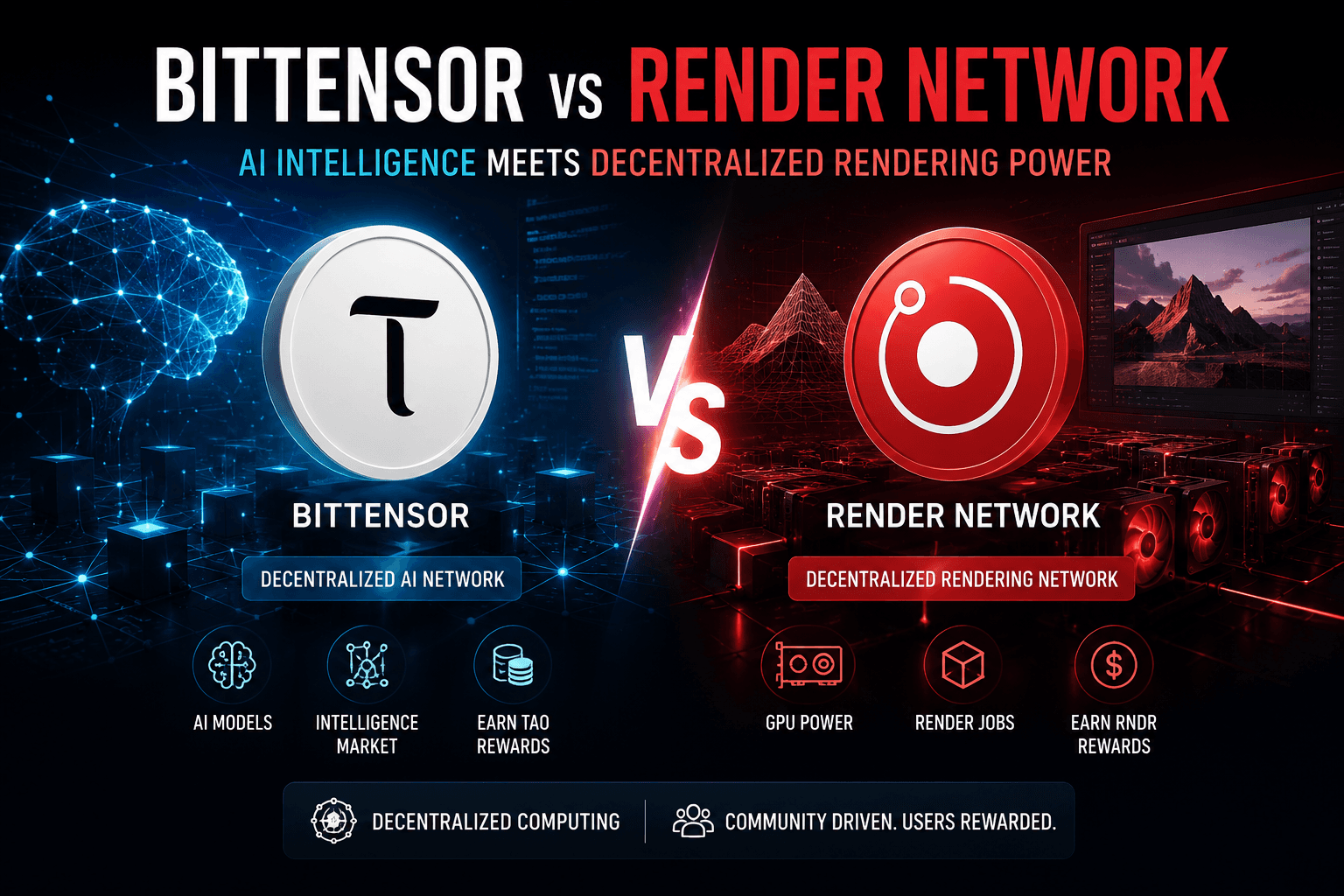




The rapid growth of decentralized artificial intelligence has introduced new blockchain-based infrastructures and decentralized AI infrastructure platforms designed to power the future of AI Among the most recognized projects in this sector are Bittensor and Render Network.
Although both operate within the decentralized AI ecosystem, their purposes are fundamentally different. Bittensor focuses on decentralized machine intelligence and AI model collaboration, while Render Network provides distributed GPU computing power for rendering and AI-related workloads.
Insight: Bittensor decentralizes intelligence, while Render Network decentralizes computational GPU power.
Table of Contents
1. Overview of Bittensor vs Render Network2. Core Differences in Infrastructure
3. Features Comparison: AI Intelligence vs GPU Compute
4. Use Cases & Ecosystem Applications
5. Which Network Has Greater Long-Term Potential?
6. Final Verdict
Frequently Asked Questions (FAQ)
If you want to understand decentralized AI infrastructure further, you can explore Bittensor Documentation for technical insights into decentralized machine learning networks.
1. Overview of Bittensor vs Render Network
Bittensor is a decentralized AI protocol that enables machine learning models to collaborate, compete, and exchange intelligence through blockchain incentives.
Render Network is a decentralized GPU computing platform designed to distribute rendering tasks and AI computational workloads across a global network of GPU providers.
While both projects contribute to decentralized AI infrastructure, they solve entirely different problems within the AI ecosystem.
2. Core Differences in Infrastructure
Bittensor operates as a decentralized intelligence marketplace where AI models are rewarded based on the value and quality of the information they provide to the network.
Render Network focuses primarily on decentralized GPU resource sharing, allowing users to access distributed computational power for rendering, AI training, and high-performance computing tasks.
- Bittensor: Decentralized AI intelligence protocol
- Render Network: Distributed GPU computing infrastructure
- Both platforms represent different categories of AI compute networks within the decentralized ecosystem.
3. Features Comparison: AI Intelligence vs GPU Compute
| Feature | Bittensor | Render Network |
|---|---|---|
| Primary Purpose | Decentralized AI intelligence | GPU rendering & compute power |
| Core Infrastructure | Machine learning subnetworks | Distributed GPU node network |
| Main Users | AI developers & researchers | Render artists, AI engineers & studios |
| Blockchain Utility | AI contribution incentives | GPU resource marketplace |
| AI Focus | Knowledge generation | Computational processing |
Render Network has emerged as one of the leading decentralized GPU marketplaces for AI and rendering workloads.
4. Use Cases & Ecosystem Applications
Bittensor is primarily used for decentralized AI model training, collaborative machine learning, and AI-driven data contribution systems.
Render Network is widely used for GPU-intensive applications such as 3D rendering, animation production, visual effects, AI model training, and cloud-based computational tasks.
Key takeaway: Bittensor powers decentralized AI intelligence, while Render Network powers decentralized AI computation.
5. Which Network Has Greater Long-Term Potential?
The long-term potential of both networks depends on which segment of the AI economy experiences greater demand growth.
- Bittensor could benefit from increasing demand for decentralized AI collaboration and open intelligence markets.
- Render Network may continue expanding as global demand for GPU computing and AI processing infrastructure rises.
- Both projects represent different but complementary layers of decentralized AI infrastructure.
6. Final Verdict
Bittensor and Render Network are often discussed together because both operate within the decentralized AI narrative, but they address entirely separate technological challenges. Both projects are becoming major AI blockchain projects contributing to decentralized AI development
Bittensor focuses on decentralizing intelligence and machine learning collaboration, whereas Render Network specializes in distributing GPU computational resources for rendering and AI workloads.
Rather than competing directly, both networks may ultimately serve complementary roles in building the next generation of decentralized AI infrastructure.
Frequently Asked Questions (FAQ)
Is Bittensor the same as Render Network?
No, Bittensor focuses on decentralized AI intelligence, while Render Network provides decentralized GPU computing infrastructure.
Does Bittensor provide GPU power?
Not directly. Bittensor primarily focuses on AI model collaboration and intelligence contribution systems.
What is Render Network mainly used for?
Render Network is commonly used for GPU-intensive tasks such as rendering, AI model training, animation, and cloud computing.
Are both projects related to AI?
Yes, both projects contribute to the decentralized AI ecosystem but at different infrastructure layers.
Can Bittensor and Render Network complement each other?
Yes, decentralized AI intelligence systems can potentially utilize decentralized GPU infrastructure for computation and training.