



Payward, the parent company of Kraken, plans to bring Hyperliquid onchain perpetual futures to U.S. clients through a regulated derivatives structure. The proposal would begin with Hyperliquid’s HIP-3 builder-deployed markets and remains subject to regulatory approval.
Summary
- Payward intends to deploy new perpetual futures markets on Hyperliquid for eligible U.S. clients.
- The markets would run on Hyperliquid’s public blockchain and use its onchain order book.
- Bitnomial Exchange would deploy and administer the markets.
- Bitnomial Clearinghouse would clear and settle the contracts.
- NinjaTrader Clearing would carry approved client accounts.
- No launch date, fee schedule, or projected trading volume has been announced.
What exactly is Payward planning for Hyperliquid onchain perps?
Payward plans to create new Hyperliquid-based perpetual futures markets for U.S. clients rather than simply opening Hyperliquid’s existing markets to American traders.
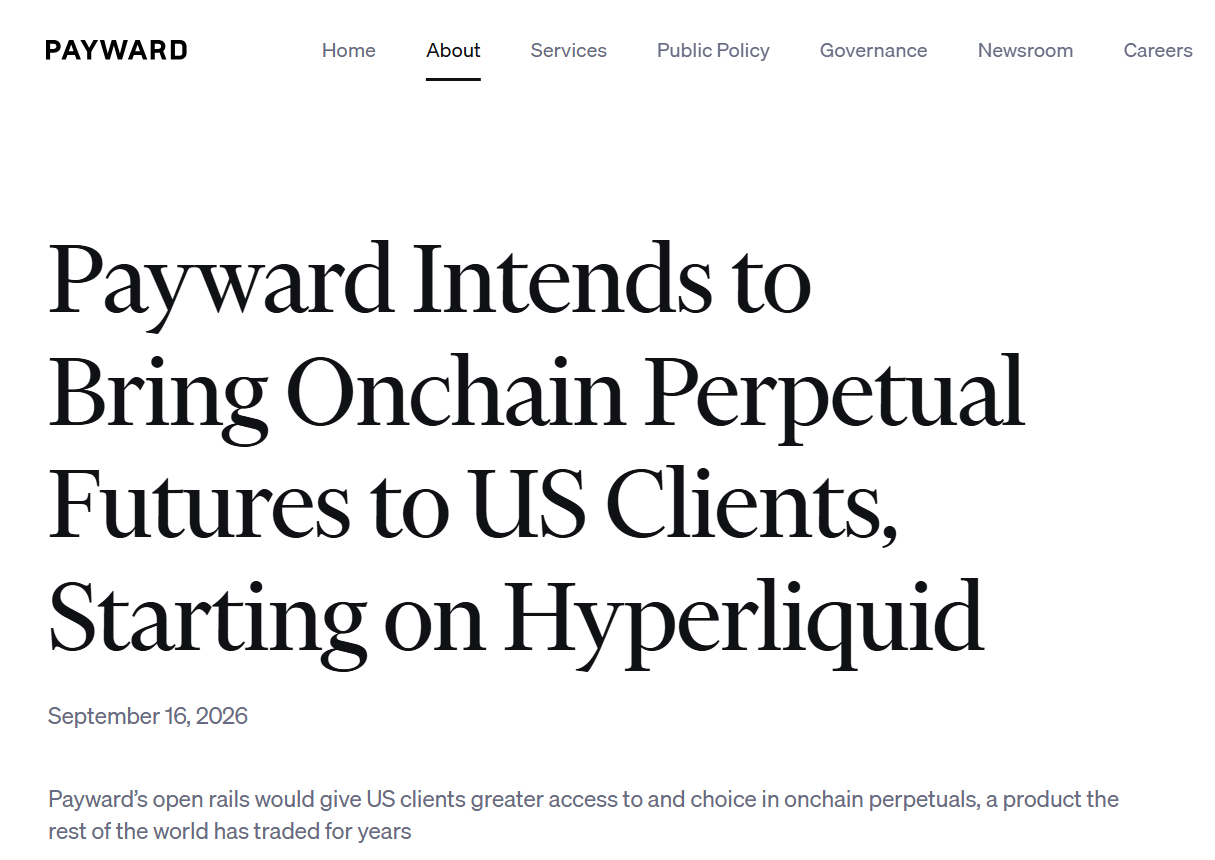 Source: Payward Press Release
The company said it intends to begin with Hyperliquid HIP-3 markets. HIP-3 is Hyperliquid’s framework for builder-deployed perpetual markets. Under this structure, an approved deployer can create and administer a separate perpetuals venue within the broader Hyperliquid environment.
Payward said the proposed contracts would be listed under the rules of Bitnomial Exchange. The announcement did not provide a launch date and stated that the planned markets are subject to regulatory approval.
How would the proposed U.S. trading structure work?
Hyperliquid would provide the onchain trading infrastructure, while Payward’s regulated entities would handle market deployment, clearing, settlement, and client-account functions.
| Function | Entity or protocol | Planned responsibility |
|---|---|---|
| Onchain execution | Hyperliquid | Its public blockchain and onchain order book would match and record trades. |
| Market deployment | Bitnomial Exchange | Create, own, and administer the HIP-3 markets under its rules. |
| Clearing and settlement | Bitnomial Clearinghouse | Clear and settle the proposed perpetual futures contracts. |
| Client accounts | NinjaTrader Clearing | Carry the futures accounts of approved clients. |
| Client eligibility | NinjaTrader and Bitnomial | Clients would need to be onboarded and approved on the relevant allowlists. |
Key insight: The proposal combines public blockchain-based trade matching with a regulated exchange, clearinghouse, and futures commission merchant structure.
Payward said U.S. clients would need a futures account with its registered broker. Only accounts onboarded by NinjaTrader and approved on both the NinjaTrader and Bitnomial allowlists would be able to trade the proposed contracts.
What does Hyperliquid HIP-3 allow market builders to control?
HIP-3 gives market deployers operational control over important parameters of their own builder-deployed perpetual venues.
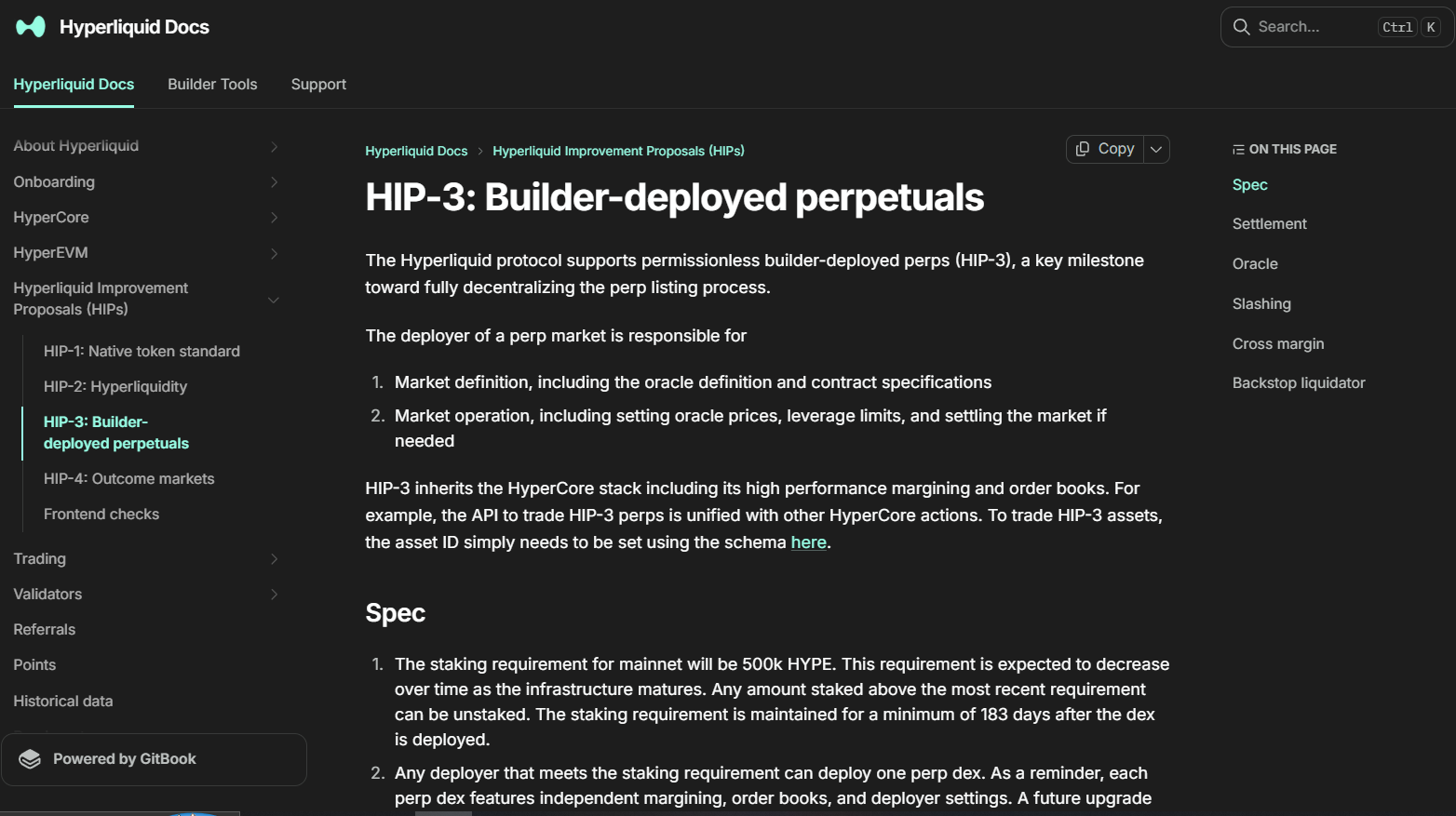 Source: Hyperliquid Docs
Hyperliquid’s documentation describes deployer actions that include registering assets, setting oracle parameters, adjusting funding settings, configuring margin tables, setting open-interest caps, and halting trading.
- Asset registration: A deployer can initialize a new perpetuals venue and register assets.
- Oracle controls: The framework includes actions for setting and updating oracle and mark-price inputs.
- Risk parameters: Deployers can configure margin tables and open-interest caps.
- Trading controls: The framework includes an option to halt trading for a market.
- Fee settings: HIP-3 documentation includes deployer fee controls for builder-deployed markets.
These controls explain why the planned product would be a Payward-deployed market on Hyperliquid, rather than a direct U.S. rollout of every perpetual contract already available on the protocol.
Why is the regulatory structure central to the proposal?
The arrangement is designed to place the proposed product inside Payward’s existing U.S. derivatives infrastructure while retaining Hyperliquid’s onchain trade-recording system.
The Commodity Futures Trading Commission designated Bitnomial Exchange as a designated contract market in April 2020. NinjaTrader Clearing identifies itself as a CFTC-registered futures commission merchant and a National Futures Association member.
Payward’s announcement said those entities would carry the relevant regulatory obligations. The company also said that any onchain perpetual futures would be listed under Bitnomial Exchange rules and would remain subject to regulatory approval.
Warning: The announcement does not mean that Hyperliquid’s current perpetual futures markets are already available to U.S. clients. It describes a plan for new markets that still requires approval and client onboarding.
What are the main differences between the proposed markets and existing Hyperliquid perps?
The main difference is the operating structure: the proposed markets would be newly deployed and administered by Payward’s regulated entities, while existing Hyperliquid markets are not automatically included in the U.S. proposal.
| Feature | Existing Hyperliquid perpetual markets | Proposed Payward HIP-3 markets |
|---|---|---|
| Market origin | Markets already operating within Hyperliquid’s ecosystem | New markets intended to be deployed by Payward |
| Trade-recording layer | Hyperliquid’s public blockchain | Hyperliquid’s public blockchain |
| U.S. access | Not automatically made available under this announcement | Intended for eligible U.S. clients, subject to approval |
| Market administrator | Depends on the relevant Hyperliquid market structure | Bitnomial Exchange as the HIP-3 deployer |
| Clearing structure | Not changed by the Payward proposal | Bitnomial Clearinghouse would clear and settle the contracts |
What has Payward not disclosed yet?
The company has not announced the planned launch date, fee schedule, expected trading volume, or economic terms of its relationship with Hyperliquid.
- No confirmed launch date has been provided.
- No fee schedule has been published.
- No projected trading volume has been disclosed.
- No details have been announced on how revenue would be divided with Hyperliquid.
- Eligibility and allowlist procedures remain part of the planned onboarding process.
What should U.S. clients watch next?
The next material developments are regulatory approval, a formal launch timetable, published contract specifications, and client-onboarding details.
Until those steps are completed, the Payward announcement should be understood as a proposal rather than a live U.S. trading product. The confirmed plan is to use Hyperliquid’s HIP-3 framework for new markets operated through Payward’s Bitnomial and NinjaTrader infrastructure.
Frequently Asked Questions
Q: Will U.S. clients immediately be able to trade all Hyperliquid perpetual futures?
A: No. Payward’s announcement concerns proposed new markets and does not make Hyperliquid’s existing perpetual markets generally available to U.S. clients.
Q: What is HIP-3?
A: HIP-3 is Hyperliquid’s framework for builder-deployed perpetual markets. It allows deployers to create and administer separate markets with controls for assets, funding, margins, open interest, and trading status.
Q: Which company would clear the proposed contracts?
A: Payward said Bitnomial Clearinghouse would clear and settle the proposed perpetual futures contracts.
Q: Which company would carry client accounts?
A: NinjaTrader Clearing would carry the client accounts. Its regulatory disclosures identify it as a CFTC-registered futures commission merchant and NFA member.
Q: Is there a confirmed launch date?
A: No. Payward has not announced a launch date, and the proposal remains subject to regulatory approval.
What are the next steps for readers?
Readers tracking this development should look for official announcements covering regulatory status, contract terms, fees, market eligibility, and the launch timetable. Until then, the most accurate description is that Payward intends to deploy regulated, U.S.-focused HIP-3 perpetual markets on Hyperliquid.
Disclaimer: The information on this blog is for educational and informational purposes only and does not constitute financial, investment, or legal advice.