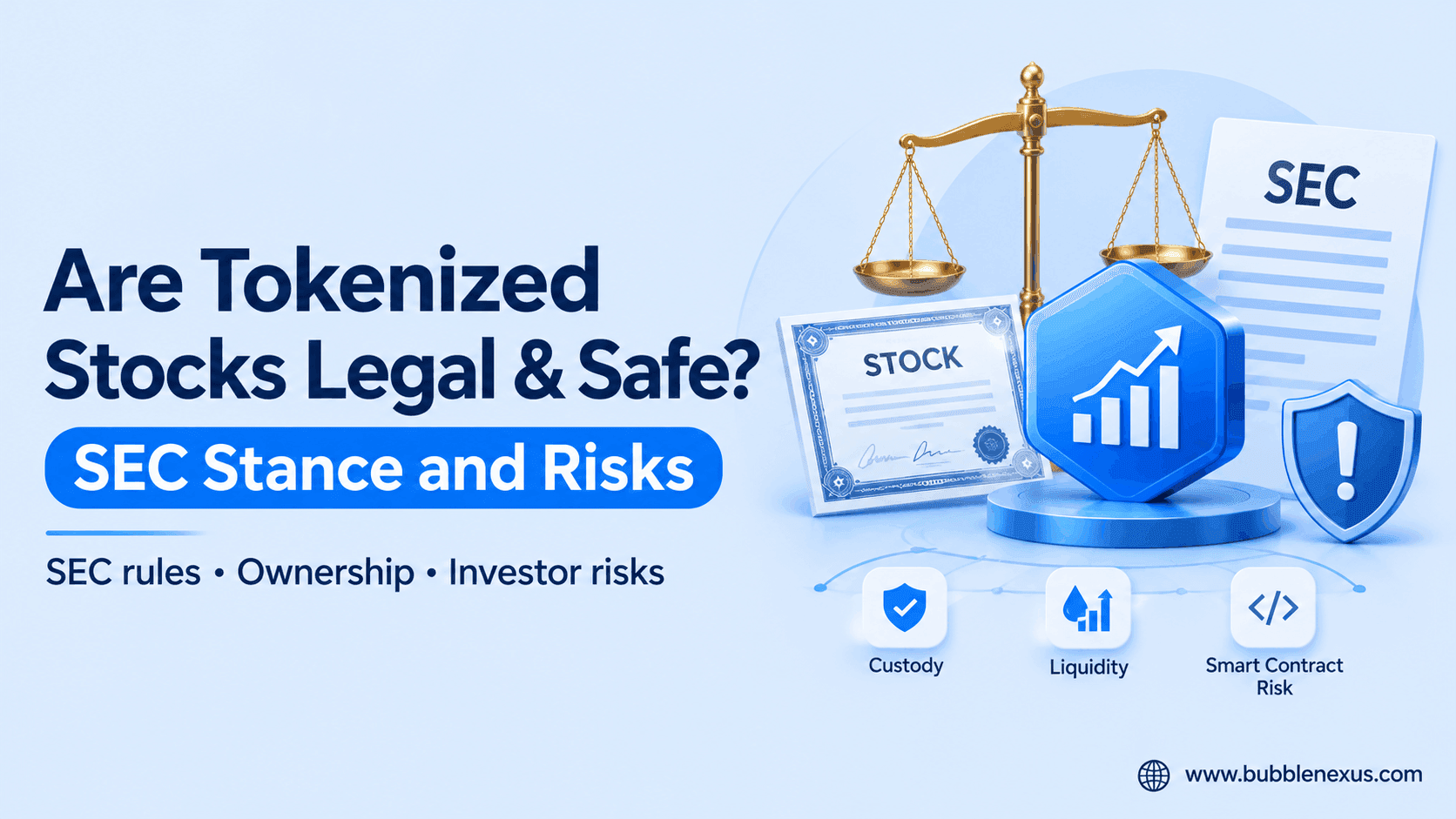



Tokenized stocks are blockchain tokens linked to the price of a company’s share. Many people ask two things before they touch them: is this allowed, and can I lose my money? The short answers: it depends on your country and on how the token is built, and yes, you can lose money. This guide explains the SEC’s position on tokenized stocks, the rules in a few other regions, and the risks to check first. Every legal statement has a date, because rules in this area change fast.
Quick answer
Tokenized stocks are not banned everywhere, but whether they are legal depends on your country and on how the token is built. In the US, the SEC says tokenized securities are still securities, so securities laws apply. Safety also varies: some tokens are backed by real shares, others only track the price.
What is the SEC’s position on tokenized stocks?
The SEC’s position is that a security stays a security when it is put on a blockchain, so the same securities laws apply. The SEC has not banned tokenized stocks, and it has not given them a free pass either. Here is the timeline, with dates.
- July 9, 2025. SEC Commissioner Hester Peirce said that tokenized securities are still securities. This was one commissioner’s statement, not a Commission rule.
- January 28, 2026. Staff from three SEC divisions (Corporation Finance, Investment Management, and Trading and Markets) published a Statement on Tokenized Securities. It creates no new rules or exemptions, and it reflects staff views, not a Commission action. Law firm summaries say it splits tokens into issuer-sponsored and third-party-sponsored types. It also warns that third-party models can add counterparty, operational and insolvency risks, and that some synthetic tokens may count as security-based swaps. Those swaps cannot be sold to US retail investors without SEC registration and trading on regulated venues.
- September 17, 2026. The SEC issued a temporary “Innovation Exemption” for tokenized stock trading venues that use permissioned liquidity pools. Conditions include limits on symbols and volume, the same rights as the traditional stock, public and auditable smart contracts, and halting when the underlying stock halts. The relief expires five years after publication, and the SEC asked for public comment.
The SEC is not the only name in the news. The Depository Trust & Clearing Corporation (DTCC) says its subsidiary DTC received an SEC no-action letter to tokenize certain stocks, ETFs and Treasuries, with a rollout planned for the second half of 2026, according to The TRADE. DTCC tokenized stocks are meant to carry the same rights as regular shares, which is different from many crypto-native tokens.
What this means in practice: there is no single answer that “tokenized stocks are legal in the US”. Legality depends on the structure and on who offers the product. One example: Gemini’s September 2026 SEC filing says its tokenized stocks were advertised only to users in the EU.
Legal status outside the US
These four regions give a snapshot. Each row links to the regulator’s own page where we could verify one.
| Region | What the regulator says | Date |
|---|---|---|
| EU (ESMA) | An ESMA executive said in September 2025 that these products typically do not give shareholder rights. ESMA’s risk report of September 10, 2026 says wrapped structures dominate the market and that, where ownership is recorded off-chain, moving the token does not move legal title to the share. It is risk monitoring, not binding guidance, and does not call wrapped tokens unlawful. A PwC Legal summary reports the market grew from about €0.3 billion to about €1.9 billion between end-2024 and June 2026. | Sep 2025, Sep 10 2026 |
| UK (FCA) | The FCA and Bank of England published a joint vision for tokenisation in UK wholesale markets and asked for industry feedback by July 3, 2026. We did not find a UK rule written specifically for US stock tokens sold to retail users, so check the FCA before you trade. | May 18, 2026 |
| Singapore (MAS) | MAS’s Guide on the Tokenisation of Capital Markets Products says existing securities law applies to tokenised products, including offers and the firms that facilitate them. Dealing in them may need a capital markets licence. | Nov 14, 2025 |
| UAE (SCA / Capital Market Authority) | The federal regulator has a security token framework for tokenised shares and bonds, and the regulator was reconstituted as the Capital Market Authority on January 1, 2026, according to law-firm guides. Dubai’s VARA and the ADGM and DIFC free zones have their own rules, so the answer depends on where the platform is licensed. | 2025–2026 |
Last verified: November 17, 2026. Rules change often, so check the regulator’s page before you act.
Are tokenized stocks the same as owning shares?
Often, no. Many tokens give you price exposure or a claim on a company, not direct ownership of the share. What you get depends on how the token is built.
| Structure | What you usually hold | Main thing to check |
|---|---|---|
| Issuer-sponsored | The company itself issues the share in token form | Which record counts as the official share register |
| Backed (custodial) token | A claim linked to real shares held by a custodian | Whether you can reach those shares if the issuer fails |
| Synthetic token | Price exposure through a derivative or tracker | You have no claim on the share at all |
The ESMA-related PwC summary puts it simply: the token is not the share. In a wrapped structure, the token holder usually owns the token and contract rights, while the registered shareholder stays someone else. For example, it notes that the issuer of xStocks describes each token as a tracker certificate issued by a Jersey special-purpose company, backed by assets held with regulated custodians. It also says Kraken’s disclosure states that holders have no voting, distribution or liquidation rights against the underlying company.
Voting rights: many tokens give none. If the issuer fails: the result depends on whether the shares are legally separated from the issuer’s own assets. SEC staff flagged insolvency risk for third-party models. Read the product terms for the exact answer.
Key risks
Tokenized stocks are not risk-free. Some are backed by real shares and are lower risk than others, but all of them carry extra risks on top of normal stock-market risks:
- Issuer and custodian risk. If either one fails or freezes redemptions, the token can lose value even when the stock does not.
- Redemption limits. Some tokens can only be redeemed by certain users, in certain regions, or above a minimum size.
- Liquidity. On November 17, 2026, several tokens on BubbleNexus’s tokenized stocks table showed zero 24-hour volume. Thin trading can mean wide spreads.
- Price gaps. A token may trade when the stock market is closed, so its price can drift from the underlying share.
- Smart-contract risk. A bug or hack in the token’s code can cause losses.
- Regulatory change. The SEC’s Innovation Exemption is temporary, and regulators in the EU and elsewhere are still reviewing the market.
We did not find a verified case of a major backed token failing, so we cite no incident here. That is not a guarantee that none will happen.
Do tokenized stocks pay dividends?
Sometimes, but not always. Some platforms pass on a dividend-style payment by contract, and some tokens give no distribution rights at all. Check the token’s terms before you count on payouts. For platform examples, see BubbleNexus’s guide to Coinbase tokenized stocks, fees and dividends.
How to reduce risk: a checklist
- Know the issuer. Find the legal name of the issuer and the custodian.
- Check regulation. Look for a licence or approval on the regulator’s own website.
- Proof of reserves or audits. Look for regular reports on the shares backing the tokens.
- Read the redemption rights. See whether you can swap the token back for shares or cash, and what the limits are.
- Fees. Check trading, custody and redemption costs.
- Region eligibility. Confirm the product is offered in your country.
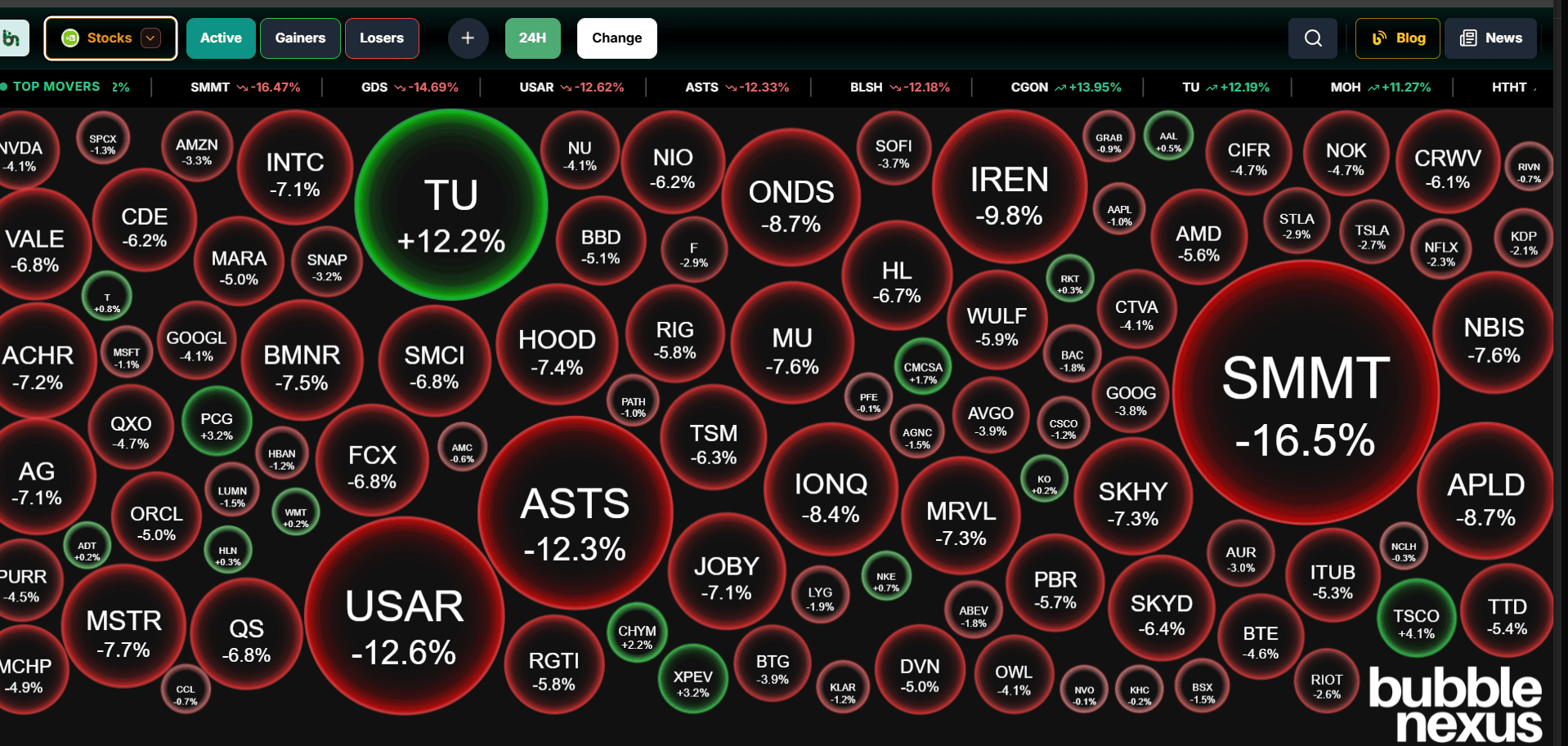
- Compare with the real stock. Use the stock market bubble map to see how the share moves against its token.
Frequently Asked Questions (FAQs)
Are tokenized stocks legal in the US?
Not banned, but it depends on the structure and the seller. The SEC says tokenized securities are still securities, so securities laws apply. Some synthetic tokens may need registration or may be limited to certain investors. Check that the platform offers the product to US users.
Are tokenized stocks safe?
Not risk-free. They carry extra risks on top of normal market risk, such as issuer, custodian, liquidity and smart-contract risk. Backed tokens from regulated issuers may lower some of these risks, but nothing removes them completely. Read the product terms, and work through the checklist above before you trade.
Can I lose money on tokenized stocks?
Yes. You can lose money if the stock falls, if the token’s price drifts away from the share, or if the issuer, custodian or platform fails. Prices may also move when regular markets are closed, and thin trading can widen the gap. Only use money you can afford to lose.
Are tokenized stocks the same as shares?
Often not. Many tokens give you price exposure or a contract claim, not direct ownership of the share, and voting or dividend rights can be limited or missing. Some structures are different: DTCC says its planned tokenization service is designed to mirror the rights of the real securities. Always read the terms.
What is DTCC’s role in tokenized stocks?
DTCC is the US market’s post-trade utility, and it plans to tokenize regular securities. Its subsidiary DTC says it received an SEC no-action letter in December 2025 to tokenize certain US stocks, ETFs and Treasuries on approved blockchains. The service was planned for the second half of 2026. Check DTCC for the current status.
Conclusion
Tokenized stocks sit in a moving legal picture. The SEC says the same securities laws apply, other regulators have raised investor-protection concerns, and the structure of each token decides what you actually own. Before you trade, check the issuer, the rules in your country and your redemption rights. You can follow live prices and volume for about 88 tokens on the BubbleNexus tokenized stocks page.
Non-disclaimer: What This Guide Can and Cannot Say
This guide summarizes public statements from regulators and law-firm and news sources, with dates, as of November 17, 2026. It cannot tell you whether a specific token is legal for you. BubbleNexus shows market data and does not sell tokens.
This article is for informational purposes only and is not financial, legal or tax advice. Tokenized assets carry risk; do your own research.