Tokenized stocks are blockchain-based instruments linked to company shares, but some give direct share rights while others provide only a claim against a provider or price exposure. The contract, not the label, determines what a buyer actually owns.
What is a Tokenized Stock?
A tokenized stock is a digital token on a blockchain that represents a share of a real company's stock. Instead of holding the share in a traditional brokerage account, you hold a crypto-style token whose price is meant to follow the real stock's price. For example, one token might track one share of Tesla.
These tokens can often be traded 24/7 and in small fractions. However, they usually don't give you the same legal rights as owning the actual share, and the rules vary by platform and country.
How Do Tokenized Stocks Work?
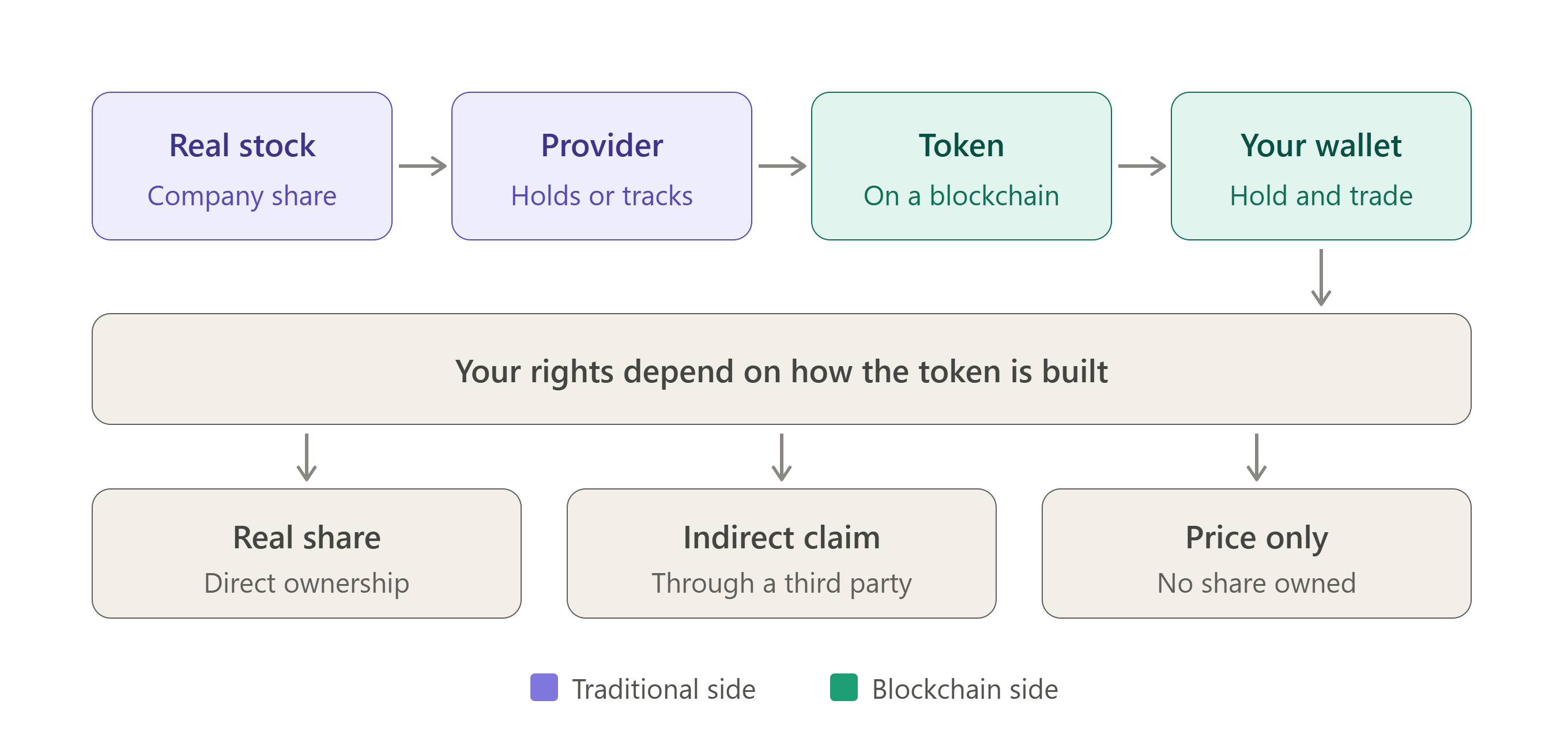
A basic transaction has four parts:
- An issuer or provider defines the product. It identifies the underlying share and publishes terms stating whether the token is the security itself, a custody-based claim, or a linked instrument.
- The token is created and recorded. A blockchain records token balances and transfers. In some structures, an official share register or custody ledger remains off-chain and must be updated or reconciled as well.
- A buyer trades through a platform or wallet. The platform may allow purchases in fractions, use a stablecoin or cash, and set its own trading hours, fees, eligibility rules and transfer limits.
- The contract handles value changes and corporate events. Dividends, stock splits, mergers, redemptions and trading halts can be treated differently from direct share ownership. The product documents say what happens; do not assume the token automatically has the same treatment as a share.
A blockchain can make the record of a transfer visible, but it does not by itself establish who legally owns the underlying shares, guarantee that collateral is available, or remove the need for securities-law compliance.
Which Is the Most Trending Tokenized Stock?
There is no single, official definition of “trending” for tokenized stocks. A token can rank high by total value, recent returns, trading volume, number of holders, or online attention and those measures can produce different answers.
As a transparent proxy, RWA.xyz’s tokenized-stocks dashboard displayed the following leading individual instruments by total value in the rows returned for 22 September 2026.
| Dashboard Entry | Ticker Shown | Total Value | What This Does and Does Not Mean |
|---|---|---|---|
| Securitize Corp | SECZ | $349.4 million | The dashboard labels it “equity,” but this is not by itself proof that it is a regular exchange-listed common share. |
| Strategy Inc. PP Variable xStock | STRCx | $136.3 million | Large share-linked token; check the product’s exact security class and terms. |
| Circle Internet Group (bStocks) | CRCLB | $121.4 million | A tokenized exposure to the listed Circle company, as identified by the dashboard. |
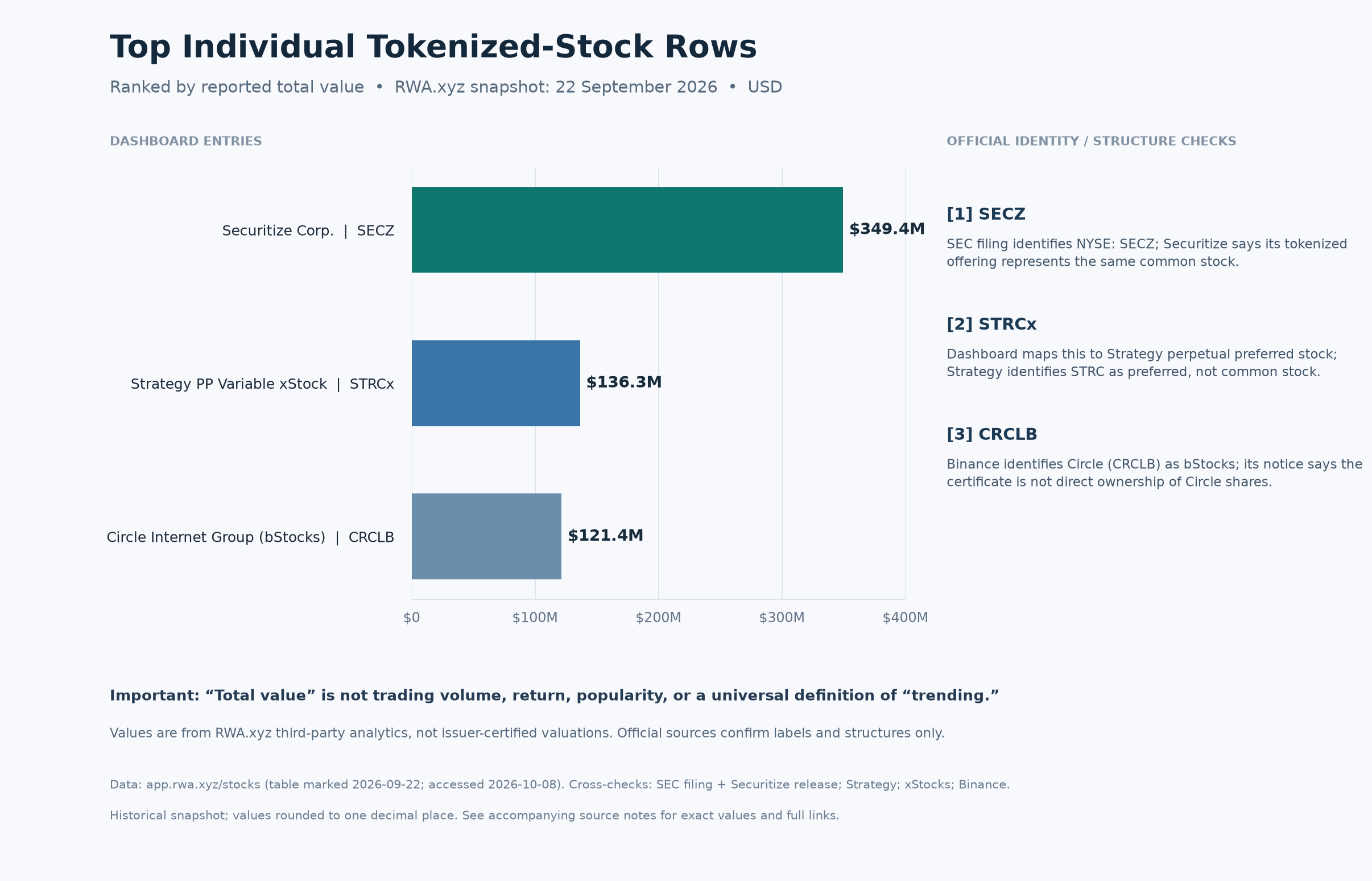
So, by the dashboard’s total-value measure, SECZ was the largest individual entry shown. That is not a claim that it had the most trades, the best returns, or the most public interest.
If the question is specifically about familiar tokens linked to listed U.S. company shares, Strategy’s STRCx and Circle’s CRCLB were among the largest visible entries, but their legal and share-class details are not interchangeable.
Which Is the Best Platform for Buying Tokenized Stocks?
There is no best platform for everyone. Availability depends on where a person lives, and the products on different platforms may be legally different instruments. The examples below describe published terms checked on 8 October 2026; they are not endorsements.
| Platform / Product | Published Structure and Access | Important Distinction to Check |
|---|---|---|
| Ondo Global Markets | Its documentation describes tokenized stocks as structured notes issued by a BVI company, backed 1:1 plus a buffer by corresponding referenced companies. The securities are held through a regulated custodial broker-dealer. Its offer is restricted to eligible non-U.S. persons and other jurisdictional conditions. | Ondo says holders do not have voting or shareholder-information rights in the note terms. Issuer/custody arrangements, redemption process and local eligibility matter. |
| Kraken xStocks | xStocks are issued by Backed Assets (JE) Limited. Product documents describe collateral linked to the underlying equity; Kraken says the tokens provide price exposure and are not direct ownership of the shares. | Access is restricted by jurisdiction, including the U.S., Canada, U.K. and Australia. |
| Robinhood Classic Stock Tokens (Europe) | Robinhood describes these as blockchain-recorded derivatives that follow U.S. stock and ETF prices, not the stocks themselves. Its help page states a 0.10% foreign-exchange fee on each order and weekday trading from Monday 02:00 to Saturday 02:00 CET/CEST, subject to local daylight-saving time. | These tokens cannot currently be sent to another wallet or platform, according to Robinhood. The derivative contract and provider risk are different from holding a share directly. |
A sensible comparison starts with the legal issuer and the exact instrument, then checks:
- Your jurisdiction and investor eligibility.
- Whether you own a share, a custody entitlement or a note/derivative.
- Voting, dividend and information rights.
- Custody, collateral, insolvency protections and redemption.
- All spreads, conversion charges and network fees.
- Whether you can transfer or sell when you want.
Read the current product terms before making a decision.
The chart below compares RWA.xyz’s platform-level total values, not product quality or stock-token trading volume. The figures are the values shown in its league table for 22 September 2026.
.png)
These platform totals combine many products and may include different security types, chains and legal structures. A larger platform total does not mean that the platform is safer or better.
Risks of Tokenized Stocks
The main risks of tokenized stocks include:
- You may not own the underlying share. Some products are notes or derivatives that only track a share price. They may not give voting, shareholder-information or direct dividend rights.
- Issuer, intermediary and custody risk. If the issuer, custodian or platform fails, access to tokens or underlying assets may be delayed or lost. The SEC notes that third-party token holders can face bankruptcy exposure to the token provider.
- Price and liquidity risk. The token can trade with a spread or at a different price from its reference share. A platform may have limited buyers, change its service, or restrict trading. A token’s extended-hours availability does not ensure that the underlying stock is trading or that a buyer will be available.
- Technology and cyber risk. Smart-contract bugs, lost keys, wallet errors, outages, hacks or network problems can interrupt transfers or cause losses. The IMF notes that tokenization may make settlement faster, but that speed can also make liquidity needs and operational problems appear quickly.
- Legal and jurisdiction risk. A product may be available in one country and restricted in another. The security-law treatment depends on the actual instrument and the way it is offered, not simply on its being “on-chain.”
- Fees and tracking differences. Issuance, redemption, spreads, currency conversion, custody and network fees can reduce the return compared with directly holding the referenced share. Robinhood and Kraken both disclose product-specific charges or spreads.
- Corporate-action and counterparty risk. Dividends, splits, mergers and delistings may be handled under the contract rather than by the company’s share register. Read the terms for the specific token; products can differ.
A token can therefore fall in value even when the blockchain works as designed. Some providers explicitly warn that buyers can lose all of the amount invested.
Tokenized Stocks Price Prediction for the Future
There is no reliable one-number tokenized stocks price prediction for the future. The category contains different instruments and references many different companies, so a single price target would be misleading.
For a token that is designed to follow one share, the underlying company’s market price is usually a major driver, but the token’s own fees, spread, liquidity, contract terms, trading hours and provider risks can make its return differ from the share.
| Scenario | What Could Support It | What Readers Should Watch |
|---|---|---|
| Expansion | Clearer rules, approved market infrastructure, reliable custody and products with transparent shareholder rights could increase adoption. | Whether announced venues receive approvals, publish final terms, and demonstrate liquid trading and robust settlement. |
| Gradual Adoption | Platforms continue adding products, but investor uptake, cross-border rules and interoperability remain uneven. | Actual platform-level issuance, redemptions, trading activity, fees and the difference between token and reference-share prices. |
| Setback | Regulatory restrictions, issuer or custodian failure, cyber incidents, weak liquidity or fragmented networks could slow adoption and cause losses. | Regulatory notices, redemption interruptions, custody disclosures, smart-contract incidents and widening spreads. |
The IMF’s 2026 note says tokenization could support faster settlement but also raises policy issues involving liquidity, governance, legal certainty, interoperability and financial stability. That is a discussion of the wider financial system, not a prediction that any specific token or stock will rise.
The future price of a tokenized stock remains tied to its underlying asset and product terms, and can fall sharply or become difficult to sell.
Future Plans for Tokenized Stocks
Several developments are real plans or regulatory steps, but they are not promises that every product will launch:
- NYSE/ICE platform development: ICE announced on 19 January 2026 that the NYSE was developing a tokenized-securities platform. Its proposed features include 24/7 operations, fractional orders, immediate settlement and stablecoin funding. ICE said the platform would require regulatory approvals; the announced design would support both tokenized shares intended to be fungible with traditional securities and natively issued digital securities.
- Digital transfer-agent work: On 24 March 2026, ICE and Securitize announced a memorandum of understanding to develop transfer-agent and broker-dealer infrastructure for the proposed NYSE platform. The announcement describes development work and expected roles, not a live retail product.
- Limited U.S. trading pathway: The SEC’s September order creates a temporary, conditional route for qualifying venues to trade certain tokenized U.S. stocks, while it requests public comment and considers further action. The order does not turn all current tokens into directly owned shares.
- Broader infrastructure questions: The IMF argues that safe settlement assets, clear legal ownership, interoperability and crisis-management plans will matter if tokenized markets expand.
In short, the future direction is toward more tokenized products and financial infrastructure, but launch dates, access, regulation, liquidity and the rights attached to each token remain product-specific and subject to change.
Key Takeaways
- “Tokenized stock” can mean an actual blockchain-recorded security, a custody-based claim, or a derivative/note linked to a stock.
- Check the legal terms to see what you own and whether you receive voting, dividend or information rights.
- There is no universal “best platform” or official “most trending tokenized stock” ranking; the metric and country matter.
- The SEC has created a narrow, conditional U.S. trading exemption, not a general approval for every stock token.
- No reliable category-wide price prediction exists. The underlying company, product structure, fees, liquidity and counterparty all matter.