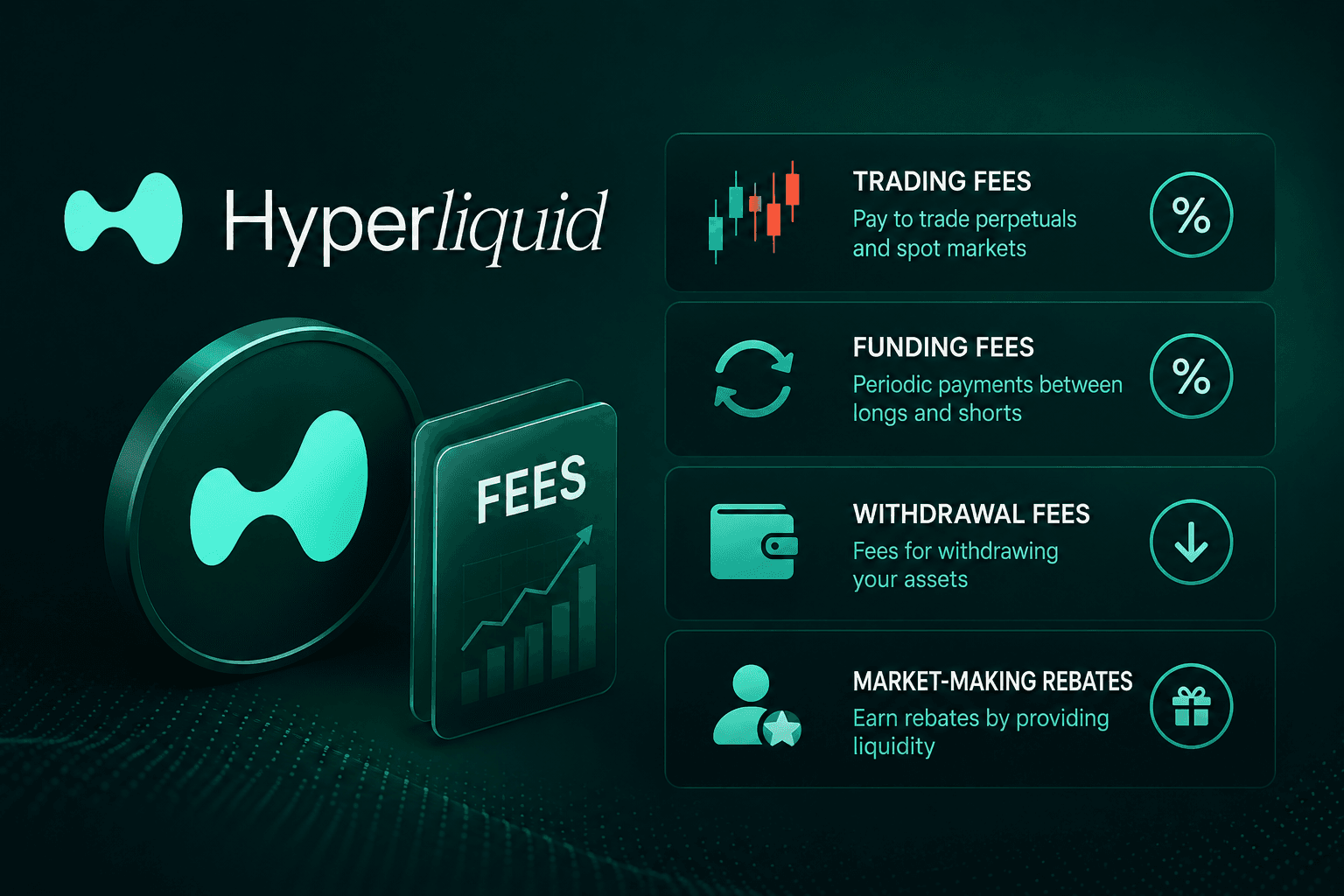




Hyperliquid Fee Structure at a Glance
- Perp taker fees: 0.045% down to 0.024% (base rates by volume tier, Tier 0-6)
- Perp maker fees: 0.015% down to 0%, with negative rebates up to −0.003% for top market makers
- Spot fees: 0.07% taker / 0.04% maker at base rates, with lower rates for aligned and stable pairs
- Funding: paid hourly, peer-to-peer between longs and shorts, capped at 4% per hour
- Withdrawals: a flat 1 USDC fee (2% drag at $50, 0.02% drag at $5,000); deposits are free
- Staking discounts: 5%-40% off trading fees for staking 10 to 500,000+ HYPE
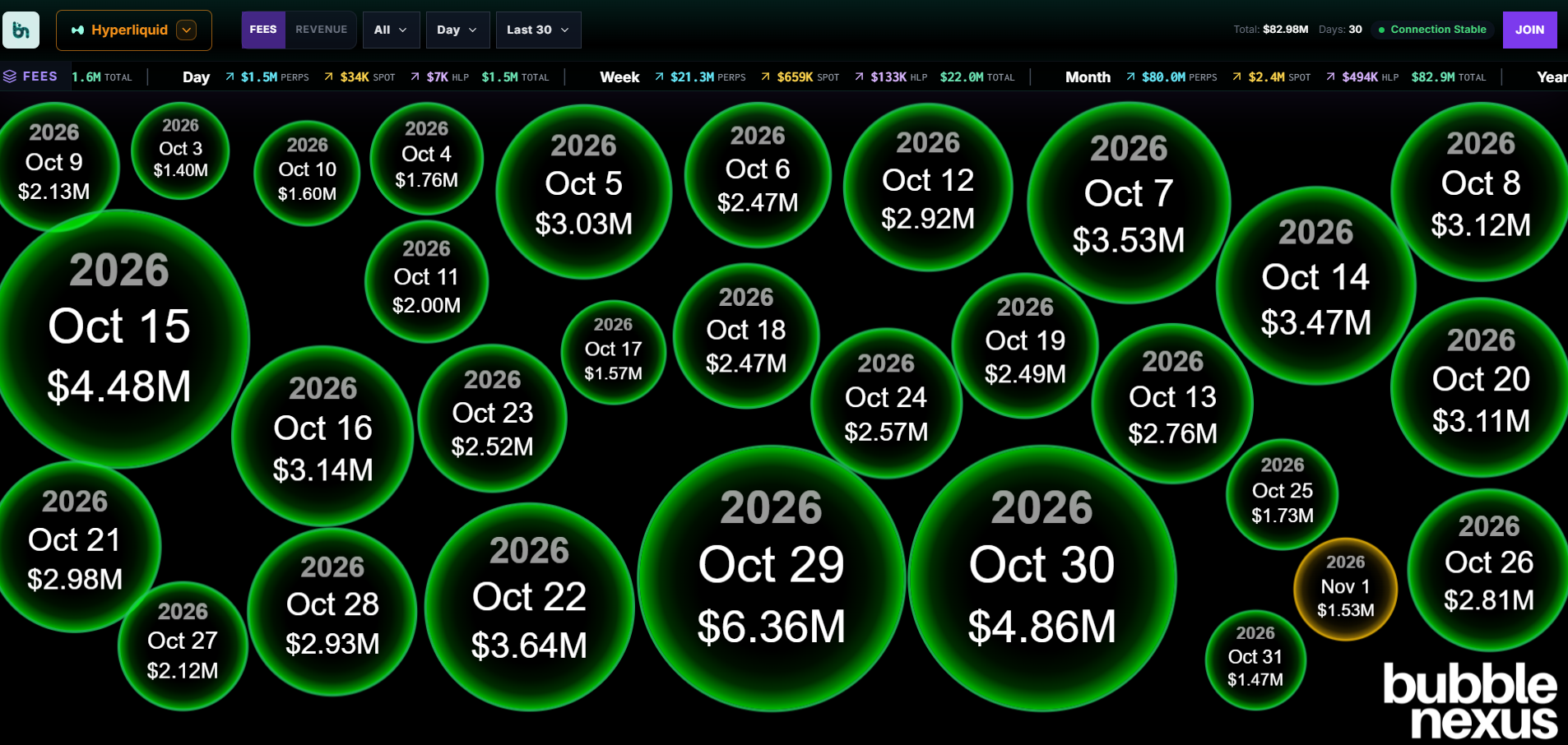 hyperliquid fees
How are Hyperliquid fee tiers calculated and when do they update?
Your tier is based on rolling 14-day weighted volume and is reassessed at the end of every day in UTC. Spot volume counts double toward the threshold, and every product type-validator perps, HIP-3 perps, and spot, shares a single fee tier per account. The weighted formula is:
14d weighted volume = 14d perps volume + 2 × 14d spot volume.
- Daily refresh: tier changes take effect at 00:00 UTC based on the trailing 14 days
- Sub-accounts: all sub-account volume aggregates to the master account, which shares one tier across every sub-account
- Vaults: vault volume is tracked separately and does not lift your personal tier
- One-time limits: referral discounts apply to your first $25M in volume; referral rewards apply to your first $1B
How much do perpetual futures trades cost on Hyperliquid?
Perp trading costs a taker or maker fee charged on the full notional value of the order (leverage included). At the base tier, takers pay 0.045% and makers pay 0.015%. Here is the complete official tier schedule:
| Volume Threshold (14d weighted) | Taker (Base) | Maker (Base) | Taker (Diamond) | Maker (Diamond) |
|---|---|---|---|---|
| Tier 0 (under $5M) | 0.045% | 0.015% | 0.0270% | 0.0090% |
| Tier 1 (> $5M) | 0.040% | 0.012% | 0.0240% | 0.0072% |
| Tier 2 (> $25M) | 0.035% | 0.008% | 0.0210% | 0.0048% |
| Tier 3 (> $100M) | 0.030% | 0.004% | 0.0180% | 0.0024% |
| Tier 4 (> $500M) | 0.028% | 0% | 0.0168% | 0% |
| Tier 5 (> $2B) | 0.026% | 0% | 0.0156% | 0% |
| Tier 6 (> $7B) | 0.024% | 0% | 0.0144% | 0% |
Diamond rates shown above apply when a trader holds the Diamond staking tier (>500,000 HYPE, 40% discount). Every other staking level gets its own discounted column in the official schedule (Bronze, Silver, Gold, Platinum, Wood).
The Base Layer: Hyperliquid Maker and Taker Fees
Hyperliquid's base rates are 0.045% taker and 0.015% maker on perpetuals, and 0.07% taker / 0.04% maker on spot all charged in USDC and assessed on the full notional value of each trade, not on your margin.
- Fees are charged on notional value, not margin. A 10x leveraged $10,000 position pays fees on the full $10,000, not on the $1,000 of collateral behind it. Leverage multiplies your fee bill exactly as it multiplies your position.
- Fees come out of your USDC balance, not your PnL. On a losing trade, your account shrinks by both the loss and the fee, which means a high-leverage scalping strategy degrades faster than the chart suggests.
- Tiers are based on a rolling 14-day weighted volume, recalculated daily in UTC. Spot volume counts double toward your tier:
(14d weighted volume) = perps volume + 2 × spot volume.
Perpetuals Fee Tiers
Fees drop in steps as your 14-day weighted volume rises. The table below shows the full official schedule at the entry tier (Base rate) and the top staking tier (Diamond) for comparison:
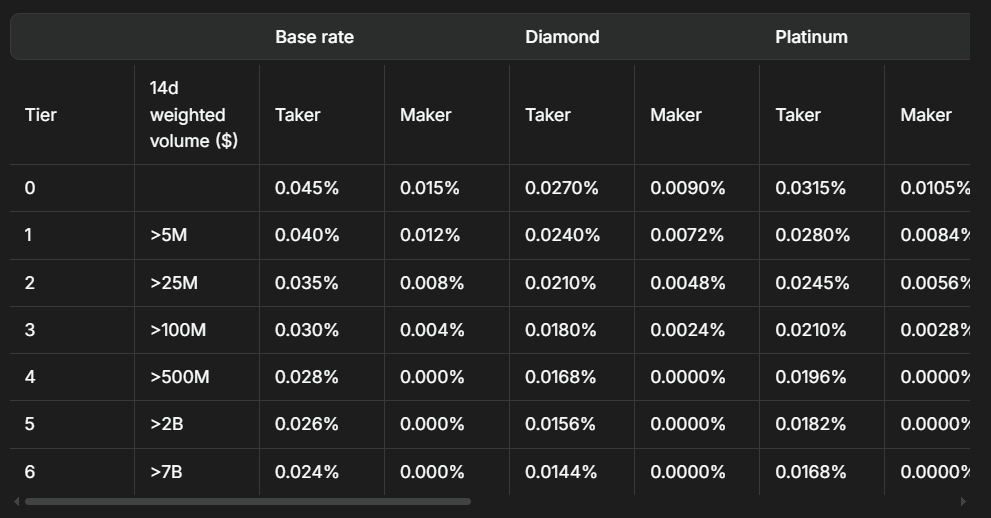 Source: Hyperliquid Fee Tiers
If you open a $1,000-margin, 10x long on BTC, your position size is $10,000. At the 0.045% base taker rate you pay $4.50 to open and roughly $4.50 to close, a round-trip cost of about 0.9% of your margin, before funding. This is why leveraged scalpers with tight profit targets bleed the most from the fee structure, even on a platform where the trades themselves carry no gas cost.
How do negative maker fees work for market makers?
High-volume makers don't just pay zero, they get paid. Makers whose 14-day weighted share of market maker volume crosses set thresholds earn negative maker fees credited directly to their trading wallet on every fill, and the rebates flow continuously rather than requiring a claim. There is no separate designated market maker (DMM) program, special rebates, or latency advantages; the volume tables are the entire system.
| 14d Weighted Maker Volume Share | Maker Fee | On a $10,000 fill |
|---|---|---|
| > 0.5% | −0.001% | $0.10 credited |
| > 1.5% | −0.002% | $0.20 credited |
| > 3.0% | −0.003% | $0.30 credited |
How much does spot trading cost, and what do aligned quote assets change?
Spot base rates are 0.07% taker / 0.04% maker at Tier 0 higher than perps, but with their own discounts. Spot volume also counts double toward your fee tier, which is how many traders climb tiers faster.
| Spot Pair Type | Taker (Tier 0) | Maker (Tier 0) | Volume Contribution |
|---|---|---|---|
| Standard pair (e.g., SOL-USDC) | 0.070% | 0.040% | 200% (2× multiplier) |
| Aligned quote asset pair | 0.056% (−20%) | 0.032% (−20%) | 240% (+20% bonus) |
| Two-spot-quote-asset pair | 0.014% (−80%) | 0.008% (−80%) | 40% (−80% reduction) |
For the full spot schedule, base Tier 0 runs 0.070% taker / 0.040% maker, compressing to 0.025% taker / 0% maker at Tier 6.
How does the hourly funding rate actually get calculated?
Funding is the carry cost of holding a perpetual (a peer-to-peer payment) from one side to the other with no fee taken by the protocol. Hyperliquid settles it every hour (CEXs typically use 8-hour windows), sampling order-book depth every 5 seconds and averaging over the hour.
- Formula: Funding rate = Average Premium Index + clamp(interest rate − Premium Index, -0.05%, +0.05%), computed as an 8-hour rate and paid hourly at one-eighth
- Interest component: fixed at 0.01% per 8 hours (about 0.00125% per hour, roughly 11% APR flowing to shorts)
- Premium component: tracks the gap between the perp price and the validator oracle price; if the perp trades above spot, longs pay shorts, and vice versa
- Cap: 4% per hour, far more permissive than CEX caps
-
Payment math:
position size × oracle price × funding rate, added or subtracted at each hourly mark
In concrete terms, a $1M notional long with a 0.02%/hour rate (premium plus interest) pays $200 per hour and $4,800 per day if that rate persisted which is exactly why funding drag dominates the cost of crowded, leveraged swing trades.
How much does hourly funding quietly cost a leveraged position?
Funding never appears on the fee schedule because it is a peer-to-peer payment between longs and shorts, but it is often the biggest recurring cost on leveraged trades.
- Paid every hour: debited or credited to your balance each hour, even when your trade is losing
- Example: a $10,000 long at 0.01% per hour pays $1.00 per hour, or $24 per day
- Versus trading fees: that passes the $9.00 round-trip taker fee on the same position in about 9 hours
What does it cost to deposit and withdraw on Hyperliquid?
Deposits are free of Hyperliquid fees; you only pay gas on the source chain (Arbitrum gas if bridging USDC, native gas on Bitcoin/Solana/Ethereum for direct asset deposits). Note the minimum: deposits under 5 USDC are not credited and are lost permanently.
Withdrawals carry a flat 1 USDC fee charged on Hyperliquid to cover the Arbitrum gas costs paid by validators. No Arbitrum transaction is needed from your wallet — you sign on Hyperliquid and funds typically arrive in 3–5 minutes.
| Withdrawal Amount | Flat Fee | Effective Fee Drag |
|---|---|---|
| $50 | 1 USDC | 2.00% |
| $500 | 1 USDC | 0.20% |
| $5,000 | 1 USDC | 0.02% |
| $50,000 | 1 USDC | 0.002% |
Here's the catch: the flat fee punishes micro-withdrawals. Withdrawing $50 costs 2% more than most perp trades. Batch withdrawals or keep a working balance on-platform instead of pulling out after every session.
Because the fee is flat, it hurts small withdrawals most: a $50 withdrawal costs 2%, more than 40 times the 0.045% base taker rate.
Deposits cost gas too. Hyperliquid charges nothing for deposits, but the USDC transfer is an Arbitrum transaction, so you pay Arbitrum network gas in ETH. It is usually small, but it moves with network congestion and you pay it on every deposit.
Batch your transfers. One deposit of $10,000 pays Arbitrum gas once, while ten deposits of $1,000 pay it ten times. In the same way, one larger withdrawal pays the 1 USDC fee once, so keep a working balance on Hyperliquid instead of withdrawing after every session.
What bridge and gas costs does Hyperliquid have besides the withdrawal fee?
Trading on Hyperliquid is gas-free, but moving money in and out is not. These costs never show up in a fee table, and frequent depositors pay them again and again.
- Deposits: no Hyperliquid fee, but the USDC transfer is an Arbitrum transaction, so you pay Arbitrum network gas in ETH
- Withdrawals: a flat 1 USDC fee on every withdrawal, whatever the size
- Other chains: funds are paid out on Arbitrum, and moving them on through a third-party bridge adds that bridge's own fee
Here's the catch: gas is charged per transfer, not per dollar. One $10,000 deposit pays Arbitrum gas once, while ten $1,000 deposits pay it ten times. Batch your transfers instead of moving money after every session.
What are the hidden costs most Hyperliquid traders miss?
Most traders judge a platform by its taker fee, but some costs only appear after the trade is placed. Liquidation is one of them.
Liquidations have no fee, but they still cost money. Unlike most centralized exchanges, Hyperliquid charges no clearance fee. If the order book closes your position, you keep the collateral that is left. If equity falls below two-thirds of the maintenance margin and the book has not cleared the position, the liquidator vault takes it over and your maintenance margin is not returned. Maintenance margin is half of the initial margin at maximum leverage, so it runs from 1.25% of position size on 40x assets to 16.7% on 3x assets. Stop-loss orders placed before the liquidation price protect that buffer.
How can you lower your Hyperliquid fees?
Two official discounts cut the base rate, and they stack with each other and with your volume tier: a referral code and HYPE staking.
Referral discount. Using a referral code gives you a 4% discount on your fees for your first $25M in volume. Apply it before you start trading.
HYPE staking discount. Staking HYPE adds a discount on top of your volume tier, on both perps and spot:
| Staking tier | HYPE staked | Trading fee discount |
|---|---|---|
| Wood | Over 10 | 5% |
| Bronze | Over 100 | 10% |
| Silver | Over 1,000 | 15% |
| Gold | Over 10,000 | 20% |
| Platinum | Over 100,000 | 30% |
| Diamond | Over 500,000 | 40% |
What the stack saves. Take a Tier 1 trader (over $5M in 14-day volume) with a referral code and a Gold stake. Their base taker fee of 0.040% becomes 0.040% × (1 − 0.20) × (1 − 0.04) = 0.0307%, a 23% total reduction. At the top of the ladder, Diamond staking plus a referral code cuts the rate by about 42%.
Cost-cutting checklist
- Use limit orders. Maker fees (0.015% base) are one-third of taker fees, and high-volume makers can earn rebates of up to −0.003%.
- Stake from the address you trade with. If you link a separate staking address to a trading address, the link is permanent, and the staking address can move all funds out of the trading address. Only link addresses you control.
- Check funding before you hold. At 0.01% per hour, funding on a $10,000 position passes a round-trip taker fee in about 9 hours.
- Batch your bridge transfers. Fewer, larger deposits and withdrawals pay Arbitrum gas and the 1 USDC fee less often.
- Size leverage to maintenance margin, not entry margin. A backstop liquidation does not return it.
Frequently Asked Questions (FAQs)
Q1: Does Hyperliquid charge gas fees when I trade perps?
A: No. Trading on HyperCore is gas-free after account activation; gas applies only on the source chain for deposits and on HyperEVM contract interactions (paid in HYPE).
Q2: What is the taker fee for a small perp trader on Hyperliquid?
A: 0.045% of notional at the base tier, falling to 0.024% at the highest volume tier, with staking discounts of 5-40% applied on top.
Q3: How often is funding paid on Hyperliquid perpetuals?
A: Every hour, at one-eighth of the computed 8-hour rate (0.01% interest plus a 5-second-sampled premium), capped at 4% per hour and paid peer-to-peer between longs and shorts.
Q4: Can I earn money as a market maker on Hyperliquid?
A: Yes — makers whose volume share exceeds 0.5%, 1.5%, or 3.0% of market maker volume earn rebates up to −0.003% per fill with no DMM program, special terms, or latency advantages.
Disclaimer: This content is for informational purposes only and does not constitute financial or trading advice. Fee structures and platform rules may change over time; always verify current rates on the official Hyperliquid platform before trading.