



Robinhood prediction markets let eligible customers buy or sell event contracts tied to outcomes such as sports, elections, economics, weather, and culture. A standard contract settles at $1 if its stated outcome happens and $0 if it does not, but fees, the market price, settlement rules, and current eligibility all affect what a trade is worth.
What Is the Robinhood Prediction Market?
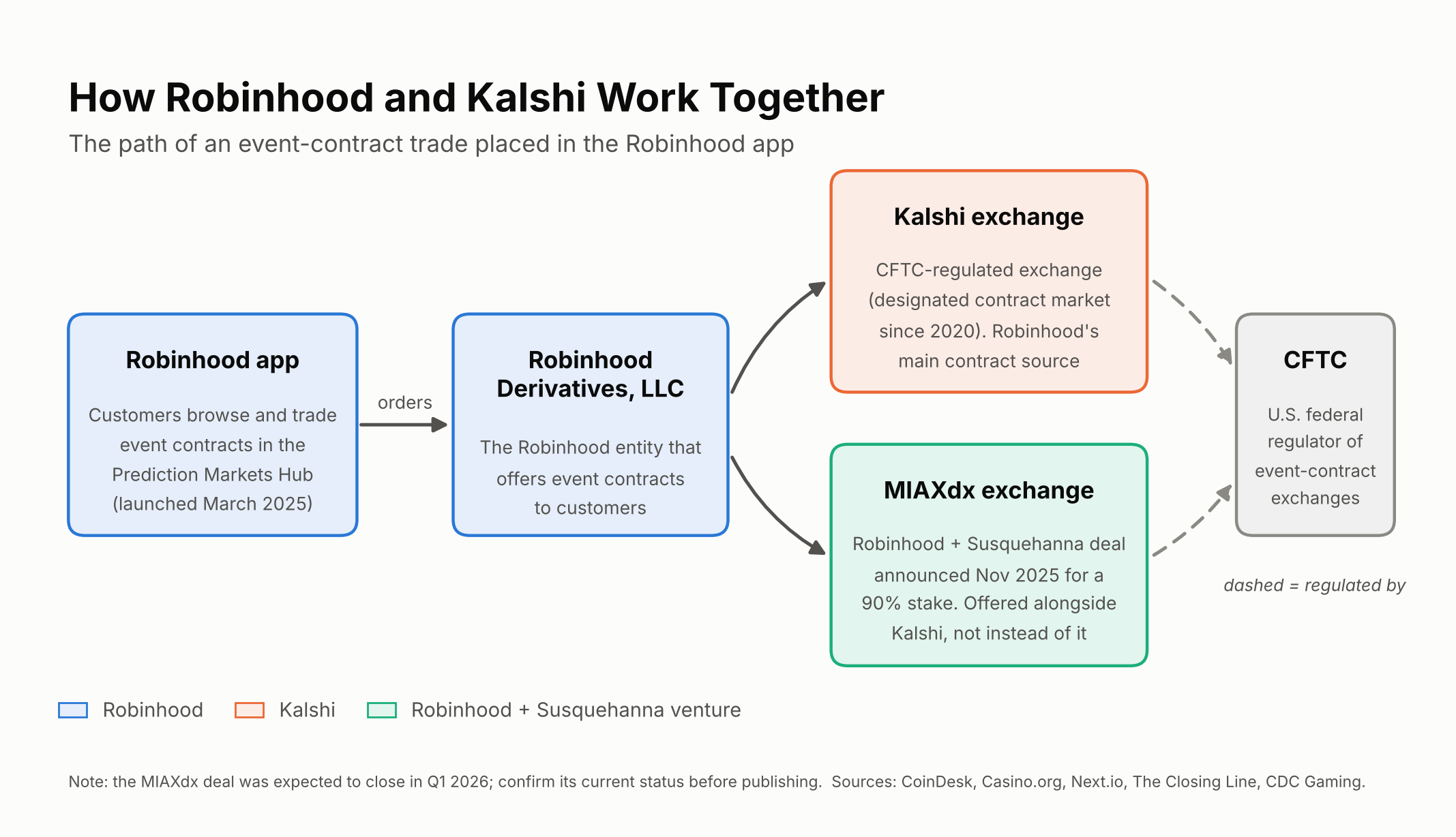
A Robinhood prediction market is a marketplace for event contracts. Each contract asks a defined question about a real-world event. You choose Yes if you think the outcome will happen or No if you think it will not. Robinhood describes these products as financial derivatives offered through Robinhood Derivatives and partner exchanges regulated by the Commodity Futures Trading Commission (CFTC).
The price moves as traders buy and sell. A Yes contract priced at 65 cents indicates that the market is pricing that outcome at roughly 65%—not that the outcome is certain or that the market has calculated an objective probability. Robinhood says standard contracts settle for $1 or $0, though the exact contract rules can provide for special outcomes.
Robinhood reported in September 2026 that more than 45 billion event contracts had been traded on its platform since launch, including more than 30 billion in 2026 through August. That is a company-reported count of contracts, not the number of individual traders, their profits, or an independent measure of accuracy.
Is Robinhood Prediction Markets Legal?
Short answer: Robinhood offers event contracts through CFTC-regulated venues, and trading is available in most US states. But whether states can regulate sports event contracts as gambling is unsettled, and courts have not agreed.
- Robinhood's position: It describes event contracts as financial derivatives offered through Robinhood Derivatives and exchanges regulated by the CFTC.
- The state challenge: Some states say sports event contracts are gambling and fall under state law. In September 2026, Reuters reported that the Sixth U.S. Circuit Court of Appeals ruled that Ohio and Tennessee could regulate Kalshi event contracts under state gambling laws. That ruling concerned Kalshi and those cases, not every state or every Robinhood market.
- Supreme Court: In September 2026, New Jersey asked the US Supreme Court to decide who regulates sports betting on prediction markets. Axios noted that it is not guaranteed the Court will take the case. If it does and sides with the states, access to some contracts could change.
- State restrictions today: Robinhood says Maryland and Nevada residents cannot trade sports event contracts, and Michigan residents have been unable to open new sports event contracts since September 9, 2026. Other restrictions may apply, so check the app.
This section describes the legal picture as of October 2026. It is not legal advice, and it can change quickly. Check the current rules for your state before trading.
The Robinhood Derivatives Account
Event contracts are not held in the same account as ordinary stock trades. Robinhood requires an approved Robinhood Derivatives (RHD) account. RHD is a registered futures commission merchant with the CFTC and a member of the National Futures Association (NFA). Robinhood says RHD is not FDIC-insured or SIPC-protected; do not assume protections attached to a separate brokerage account automatically apply to event-contract activity.
Event-contract buying power is separate from regular brokerage and crypto buying power. Robinhood says funds move between those accounts automatically rather than through a manual transfer, and recent deposits may not be usable until they settle.
Separately, live Robinhood perpetual-market data tracks prices, funding rates, and open interest for tokenized assets; it does not show event-contract odds.
Who Can Trade Event Contracts on Robinhood?
Robinhood's listed baseline requirements are:
- Be at least 18.
- Live in the United States.
- Have an individual brokerage account.
- Be approved for an RHD account.
Eligibility also depends on the contract and where you are located. Event contracts are not available in every state or territory, and Robinhood's sports restrictions can change.
| State | What Robinhood says (as of Oct 2026) |
|---|---|
| Maryland | Residents cannot trade sports event contracts. |
| Nevada | Residents cannot trade sports event contracts. |
| Michigan | No new sports event contracts since September 9, 2026. |
| Other states | Some contracts may not be available; check the app for the current list. |
Approval is not automatic. Robinhood says it considers factors such as trading experience, investment profile, and state of residence. Employment rules, account reviews, location checks, or other restrictions can prevent new trades. A position-closing-only restriction may let a customer close an existing position but block new ones.
Understanding Event Contracts: Yes/No Pricing Explained
A contract’s price is the amount paid to enter the position, not the amount you will receive if you win. For a standard contract, the winning side receives $1 per contract at settlement. Your gross profit is the payout minus what you paid; fees reduce the final result.
| Example: one Yes contract bought for | If Yes wins: payout / gross profit before fees | If Yes loses: payout / gross result before fees |
|---|---|---|
| $0.40 | $1.00 / +$0.60 | $0 / −$0.40 |
For example, 100 Yes contracts at $0.40 cost $40 before fees. If the contract resolves Yes, the payout is $100 and the gross gain is $60 before fees. If it resolves No, the payout is $0 and the $40 purchase cost is lost, along with any applicable fees. This is an illustration, not a prediction of a real market’s odds or outcome.
You do not always have to wait for settlement. Robinhood says you may sell before expiration at the current market price. If a contract bought at $0.40 later trades at $0.55, a sale would bring in $0.55 before fees, for a $0.15 gross gain. If the market price falls, an early sale can instead lock in a loss.
Read the contract’s About section and terms before trading. They specify the question’s threshold, the source of official data, the expiration time, and any special rules. “More than 100” may treat exactly 100 differently from “100 or more.”
How to Place a Trade Step by Step
Robinhood says event contracts are currently tradable in its mobile app; the website is view-only for this product. The usual flow is:
- Open Prediction markets and choose an event.
- Read the contract’s full question, settlement source, threshold, timing, and special conditions.
- Select Yes or No.
- Choose a quantity in contracts or, for an opening order, a dollar amount where available. The order ticket shows the price and applicable costs.
- Choose the available limit-order behavior. An immediate-or-cancel (IOC) order fills immediately if a match is available and cancels any unfilled portion. A good-til-date (GTD) contract order can remain open until it fills or expires at 3 a.m. Eastern Time the next calendar day. Dollar-based orders are IOC orders.
- Review the order, including fees, then submit it in the app.
Robinhood says opening orders in contracts generally require whole contracts, while fractional amounts may be available on certain dollar or closing orders. A submitted order is not a guaranteed fill: a matching counterparty and market quote must be available.
Robinhood and Kalshi: The Partnership and How They Compare
Robinhood launched pro and college football event contracts through KalshiEX LLC in 2025. Kalshi is an exchange; Robinhood gives its customers access to selected exchange markets through its app.
Kalshi is not the only venue Robinhood uses in 2026. Robinhood’s September 2026 update says event contracts continue to route to Kalshi, ForecastEx, and Rothera, while a selection of football contracts is also routed to Crypto.com’s CFTC-regulated exchange and clearinghouse, which operates under the Crypto.com Derivatives North America and OG.com brands. The venue can vary by market and availability.
| Feature | Robinhood | Kalshi directly |
|---|---|---|
| Customer access | An RHD account and the Robinhood app are required. | Kalshi describes its platform as a direct exchange for trading event outcomes. |
| Market role | Robinhood routes eligible customer orders to partner venues; it says it does not make the contracts’ official settlement rules. | Kalshi operates an exchange and publishes market-specific rules and settlement information. |
| Price meaning | Robinhood says prices reflect market-implied probability. | Kalshi also says Yes/No prices move with market participants’ implied probability. |
| What to check | The Robinhood order ticket, fee disclosure, exchange venue, and contract terms. | The Kalshi market rules, fees, and source used to determine the result. |
Robinhood’s and Kalshi’s rules, fees, markets, and account processes are not identical. The table describes their broad roles; it does not establish which platform has better pricing or liquidity for a particular contract.
How Payouts and Settlement Work
An event ending does not necessarily mean the contract settles instantly. The exchange first checks the official source named in the contract rules. The exchange partner determines the result; Robinhood says it cannot override that settlement, even if a news report, sports app, or other data source appears to show a different result.
For a standard binary contract, the winning side receives $1 per contract and the losing side receives $0. But contract rules can specify exceptions. A cancelled event, tie, player who does not participate, or a multi-part combo may have a nonstandard payout. For combos, all legs generally have to meet the terms, and some nonstandard results are multiplied together. Read the specific terms rather than assuming every contract is all-or-nothing.
Robinhood says payouts are generally available to withdraw within one business day after settlement, not necessarily one day after the event itself. Some sports outcomes may be available in one to two business days; elections and other events can take longer. Weekends and bank holidays can extend the wait.
How Do I Withdraw Money From Robinhood Prediction Markets?
- Wait for the contract to settle. The event has to finish, and its result must be officially confirmed. The event ending does not necessarily mean the money is ready to withdraw. Robinhood says proceeds are generally available within one business day after settlement. Sports payouts may take one to two business days, while some events, such as elections, can take longer.
- Check that the payout has been processed. In the app, go to Account → History and filter for Event contracts. Look for the payout record. Check that the money is listed as available to withdraw, not just as an open position or event-contract buying power.
- Wait for the cash to appear as withdrawable. Event-contract buying power and regular brokerage buying power are separate. Robinhood says funds move between these accounts automatically, so you don’t manually transfer buying power between them. The app will show how much is available to withdraw.
- Open the withdrawal screen. In the app, select Account → Menu → Transfers → Withdraw. Enter how much you want to withdraw, then choose the Robinhood account where the available cash is held and select a linked bank account or eligible debit card.
- Review the transfer method and any fee. Standard bank withdrawals through ACH have no fee. An eligible instant withdrawal may cost 1.75%, with a $1 minimum and $150 maximum per transaction. Robinhood will show any fee before you confirm. Select Transfer to submit the withdrawal.
Processing times can vary, and weekends or bank holidays may add delays. If the funds still aren’t available after two business days, check your event-contract payout in Account → History.
Robinhood Prediction Market Fees and Costs to Expect
Robinhood’s current overview says its probability-weighted commission model took effect on June 1, 2026. The commission is calculated as k × p × (1 − p) × number of contracts, where p is the contract price and k is 5% for Robinhood Gold members or 10% for other customers. Robinhood rounds the commission up to the nearest cent and caps it at $0.01 per contract. Exchange fees vary and can be up to another $0.01 per contract. Robinhood says fees apply when opening and closing a trade.
Here is Robinhood’s example for 100 Yes contracts priced at $0.90, assuming a $0.01-per-contract exchange fee:
| Cost item | With Robinhood Gold | Without Robinhood Gold |
|---|---|---|
| Contract purchase | $90.00 | $90.00 |
| Exchange fee | $1.00 | $1.00 |
| Robinhood commission | $0.45 | $0.90 |
| Total opening cost | $91.45 | $91.90 |
Robinhood’s overview lists Gold at $5 per month; membership terms and pricing can change. A lower commission on some trades does not by itself show that a paid subscription is worthwhile. Include the subscription cost, exchange fees, possible closing fees, and the contract’s price spread when comparing total costs.
How Prediction Market Gains Are Taxed
Robinhood says event-contract activity appears in its transaction history and annual statement. The statement lists costs, proceeds, fees, commissions, and net profit or loss, but Robinhood says it is not a tax form and that it does not issue a 1099 for these trades. Robinhood also says the IRS has not issued specific guidance on event-contract tax treatment.
That leaves an important uncertainty: do not assume that all event contracts receive the same tax treatment, or that a particular IRS form applies just because the account is a derivatives account. The IRS describes Form 6781 as a form for gains and losses on Section 1256 contracts and straddles; its page does not say that Robinhood event contracts qualify.
For sports contracts specifically, the Tax Law Center published an analysis in October 2026 arguing that sports event contracts appear to fall under federal wagering-tax rules. That is an expert legal analysis, not an IRS ruling or a final court decision. Save your trade history, settlement records, and fees, and ask a qualified tax professional how current rules apply to your situation.
Football and Sports Contracts on Robinhood
Robinhood’s football hub can include game outcomes, player-stat contracts, spreads, totals, and custom combinations, depending on the market and exchange. Robinhood says supported custom combos can include up to 10 legs and trade as a single contract; users cannot open or close individual legs separately. A combo order may fail to fill if the exchange cannot provide a quote or no counterparty is available.
Sports rules can produce unexpected results. A tied game, a postponed or cancelled event, a player who does not participate, or a result exactly on a threshold may be treated under special terms. Before buying, read the market’s settlement source and rules, including whether overtime counts, how a player’s non-participation is handled, and what “over,” “under,” or “or more” means.
Prediction Markets vs. Sports Betting
The consumer experience can look similar: a customer risks money on a sports outcome and may receive more than the amount paid if correct. The mechanics differ. In Robinhood’s description, event-contract prices are formed in a market where buyers and sellers interact; a sportsbook typically posts its own line. Robinhood offers event contracts through an RHD account and partner exchanges, not through its ordinary stock-trading account.
That product description does not settle the legal question. In September 2026, Reuters reported that the Sixth U.S. Circuit Court of Appeals ruled that Ohio and Tennessee could regulate Kalshi event contracts under state gambling laws. Reuters described that decision as part of a split among federal appeals courts over state and federal authority. The ruling concerned Kalshi and those cases; it should not be read as a universal decision covering every state or every Robinhood market.
For readers, the practical takeaway is to assess the actual contract, price, fees, and downside—not rely on a platform label to conclude that a sports contract has no gambling-like risk or regulatory uncertainty.
Robinhood vs. Coinbase Prediction Markets
Coinbase also offers prediction markets through a derivatives account, but its current help pages say its markets are operated by Kalshi. Coinbase says its fee breakdown appears before an order is placed.
| Feature | Robinhood | Coinbase |
|---|---|---|
| Contract venue | Robinhood says routing can involve Kalshi, ForecastEx, Rothera, and selected Crypto.com/OG.com markets. | Coinbase says its prediction markets are operated by Kalshi. |
| Account and access | Approved RHD account; Robinhood says not every contract or state is available. | Coinbase Financial Markets account; its current help page lists U.S. access excluding Nevada and Michigan. |
| Fees | The current Robinhood overview publishes a formula and per-contract cap, plus possible exchange fees. | Coinbase says the order confirmation shows the fee; the cited help page does not give one universal rate. |
| Money after a win | Robinhood says proceeds are generally withdrawable within one business day after settlement. | Coinbase says settled proceeds automatically transfer to the primary account during weekday transfer windows. |
| Trading interface | Robinhood says prediction markets are tradable in its mobile app and viewable on web. | Coinbase documents buying and selling on mobile or browser. |
Availability and details change. Compare the actual contract rules, total order cost, and payout timing in each app before deciding; this table is not a recommendation.
Key Risks Before You Trade
- You can lose the full amount paid. A losing standard contract settles at $0; fees are an additional cost.
- The price is not a guarantee. It reflects market activity and can move sharply as new information arrives.
- You may not be able to exit at your preferred price. A buyer or quote must be available; an IOC order may cancel, and a combo can be harder to close.
- Rules determine the result. A threshold, official data source, timing rule, cancellation, tie, or player-status clause can change how a market resolves.
- Fees can reduce returns. Opening and closing charges, exchange fees, and spreads can make a winning prediction unprofitable after costs.
- Access and legal conditions can change. State rules, exchange routing, and ongoing litigation can affect which sports markets are available.
- Account protections differ. Robinhood says RHD event-contract accounts are not FDIC-insured or SIPC-protected.
- Tax reporting is unsettled. Robinhood says it provides an annual statement rather than a 1099 for event contracts; the tax treatment may depend on current law and the contract.
The CFTC says speculation involves risk and advises customers to understand contract terms and fees and to trade only with risk capital—money they can afford to risk after meeting living expenses and other savings needs.
What Real Users Say About It
Public Reddit posts show that some users find the arithmetic and timing confusing, but they are anecdotes, not a representative survey. One Robinhood-community poster asked about an order-rejection message saying the amount required would exceed the maximum possible return. Another user reported waiting for proceeds after selling early, without providing a verified account record or a confirmed resolution. A separate poster described how one large loss could wipe out a run of small wins.
These posts do not establish how common those experiences are, and some may predate Robinhood’s June 2026 fee change. Treat them as examples of questions to check, not evidence of current platform-wide performance. Robinhood’s own help pages are the better source for current settlement timing, fees, and order rules.
Frequently Asked Questions (FAQs)
How much can one Robinhood event contract pay?
A standard winning contract pays $1. A losing one pays $0. Your profit is the payout minus your purchase cost and fees. Some contracts have special rules or nonstandard payouts, so check the terms.
When can I withdraw Robinhood event-contract winnings?
Only after the exchange resolves the event and the proceeds become withdrawable. Robinhood says proceeds are generally available within one business day after settlement, but some markets take longer and bank holidays or weekends can delay access.
Can I sell a Robinhood prediction market contract before the event ends?
Robinhood says you can try to close a position at the current market price before settlement. The price may be higher or lower than your entry price, and a buyer must be available.
Is Robinhood’s prediction market available in every state?
No. Robinhood says eligibility depends on location and the specific contract. Check current access in the app; do not rely on a state list saved from an older article.
Non-disclaimer: What This Guide Can and Cannot Say
This guide explains product mechanics and public rules checked on October 16, 2026. It does not predict an event’s result or recommend a trade. Fees, state access, exchange routing, settlement terms, tax guidance, and court decisions can change; confirm the current contract details and get qualified tax advice for your own circumstances.