Summary
Kairos has added Hyperliquid outcome markets and connected them to its announced $20,000 cross-exchange competition, while several contest details remain unconfirmed publicly.
- What changed: Hyperliquid outcome markets are now live in the Kairos prediction-market terminal.
- Why it matters: Kairos brings Hyperliquid’s HIP-4 markets into a cross-venue interface that also presents other prediction-market venues.
- Competition: Kairos announced a new $20,000 cross-exchange trading competition; its official announcement says traders can use any venue, and Hyperliquid markets are eligible.
- What is not yet confirmed publicly: the full prize allocation, scoring formula, eligibility rules, minimum activity, and end date.
What is launched on Kairos?
Hyperliquid outcome markets are now accessible through Kairos’s trading interface, and those markets are included in the newly announced competition. The announcement came from Kairos’s official account and founder Jay Malavia. It describes the integration as a way for traders to access Hyperliquid markets through Kairos’s prediction-market terminal rather than treating Hyperliquid as a separate research tab.
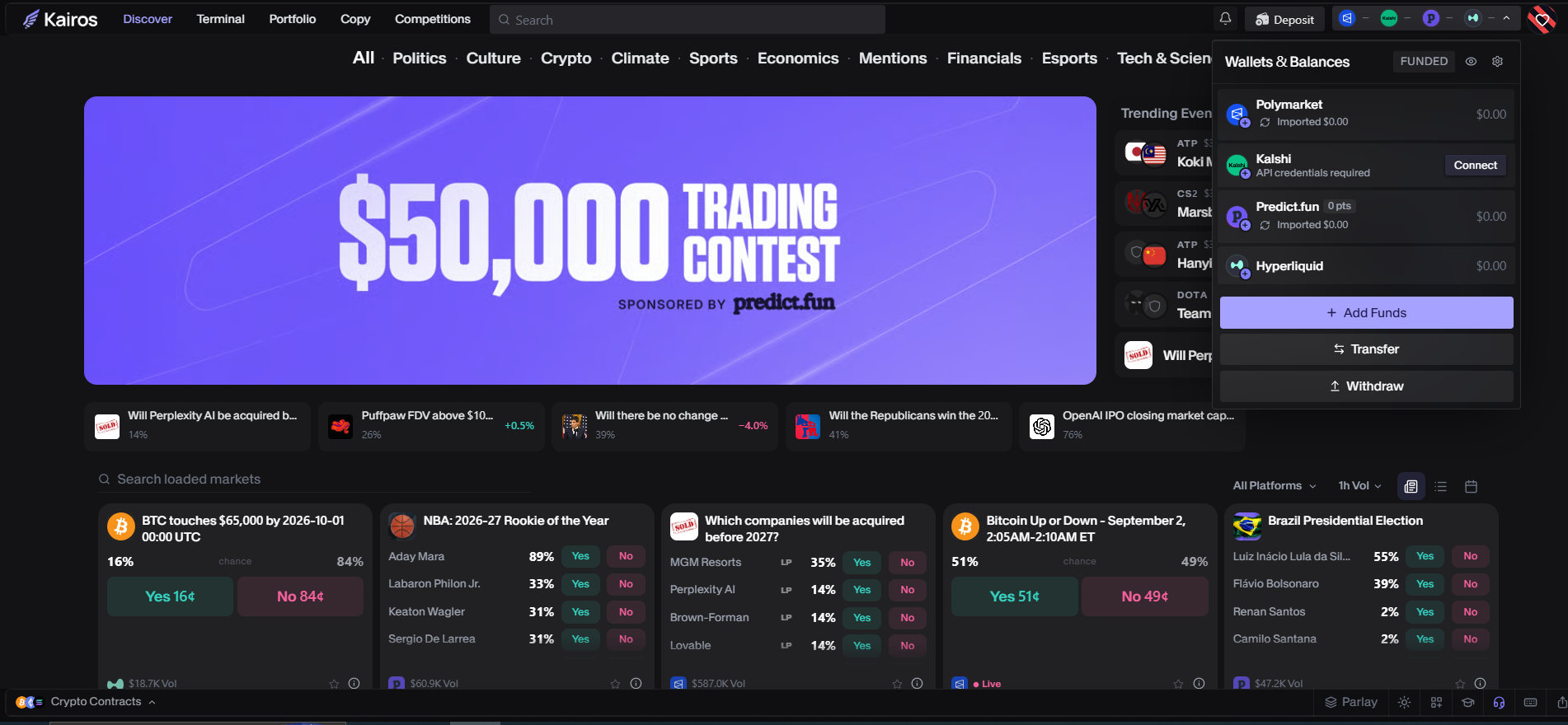 Source: Kairo Dashboard
The separate competition announcement, published on August 28, described the event as a cross-platform prediction-market trading competition sponsored by TXODDS. It stated that traders could trade on any venue and gave a September 1, 2026 start date. The later integration announcement confirms that Hyperliquid markets are eligible.
Key insight“Cross-exchange” does not mean the underlying contracts become identical or that Kairos controls settlement. Kairos is the interface and aggregation layer; the market’s contract specification, matching, fees, and settlement remain tied to the relevant venue.
How do Hyperliquid outcome markets work?
Hyperliquid’s HIP-4 framework creates fully collateralized outcome contracts that settle under the rules published for each market. The first mainnet rollout went live on May 2, 2026, initially using recurring binary contracts tied to the Bitcoin mark price. HIP-4 is separate from Hyperliquid’s leveraged perpetual contracts: it does not use borrowed capital and does not expose an outcome position to liquidation.
YES position:
If the defined event occurs, the contract settles according to the market’s payout rule
Maximum loss: entry cost
NO position:
If the defined event does not occur, the contract settles according to the same published rule
No leverage or liquidation
HIP-4 links Yes and No liquidity through a merged order book. That structure lets the two sides share liquidity while preserving the market’s defined outcome and expiry. The practical lesson is straightforward: a price is not the entire trade. Read the question, resolution condition, expiry, fees, and available depth before placing an order.
What does Kairos add to the trading workflow?
Kairos’s stated value is consolidation: one workspace for market discovery, cross-venue books, news, analytics, and execution. Its official site describes streaming order books, normalized pricing, aggregated endpoints, and configurable algorithmic strategies. Those are product capabilities presented by Kairos itself, not an independent guarantee of fills, speed, or profitability.
- Discover: Find the relevant event and compare available venues.
- Inspect: Read the contract rules, expiry, book depth, and fee terms.
- Size: Choose a position whose full potential loss is acceptable.
- Monitor: Track execution, settlement conditions, and competition status.
How does Hyperliquid compare with trading through Kairos?
The distinction is venue versus interface. Hyperliquid supplies the HIP-4 market structure and settlement environment; Kairos supplies a terminal designed to compare and manage prediction markets across venues. The table below keeps those roles separate.
| Question | Hyperliquid directly | Kairos terminal |
|---|---|---|
| What is it? | An on-chain venue with HIP-4 outcome contracts. | A prediction-market trading and intelligence interface. |
| What is being traded? | Hyperliquid’s own outcome contracts. | Markets presented across supported venues, including Hyperliquid. |
| Who defines settlement? | The relevant Hyperliquid market rules and settlement process. | Kairos does not replace the underlying venue’s settlement rules. |
| What is the competition angle? | Eligible Hyperliquid markets can count in Kairos’s announced cross-exchange competition. | The competition is organized around trading across venues, subject to the official terms. |
What are the confirmed $20K competition details?
The confirmed headline terms are the $20,000 prize pool, cross-exchange format, and Hyperliquid eligibility. Kairos’s public announcements do not, in the material reviewed for this guide, establish the details needed to calculate a participant’s expected reward or rank.
- $20,000 total competition prize pool.
- The competition is cross-platform and traders can trade on any venue.
- Hyperliquid markets are eligible following the Kairos integration.
- Not confirmed in the public announcement: prize tiers, scoring, minimum volume, eligible jurisdictions, end date, and distribution timetable.
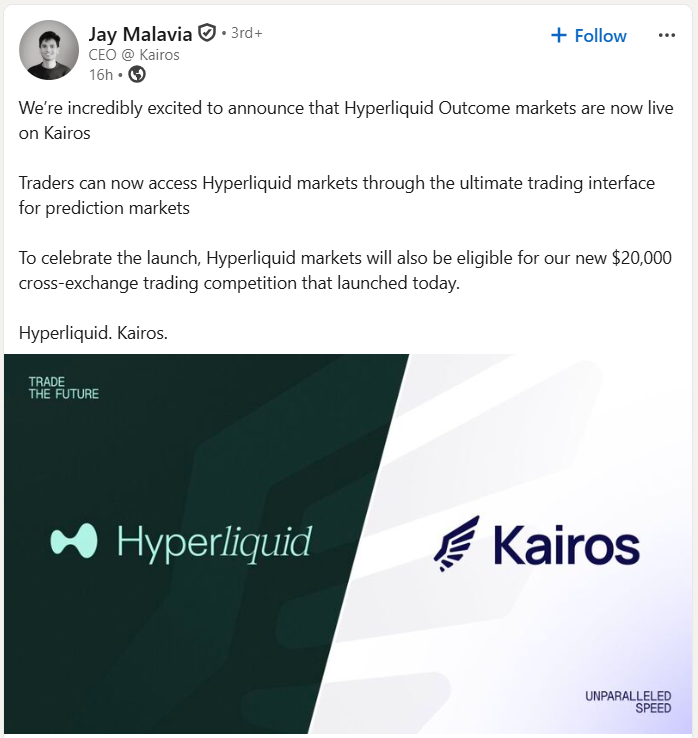 Source: Jay Malavia (CEO @ Kairos)
Do not trade from the headline aloneA prize pool is not a projected return. Do not infer a guaranteed payout, ranking method, or required trading volume from the $20,000 figure. Verify the live competition terms inside the official Kairos competition app before committing capital.
What should a trader check before participating?
The safest starting point is contract comprehension, not competition optimization. A short pre-trade checklist can prevent a market that looks similar across venues from being treated as interchangeable when its resolution wording or settlement path differs.
- Confirm the exact event question and the source or rule used for resolution.
- Check contract expiry, payout mechanics, fees, spread, and order-book depth.
- Confirm that the venue and product are available where you live.
- Use only capital you can afford to lose; HIP-4’s no-liquidation design does not remove market risk.
- Read the current competition terms rather than relying on social-post summaries.
What happens next?
The next meaningful update is likely to be the publication or display of complete competition rules. Until then, the verified story is limited but clear: Kairos has added Hyperliquid outcome markets, and the markets are eligible for a $20,000 cross-exchange competition that began on September 1, 2026. The integration expands the set of venues visible in Kairos; it does not eliminate the need to understand each venue’s contract and settlement mechanics.
Frequently Asked Questions (FAQs)
Q: What are Hyperliquid outcome markets?
A: Hyperliquid outcome markets are fully collateralized contracts built under the HIP-4 framework. They allow traders to take positions on defined outcomes without leverage or liquidation, with settlement determined by each market’s published rules.
Q: Can I trade Hyperliquid outcome markets on Kairos?
A: Yes. Kairos has announced that Hyperliquid Outcome markets are live on its prediction-market trading terminal. Traders should confirm current access, account requirements, fees, and geographic availability in the official Kairos app.
Q: What is the $20,000 Kairos competition?
A: It is a cross-exchange prediction-market trading competition announced by Kairos and sponsored by TXODDS. The confirmed prize pool is $20,000, and Kairos has stated that traders can use any venue, including eligible Hyperliquid markets.
Q: What are the official rules of the $20K competition?
A: The public announcement confirms the prize pool, cross-exchange format, and Hyperliquid eligibility. It does not by itself confirm the complete prize allocation, scoring formula, minimum trading activity, eligibility requirements, end date, or payout schedule. Check the live competition terms before participating.
Q: How do Yes and No positions work on Hyperliquid?
A: HIP-4 links Yes and No liquidity through a merged order book. Each position is tied to a defined event, expiry, and settlement condition, so traders should read the full market specification rather than relying only on the displayed price.
Q; Does no liquidation mean there is no risk?
A: No. Outcome contracts do not use leverage or liquidation, but a trader can still lose the capital committed if the position settles unfavorably. Spread, slippage, fees, market rules, and settlement risk also apply.
Disclaimer: This content is for informational purposes only, not financial advice. Prediction-market and crypto trading involve substantial risk, including loss of the capital committed. Review the official Kairos and Hyperliquid terms and confirm local availability before trading.