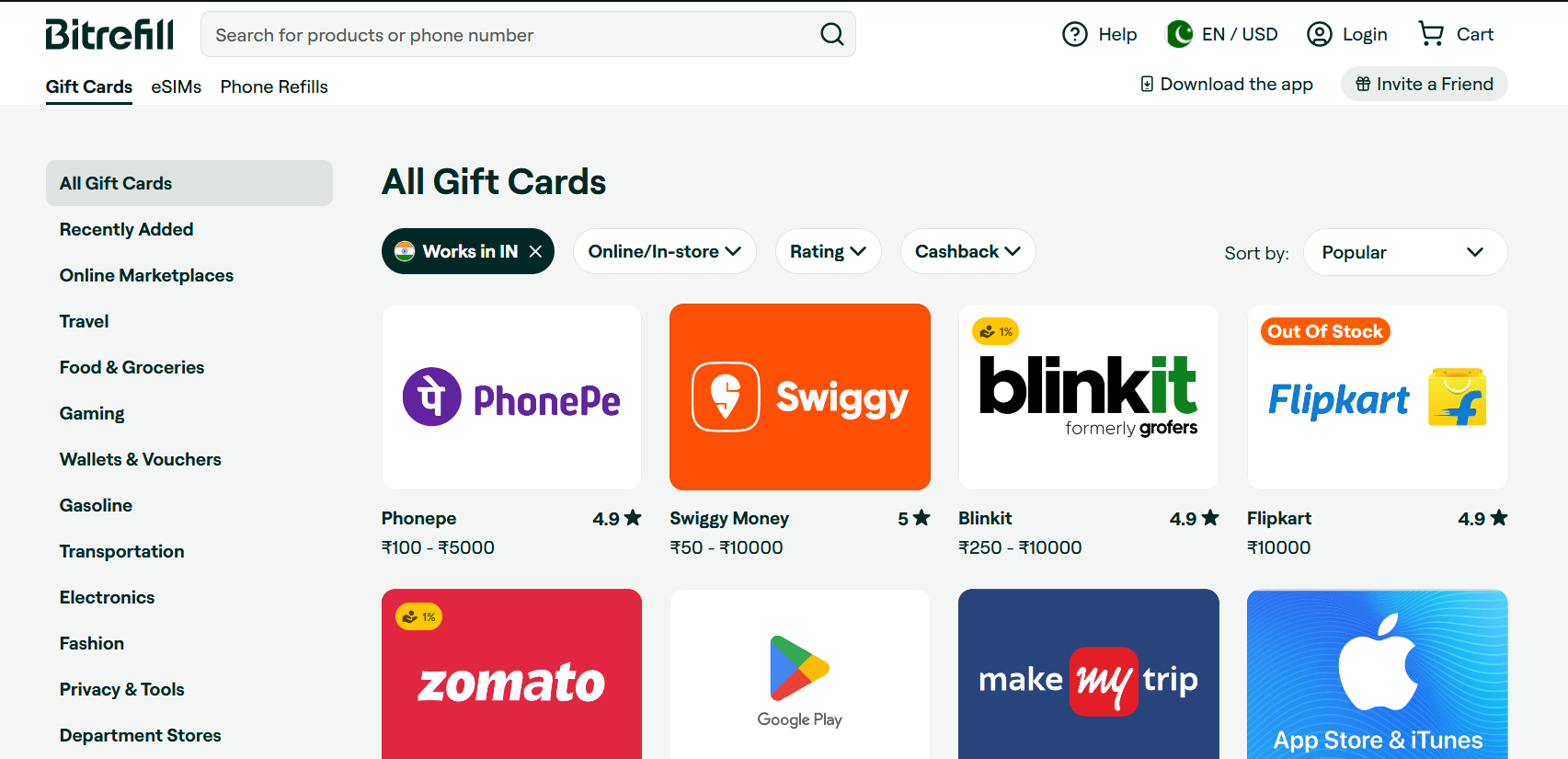
Crypto is not normally accepted at Indian supermarket, petrol pump or jewellery counter. The practical route described here is different: "A user pays a foreign gift-card platform with crypto, receives a voucher issued for a particular Indian merchant, and redeems that voucher under the merchant’s own terms".
Summary
- What changes hands: crypto is exchanged for a merchant-specific digital voucher; the shop generally receives the voucher, not crypto.
- Verified examples: official Bitrefill pages list Reliance Smart Bazaar for groceries, a Bharat Petroleum voucher for fuel, and a Kalyan Gold Coin Card for gold coins and jewellery.
- The limitations are material: the examples are India-only, store-based products with one-time-use, expiry, balance, or acceptance restrictions.
- What this is not: a finding that the route is anonymous, tax-free, permitted for every resident, or outside Indian foreign-exchange and anti-money-laundering rules.
 Source: Bitrefill Gift Cards
How does the crypto-to-gift-card route work?
The platform is the payment bridge. It accepts a supported cryptocurrency, supplies a voucher code or digital gift card, and the user presents that code to the named merchant.
- Choose an India-eligible merchant voucher
- Pay the platform from a crypto wallet
- Receive a code by email or checkout
- Check the merchant’s redemption rules
- Redeem in the permitted store or channel
- Pay any permitted balance separately
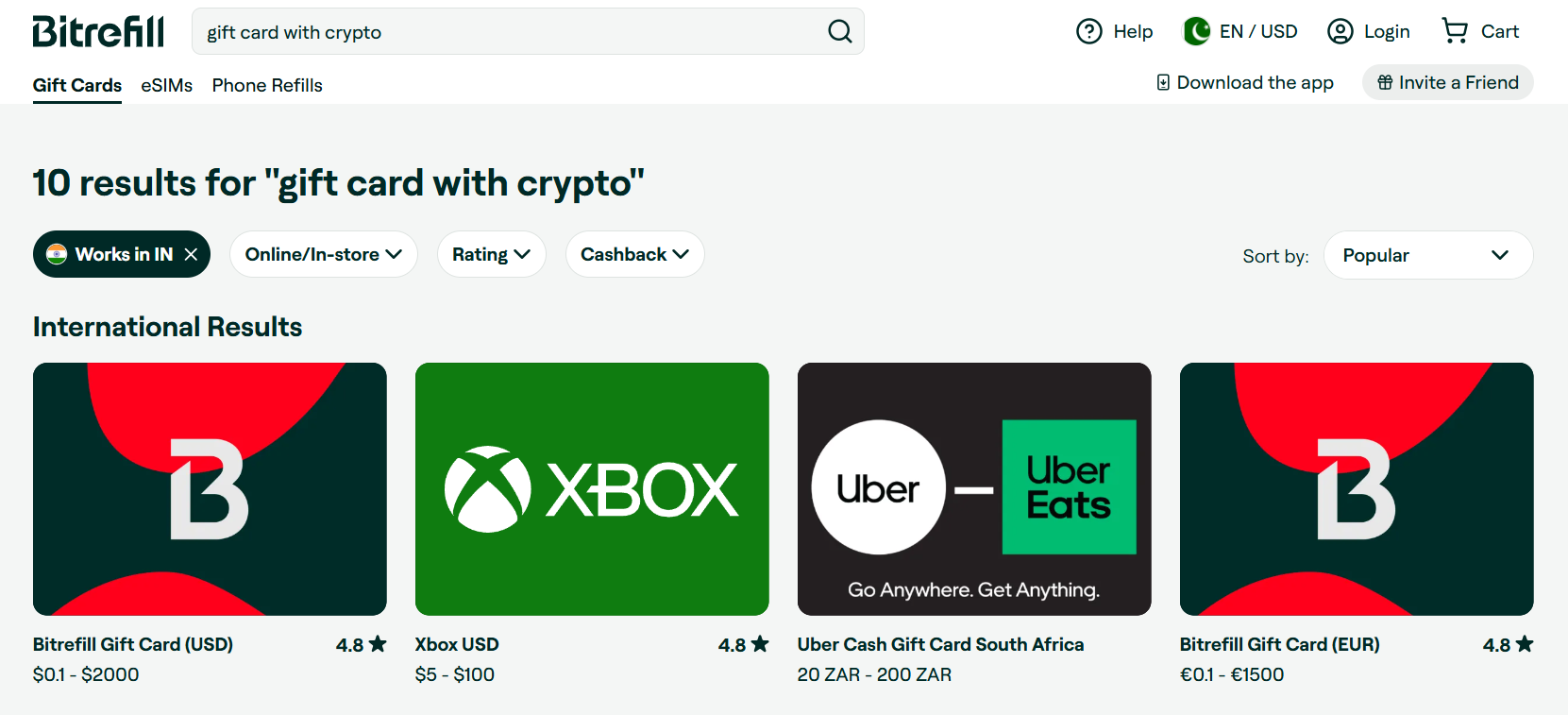
Bitrefill states that its gift cards can be bought with several crypto assets, including Bitcoin, Ethereum, USDC, USDT and Solana, and that delivery is generally digital. That describes the platform’s checkout capability; it does not mean every merchant accepts crypto or every asset for every product.
Warning: “overseas platform” does not mean “overseas shopping”
The platform may be incorporated outside India, while the voucher is issued for redemption at an Indian merchant. The retail purchase remains subject to the voucher issuer’s and merchant’s terms, and the cross-border payment and tax position must be assessed separately.
What can users buy for groceries, fuel and gold?
The official product pages show concrete, merchant-specific examples, but they do not establish that all Indian users have uninterrupted access or that every outlet will accept every voucher.
| Use case | Verified example | Redemption shown on the official page | Key restrictions |
|---|---|---|---|
| Groceries | Reliance Smart Bazaar Gift Card | India; redeem in-store; covers qualified products at listed Reliance Smart Bazaar stores. | Single use; cannot be used online; cannot buy gold or silver coins; valid for 12 months from receipt; no cash exchange. |
| Fuel | Bharat Petroleum Fuel Voucher | At select BPCL outlets; described for fuel, with the page also mentioning engine oil, car care, servicing and maintenance. | The page’s terms say fuel-only, valid for six months, no part redemption and no cash conversion. At the time checked, the product page displayed “sold out.” |
| Gold and jewellery | Kalyan Gold Coin Card Gift Card | India; redeem in-store at Kalyan Jewellers; product page describes 24-karat gold coins and designer jewellery. | One-time redemption; valid for 364 days; up to 10 cards on one bill; not cash; delivery can sometimes take 24–48 hours under the listed terms. |
 Source: Purchase Gift Card Voucher
These are examples of listings and terms visible on the cited official platform pages on 9 September 2026, not a guarantee of current stock, outlet acceptance, product eligibility or pricing.
Why do the merchant pages say the shop does not accept crypto?
Because the crypto payment occurs at the intermediary platform, while the merchant voucher is redeemed later as a closed-loop payment instrument.
 Source: Gift Card With Crypto
For example
Bitrefill’s BPCL page explicitly says BPCL does not accept crypto directly, while the same page offers crypto as a way to purchase the voucher. Its Reliance Smart Bazaar and Kalyan pages use the same basic distinction. This is a payment-routing description, not a conclusion about regulatory treatment.
What does Indian tax and compliance guidance change?
Using a voucher does not erase the tax character of crypto transactions or automatically settle the foreign-exchange, payment, or anti-money-laundering questions.
- VDA tax:
The Income Tax Department says income from transfer of a Virtual Digital Asset is taxed at 30% plus surcharge and cess, with deductions generally limited to the cost of acquisition. - Record keeping:
Keep wallet addresses, transaction IDs, timestamps, crypto quantity, rupee value, platform invoice, voucher code, fees, redemption evidence and the merchant bill. - Foreign exchange:
RBI guidance says permitted use of international payment instruments is tied to permissible current-account transactions and applicable LRS rules. A crypto-funded voucher route should not be assumed to bypass FEMA requirements. - AML:
FIU-IND identifies virtual-digital-asset service providers as subject to anti-money-laundering compliance and states that registration is a prerequisite for reporting entities in its guidance. That does not certify every overseas platform or every transaction. - Match the geography: “Works only in India” does not mean every store or online channel accepts it.
- Read the merchant terms: Check whether the card is one-time, part-redeemable, stackable, refundable, transferable or usable for the exact product.
- Confirm stock and settlement: A listing can show a product while the checkout page shows sold out or delivery delays.
- Calculate the real cost: Compare the crypto sent, network fee, platform spread, any discount or cashback, and the rupee value actually redeemable.
- Protect the code: A bearer voucher may be treated as used once someone else obtains it. Do not publish it or share screenshots containing the code.
- Preserve evidence: Save the invoice and redemption proof for tax, dispute and consumer-support purposes.
Do not treat a gift card as a tax or compliance shield
A voucher can change the form of payment without changing the need to explain the source, transfer and value of the crypto. Avoid claims such as “no tax,” “no reporting,” “fully private,” or “outside RBI rules” unless a qualified professional has analysed the exact facts and current law.
What should a user check before buying a voucher?
Confirm the country, outlet, category, expiry, redemption method, stock status, refund policy and total rupee cost before sending crypto.
What is the clearest way to understand the opportunity and the risk?
The route offers a convenient bridge from digital assets to specific retail spending, but it adds intermediary, voucher, pricing, fraud and regulatory risks that ordinary card payments do not have in the same form.
| Potential utility | Countervailing risk |
|---|---|
| Can spend supported crypto without the merchant integrating a blockchain payment. | The platform, voucher issuer and merchant each add a separate point of failure. |
| Digital delivery can be quick. | Wrong network, wrong country or a delayed code can make recovery difficult. |
| Works for defined everyday categories. | Closed-loop vouchers are not cash and may have expiry, one-time-use and no-refund terms. |
| May simplify a small purchase for an existing crypto holder. | It does not remove price volatility, tax obligations, source-of-funds questions or cross-border legal uncertainty. |
Frequently Asked Questions (FAQs)
Q: Do Indian grocery stores, fuel stations or jewellers accept Bitcoin or USDT directly?
A: The cited merchant pages say no for the examples covered. The crypto is used to buy an intermediary voucher; the merchant receives and redeems the voucher.
Q: Can a Reliance Smart Bazaar voucher be used online or to buy gold?
A: The cited terms say it is for listed stores, cannot be redeemed online, and cannot be used to purchase gold or silver coins.
Q: Is the BPCL voucher always available?
A: No guarantee should be assumed. The official listing checked on 9 September 2026 displayed “sold out,” and its terms limit redemption to the permitted use and validity period.
Q: Does buying a gift card mean there is no crypto tax?
A: No. The Income Tax Department’s VDA guidance concerns income from transfer of VDAs. A voucher format does not by itself determine the tax result.
Q: Are overseas gift-card platforms automatically outside RBI or AML rules?
A: No. That is an unverified legal conclusion. Cross-border payment, FEMA, PMLA, tax and consumer-protection questions depend on the exact parties, flow of funds, product and facts.
Disclaimer: The information provided in this blog post is for educational and informational purposes only and does not constitute financial, investment, or legal advice.