 Source: crypto.news
What is the key update?
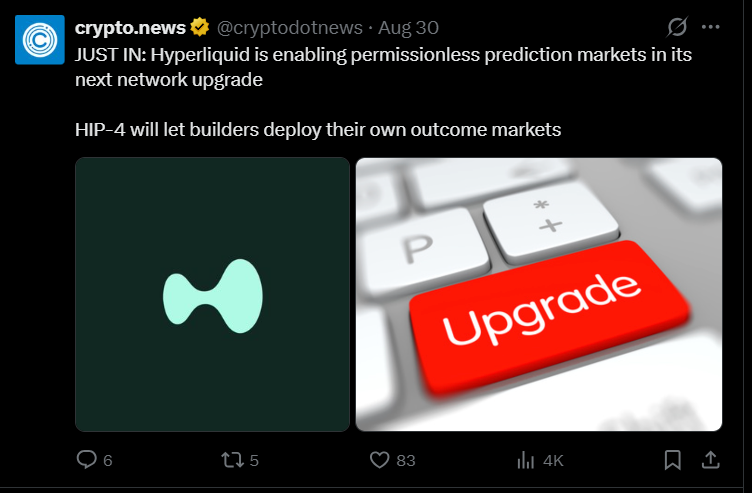
Hyperliquid plans to move from validator-controlled outcome markets toward permissionless deployment based on templates approved by validators.
- HIP-4 is already on mainnet: the initial outcome-market release went live in May 2026.
- The new capability is still being rolled out: permissionless deployment is planned for testnet first and mainnet later.
- Builders will use approved templates: they will not be able to define every market rule without constraints.
- Validators retain a standards role: they approve templates and can penalize deployers when the framework’s rules are breached.
How will permissionless deployment work?
A builder will instantiate a market from a validator-approved template and remain responsible for operating and settling that market within the template’s rules.
The official developer documentation says templates can define the market’s display text, side names, typed keywords and semantic restrictions. This creates a controlled permissionless model: market creation can be open to eligible deployers, while the permitted structure is established in advance.
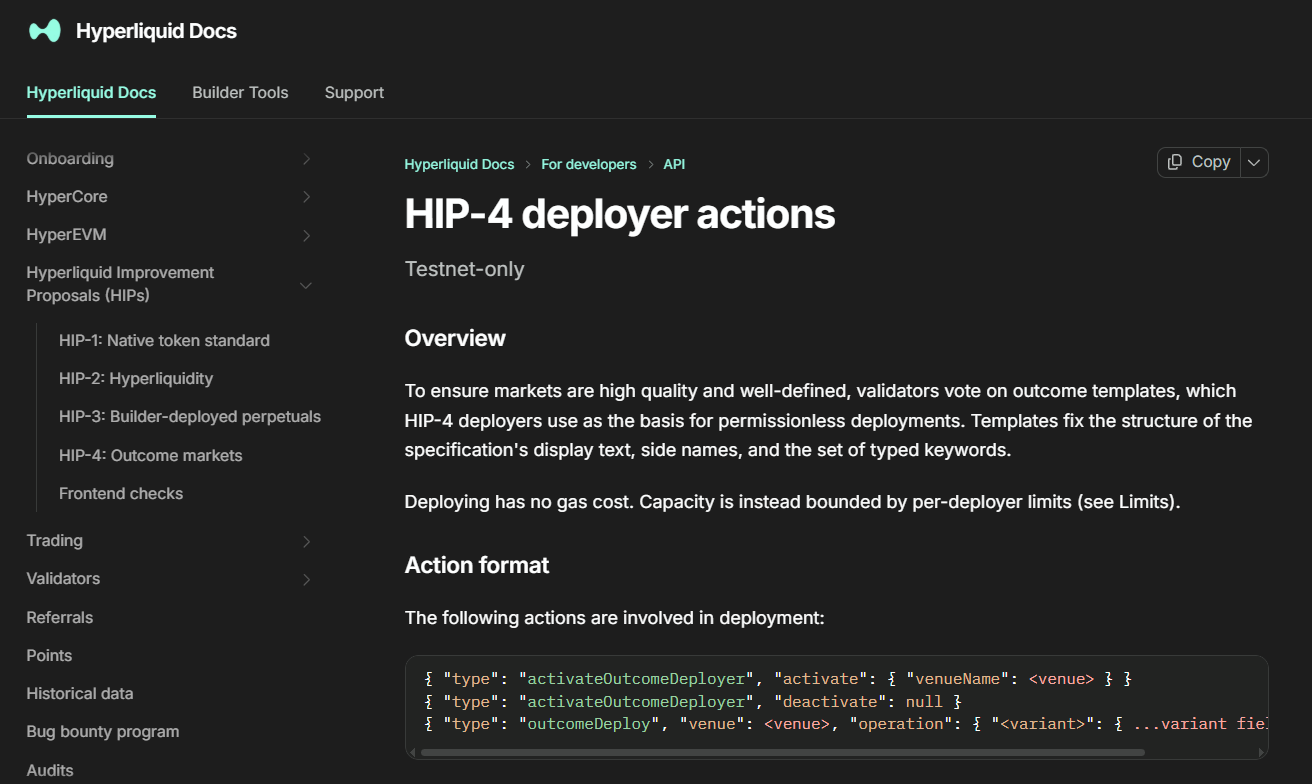
Hyperliquid’s announced framework also includes an economic requirement. Active outcome deployers are expected to maintain a 500,000 HYPE stake. Validator votes may slash the stake when a market is malformed or settled incorrectly. Deployers may also receive a share of trading-fee revenue under the protocol’s fee parameters.
- Templates: define the permitted market structure.
- Deployment: builders create individual markets by supplying values allowed by the template.
- Settlement: the deployer is responsible for resolving its markets under the applicable rules.
- Accountability: the stake creates an economic penalty for serious deployment or settlement failures.
What does the rollout timeline show?
The confirmed sequence is an existing HIP-4 mainnet foundation, a planned permissionless testnet phase, and a later mainnet phase with no verified final date.
- May 2026: HIP-4 outcome trading becomes available on Hyperliquid mainnet.
- Current development phase: permissionless deployer actions are being documented and tested, with public documentation indicating testnet availability.
- Later phase: permissionless outcome-market deployment is expected to reach mainnet after testnet testing.
The distinction matters. A registered or reported outcome venue on testnet, or an on-chain deployment transaction, should not automatically be described as a live permissionless mainnet prediction-market launch.
How does Hyperliquid compare with Polymarket and Kalshi?
Hyperliquid is approaching prediction markets from an on-chain trading-infrastructure base, while Polymarket and Kalshi are established event-market platforms with their own product and access models.
This is a structural comparison. It does not mean that the three platforms offer identical contracts, jurisdictions, user access or regulatory status.
| Dimension | Hyperliquid HIP-4 | Polymarket | Kalshi |
|---|---|---|---|
| Core product | On-chain outcome markets integrated with HyperCore | Prediction-market platform | Event-contract platform |
| Builder deployment | Planned permissionless deployment through validator-approved templates | Not the HIP-4 deployment model | Not the HIP-4 deployment model |
| Position design | Fully collateralized outcome contracts without leverage or liquidations in the basic design | Platform-specific | Platform-specific |
| Infrastructure context | Uses Hyperliquid’s on-chain trading environment | Separate prediction-market infrastructure | Separate event-contract infrastructure |
What are the main risks and open questions?
Permissionless deployment can expand market choice, but it also makes market definitions, settlement sources, liquidity and dispute handling more important.
- Definition risk: a question must be precise enough for traders to understand what constitutes a winning result.
- Settlement risk: off-chain events require a reliable source and a clearly stated settlement rule.
- Liquidity risk: permissionless creation does not guarantee that a market will attract active buyers and sellers.
- Parameter risk: staking, fee and capacity settings may change before the mainnet release.
- Access risk: availability depends on the final protocol release, interface support and applicable jurisdictional rules.
Hyperliquid has indicated that validator-controlled markets will remain possible for unusual or especially important events, but are expected to be rare compared with template-based deployments.
What should builders and users watch next?
The next meaningful evidence will be the testnet activation, the final approved template set, and an official mainnet release announcement.- Whether the testnet supports the complete deployer workflow.
- Which templates validators approve and how their semantic restrictions work.
- Whether the 500,000 HYPE staking requirement and fee parameters remain unchanged.
- How deployers document settlement sources for real-world events.
- Whether new markets develop sufficient liquidity for useful price discovery.
HIP-4’s central proposition is not simply that Hyperliquid can host more prediction markets. It is that an on-chain trading network can provide a repeatable framework in which builders create outcome contracts, validators set the boundaries and deployers carry responsibility for settlement. The upcoming testnet phase will show how well that balance works in practice.
Frequently Asked Questions (FAQs)
Q: Is permissionless HIP-4 deployment live on mainnet?
A: It has been announced as an upcoming feature planned for testnet first and mainnet later. A final mainnet launch date has not been verified.
Q: Is HIP-4 itself already live?
A: Yes. HIP-4 outcome trading launched on Hyperliquid mainnet in May 2026. The permissionless builder layer is the later enhancement.
Q: Does HIP-4 use leverage?
A: The basic HIP-4 design is fully collateralized and does not use leverage, funding payments or liquidations.
Q: Who approves the templates?
A: Hyperliquid validators vote on the templates from which deployers create markets.
Q: What is the reported staking requirement?
A: The announced framework has been reported as requiring active outcome deployers to maintain 500,000 HYPE. This parameter should be rechecked against the live protocol documentation before deployment.
Disclaimer: This content is for informational purposes only and does not constitute financial or legal advice. Crypto assets are highly volatile and involve significant risk. Always do your own research and consider your risk tolerance before making any financial decisions.